March 15 Tom Bodenhemier MD Maximizing Care Management; an - - PowerPoint PPT Presentation

march 15 tom bodenhemier md
SMART_READER_LITE
LIVE PREVIEW

March 15 Tom Bodenhemier MD Maximizing Care Management; an - - PowerPoint PPT Presentation

The Michigan Center for Clinical Systems Improvement welcomes you to our 3 part webinar series March 15 Tom Bodenhemier MD Maximizing Care Management; an emphasis on care/case management and health coaching May 3 John Fox


slide-1
SLIDE 1

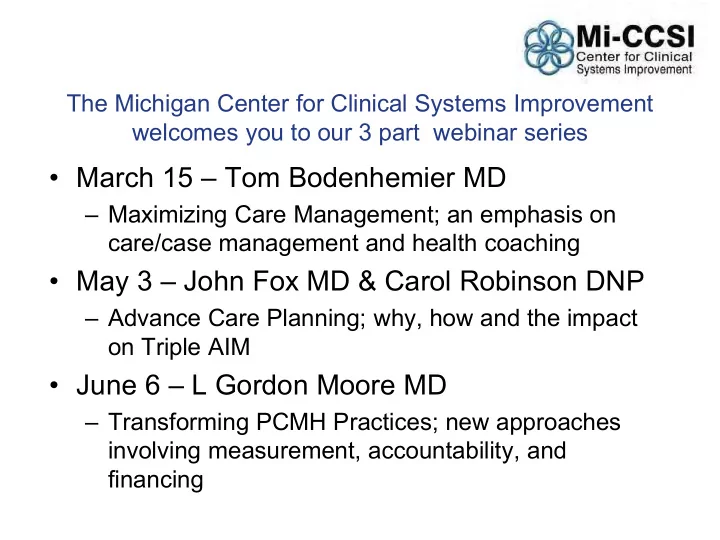
The Michigan Center for Clinical Systems Improvement welcomes you to our 3 part webinar series

  • March 15 – Tom Bodenhemier MD

– Maximizing Care Management; an emphasis on care/case management and health coaching

  • May 3 – John Fox MD & Carol Robinson DNP

– Advance Care Planning; why, how and the impact

  • n Triple AIM
  • June 6 – L Gordon Moore MD

– Transforming PCMH Practices; new approaches involving measurement, accountability, and financing

slide-2
SLIDE 2

Our speaker today

Thomas Bodenheimer MD, MPH is a general internist who received his medical degree at Harvard and completed his residency at UCSF. He spent 32 years in full-time primary care practice in San Francisco's Mission District – 10 years in community health centers and 22 years in private practice. He is currently Professor Emeritus of Family and Community Medicine at University of California, San Francisco and Founding Director of the Center for Excellence in Primary Care. He is co-author of Understanding Health Policy, 7th Edition, 2016, and Improving Primary Care, 2006 (both McGraw-Hill). He has written numerous health policy articles in the New England Journal

  • f Medicine, JAMA, Annals of Family Medicine, and Health Affairs.
slide-3
SLIDE 3

Disclosure Statement of Financial Interest

  • I, Thomas Bodenheimer MD, MPH

DO NOT have a financial interest/arrangement or affiliation with

  • ne or more organizations that could

be perceived as a real or apparent conflict of interest in the context of the subject of this presentation.

slide-4
SLIDE 4

Care management of patients with complex healthcare needs

Thomas Bodenheimer MD Center for Excellence in Primary Care University of California, San Francisco

Michigan Center for Clinical Systems Improvement March 15, 2016

slide-5
SLIDE 5

The Building Blocks of High- Performing Primary Care

Annals of Family Medicine 2014;12:166

slide-6
SLIDE 6

Building Block 6. Population management:

stratifying the panel

Pan Panel l Manage ageme ment nt:

Ensuring that ALL of the patients in

  • ur panel get recommended

preventive and chronic care

slide-7
SLIDE 7

Population management:

stratifying the panel

He Health Coaching: ing: Helping patients

with less complex chronic conditions to improve their self-management skills.

slide-8
SLIDE 8

Population management:

Stratifying the panel

Compl plex Care Manage ageme ment nt:

Targeted, team-based management for patients with complex healthcare needs

slide-9
SLIDE 9

Care coordination and care management

Care coordination ensures that

  • Specialists, hospitals, labs, pharmacies,

home care agencies – the medical neighborhood -- are available to primary care patients, and

  • Primary care and the medical neighborhood

share information in a timely manner

  • Mainly done by non-licensed personnel

Care management

assists patients/families to live with their chronic conditions through patient education, health coaching, medication management

  • Requires licensed personnel

Complex care management is

team-based care management for complex patients to 1) improve health and 2) reduce the need for expensive services.

Care coordination is

an important part of complex care management: making sure patients can navigate the confusing health system

slide-10
SLIDE 10

PCP

The confusing health system

slide-11
SLIDE 11

Care coordination or care management?

Referral coordinator in primary care practice checks with a health plan to see if it has approved a CT scan for a patient. A social worker has a discussion with a high-utilizing patient about alternatives to calling 911 Spanish-speaking MA goes to specialist visit with Latino patient to translate RN discusses alternatives to using opioids for a chronic pain patient and offers substance use referrals MA uses a referral log to contact specialists who have not returned consultation reports to see if the patient attended the appointment and to get the report MA health coach engages a patient to discuss medication adherence

slide-12
SLIDE 12

Care management for patients with 1 – 2 chronic conditions

Systematic review of 41 studies of patients with diabetes: planned visits with nurse care manager was associated with improved outcomes1 Meta-analysis of 66 studies of quality improvement strategies for patients with diabetes

  • Team-based care
  • Planned visits by nurses or pharmacists
  • The planned visits provide health coaching

(self-management support)

  • Best results when RN or pharmacist (using

standing orders) makes medication adjustments without awaiting physician authorization2

  • 1. Renders et al. Diabetes Care 2001;24:1821.
  • 2. Shojania, JAMA 2006;296:427.

The most effective strategies

slide-13
SLIDE 13

Health Coaching: Engaging Patients and Families in Their Care

slide-14
SLIDE 14

What is health coaching

Paradigm shift: From: Doctor (or nurse) tells patient what to do and calls them non- compliant if they don’t do it To: Engaging patients to learn their goals and what they are willing and able to do; meeting them half-way

Health coaching assists patients to gain the knowledge, skills, and confidence to become informed, active participants in managing their chronic condition [Ghorob, Fam

Pract Management, May/June 2013]

The 2 key components of care management are health coaching and medication management Health coaching is:

  • 1. A function everyone should do
  • 2. A job that a few people should

be trained in and have time for

slide-15
SLIDE 15

Health Coaching Evidence

RCT: patients with diabetes, hypertension and/or hyperlipidemia with medical assistants trained as health coaches had significantly improved A1c and LDL- cholesterol compared with non-coached patients1 In a RCT of low-income patients with poorly controlled diabetes, patients with peer health coaches (other patients with diabetes) had significantly improved A1c levels compared with controls2

1) Willard-Grace, Ann Fam Med 2015;13:130; 2) Thom et al, Ann Fam Med 2013:11:137.

slide-16
SLIDE 16

Health coaching skills and evidence Curriculum, tools, videos at cepc.ucsf.edu

  • Engaging patients by asking what they think and what

are their goals is associated with better outcomes than telling patients what to do1

Ask-tell-ask

  • Diabetic patients who know their A1c and their A1c goal

have better control than a control group2

Know your numbers

  • 50% of patients leave the medical visit without

understanding their care plan. Diabetic patients whose care team closes the loop have better A1c levels3

Close the loop (teachback)

  • The more actively a patient is involved, the better the

adherence4

Counseling on medication adherence

1) Heisler et al, JGIM 2002;17:243. 2) Levetan et al, Diabetes Care 2002;25:2. 3) Schillinger et al, Arch Intern Med 2003:163:83. 4) Osterberg, Blaschke, NEJM 2005;353:487.

slide-17
SLIDE 17

Health coaching skills and evidence: action plans

Action plans are agreements between a health coach and patient specifying a behavior change that the patient has chosen to make Patients with diabetes randomly assigned to traditional patient education or goal- setting with action plans The group doing action plans had significant reduction in HbA1c compared with the patient education group, whose A1c did not change Naik et al, Arch Intern Med 2011;171:453

slide-18
SLIDE 18

Wisdom from Kate Lorig RN, PhD

The founder of evidence-based health coaching

Stanford Patient Education Research Center

“If you are confident you can do something, you probably can do it. If you are not confident, you probably can’t.”

slide-19
SLIDE 19

Average per capita spending by number

  • f chronic conditions (2004)

$994 $2,753 $5,062 $7,381 $10,091 $16,819 $0 $2,000 $4,000 $6,000 $8,000 $10,000 $12,000 $14,000 $16,000 $18,000 1 2 3 4 5+

Number of chronic conditions

Anderson, “Chronic conditions” Johns Hopkins, 2007

slide-20
SLIDE 20
slide-21
SLIDE 21

Complex care management

Care management for patients with complex health care needs

  • Reducing total costs
  • Improving health and quality of life

What are the goals?

  • Team of RN, SW,

pharmacist, health coach/patient navigator

Who does complex care management?

  • RN or SW alone, about 50
  • RN + SW + health coach/patient navigator, perhaps 200

What are the case loads? Because it takes a lot of resources, who are the best patients to target? What does the team do? What are some complex care management models?

slide-22
SLIDE 22

Who needs CCM?

  • Multiple chronic conditions
  • Frequent hospitalizations, high costs
  • Many prescription medications
  • Many care providers, requiring care coordination
  • Limitations of ADL

Most are patients with CCM is intensive, costly process requiring highly skilled personnel

  • Too healthy (i.e., low risk for hospitalization

and excessive costs)

  • Too sick to benefit

It shouldn’t be offered to patients who are

slide-23
SLIDE 23

How select patients for CCM?

Health plan high-risk lists (e.g. those with 2 or more hospital admits in past year, or high risk score) Hx of costs over 2-3 years, number of dx’s, number of rx’s, depression, self-mgm skills, social isolation Opinion of PCP and primary care team Need both; they are never the same After identifying patients, RN discusses with patient/family to see if they agree to engage

Hong C et al. Caring for High-Need, High-Cost Patients: What Makes for a Successful Care Management Program? Commonwealth Fund, August 2014

slide-24
SLIDE 24

Key components of complex care management (CCM)

Team assesses what the patient needs Team develops care plan with patient, family, physicians Team teaches patient/family about diseases, symptoms

  • Close the loop
  • Know your numbers
  • Medication adherence counseling
  • Action plans

Team uses health coaching techniques Team coaches patient/family on yellow flags, red flags Team tracks how patient is doing over time, revises care plan as needed

slide-25
SLIDE 25

Payment for complex care management

  • Pays face-to-face visits with physicians, NPs, PAs
  • Teams are an expense, not a revenue source

The dysfunction

  • f fee-for-service
  • PCMH payments
  • Pay-for-performance

Fee-for-service add-ons

  • Capitation
  • Global budget, usually in an ACO
  • Shared savings from reducing hospitalizations

in an ACO

Alternative payment models

slide-26
SLIDE 26

Payment for complex care management: Medicare’s new care management fee

CPT code 99490: physicians, NPs, PAs, clinical nurse specialists Eligible patients: 2 or more chronic conditions that increase risk of death, exacerbation, or functional decline Care plan: problem list, goals, symptom management, medication management, care coordination Provider/team accessible 24/7 Lots of work, fee about $45 once a month Complex care manager, 100 patients/month: $54,000. Many practices find the amount of work to be greater than the amount of payment

slide-27
SLIDE 27

Some complex care management models

Health Plan Model: Health plan employs CCM team, mainly telephonic Hospital Discharge Model: Transition from inpatient to home Primary Care Model: CCM team embedded in one or more primary care practices aICU Model: All care provided by separate high-risk clinic or high-risk team, patient leaves PCP ED Model: Emergency Department-embedded team provides CCM Home Care Model: Care entirely in patient’s home Housing First Model: Homeless or precariously housed people receive stable housing with social services Community-Based Model: Care provided where patients are

Bodenheimer T, Berry-Millett R. Care Management for Patients with Complex Healthcare Needs, Robert Wood Johnson Foundation, 2009; Bodenheimer T. Strategies to Reduce Costs and Improve Care for High-Utilizing Medicaid Patients: Reflections on Pioneering Programs. Center for Health Care Strategies, October 2013.

slide-28
SLIDE 28

Health plan model:

CareOregon Medicaid managed care plan

  • Masters degree in social work or psychology
  • Experience in community work and addiction

Health resilience specialists are hired by the health plan and embedded in primary care practices

  • Physical disease (COPD, CHF, HBP, diabetes
  • Mental health issues
  • Addiction, mostly opioids and alcohol

Most patients have 3 issues

Patients seen in clinic, at home, in community settings; are accompanied to specialist and community referral sites. Not just telephonic care management

  • Help navigate health and social service systems
  • Motivational interviewing
  • Health literacy education
  • Self-management skill development

In addition to building trust, the health resilience specialists

  • All meet weekly for to discuss difficult cases

Supervised by RN, behaviorist, pharmacist

slide-29
SLIDE 29

Hospital discharge model:

Care Transitions Intervention

Coleman et al, Arch Intern Med 2006;166:1822

RNs trained as “transition coaches” to teach patients/familie s skills to care for themselves 1 hospital visit, 1 home visit post-discharge, 3 post- discharge phone calls Significantly lower readmission rates and lower hospital costs compared with controls

slide-30
SLIDE 30

Primary care model: patients stay with PCP

Geriatric Resources for Assessment and Care of Elders (GRACE) Counsell et al, JAMA 2007;298:2623

NP/SW care management team working with PCPs and geriatrician In-clinic, home and phone contacts Extensive training

  • f care

management team Small case load for care management team Higher-risk subgroup: lower ED/hospitalization rates year 2, lower total costs year 3 compared with controls

slide-31
SLIDE 31

Ambulatory intensive caring unit (aICU) model

Complex patients cared for by separate high- risk clinic (aICU) with a team of physician, RN, SW, perhaps pharmacist, health coaches If patients have PCP, they leave PCP; most are satisfied because the aICU provides much more care and is accessible Primary care physicians often happy that complex patients leave for the aICU because these patients take a lot of time Rather than a separate aICU there might be a high-risk team in the primary care practice; patients leave their PCP to be on that team

slide-32
SLIDE 32

aICU hybrid

Hybrid: patients choose CCM in aICU or stay with PCP

Patient’s PCP RN-led CCM team Separate clinic/team with CCM team including physician Patient chooses

Keep PCP Leave PCP aICU RN spends part-time at aICU and part-time care- managing patients in primary care

+

slide-33
SLIDE 33

aICU hybrid model:

Stanford Coordinated Care

Separate clinic only for complex patients Patients can choose to stay with PCP or leave PCP and receive all care at Stanford Coordinated Care aICU team is 3 MDs, RN, LCSW, pharmacist, physical therapist/chronic pain expert, 3 care coordinators RN goes to practices of patients keeping their PCP

Care coordinators are health coaches, join visit as scribe, post-visit and between- visit to ensure understanding, set goals, teach yellow/red flags, help patients navigate the system, go with patients to specialists

slide-34
SLIDE 34

aICU hybrid model: Stanford Coordinated Care

Multiple clinical measures (like A1c, BP), functional measures (ADLs), utilization measures (ED visits, admits), and patient experience measures

Metrics on big wall chart with red/yellow/green dots (red=bad, green=good). Goal: “get the red

  • ut”

CCM team meets to discuss patients, see if improvement or not on the red/yellow/green wall chart Early data: ED visits down 39%, hospital admits down 25%. Patient and staff satisfaction 99%, HEDIS quality measures 99th percentile

slide-35
SLIDE 35

Across all these programs, what works?

Most critical is health coaching: teaching patients/families/caregivers how to self-manage their conditions

slide-36
SLIDE 36

Health coaching for complex patients

Coaching of complex patients is both similar and different from coaching of less complicated patients When you separate out the problems of a complex patients, each problem is not so complicated; complexity is the interaction of multiple problems. A care plan and action plan can be created for each

  • f the separate problems

Example:

  • Diabetes: care plan is lifestyle change and titrating medications
  • Osteoarthritis: care plan is physical therapy, exercise program,

anti-inflammatory medications

  • Domestic violence: meet with social worker to make definitive care

plan

slide-37
SLIDE 37

Health coaching for complex patients

Reducing hospitalizations is both a cost outcome and a quality

  • utcome

Best way to reduce hospitalizations is teaching yellow and red

  • flags. Example CHF: increased shortness of breath, edema, or 3

pound weight gain are yellow flags. Coaching teaches 1) weigh yourself daily and if weight up 3 pounds, call care team or take extra furosemide 2) Reduce salt intake 3) Take medications faithfully

slide-38
SLIDE 38

Take-home messages

  • Panel management
  • Health coaching
  • Complex care management

Population-based care includes Care management includes patient education, health coaching and medication management Health coaching assists patients to gain the knowledge, skills, and confidence to become informed, active participants in their care

  • Patients with 1 or 2 conditions
  • Patients with multiple conditions and complex healthcare

needs

Health coaching is essential for all patients with chronic conditions

Gradually, we are learning from experience how to care for patients with high costs and complex healthcare needs

slide-39
SLIDE 39

Thank you for improving health care for the people of Michigan

slide-40
SLIDE 40

Reminder

  • CME and SW CE

– To obtain your continued education credits please complete and return the evaluation form emailed to you – Include your name in the attestation request on the form – Return the form to Kristen.gildner@miccsi.org or fax to 616.608.4058 – If you did not receive the evaluation please email Kristen at the email address above.