
SLIDE 1
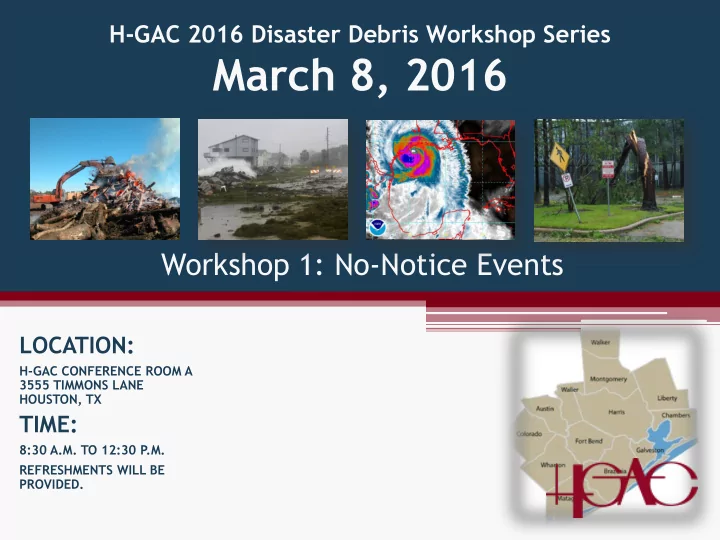
H-GAC 2016 Disaster Debris Workshop Series
March 8, 2016
Workshop 1: No-Notice Events
LOCATION:
H-GAC CONFERENCE ROOM A 3555 TIMMONS LANE HOUSTON, TX
TIME:
8:30 A.M. TO 12:30 P.M. REFRESHMENTS WILL BE PROVIDED.
March 8, 2016 Workshop 1: No-Notice Events LOCATION: H-GAC - - PowerPoint PPT Presentation
H-GAC 2016 Disaster Debris Workshop Series March 8, 2016 Workshop 1: No-Notice Events LOCATION: H-GAC CONFERENCE ROOM A 3555 TIMMONS LANE HOUSTON, TX TIME: 8:30 A.M. TO 12:30 P.M. REFRESHMENTS WILL BE PROVIDED. Agenda Introductions and
H-GAC 2016 Disaster Debris Workshop Series
LOCATION:
H-GAC CONFERENCE ROOM A 3555 TIMMONS LANE HOUSTON, TX
TIME:
8:30 A.M. TO 12:30 P.M. REFRESHMENTS WILL BE PROVIDED.
2
4
5
Why Does Debris Matter?
6
7
DR-4223 Tornados, Straight- line Winds, Flooding May 2015 DR-4245 Tornados, Straight- line Winds, Flooding October 2015 DR-4255 Winter Storms Tornados, Straight- line Winds, Flooding October 2015
Public Assistance (PA) Program and Policy Guide
8
Who's Involved?
9
Truck Certification
10
Debris Basics
11
Specialized Programs
12
Hazardous Hanging Limbs (Hangers)
diameter at the point of the break
threatening a public use area
public property
13
diameter when measured 4 and 1/2 feet from the ground and must meet at least one of the following criteria:
damaged or destroyed (as determined by a certified arborist)
expose the heartwood
degrees
14
Debris Management Sites
resolution
modifications
depending on origin
15
Final Disposal
contingencies for final disposal of vegetative and mixed debris are established.
permitted.
disposed/applied at final disposal site.
16
ROE Program – Before and After
17
Contractor Invoicing
18
Final Disposal
19
21
22
Warning time before the disaster
23
24
Overarching Considerations
25
Overarching Considerations
26
Debris Removal Considerations
27
Response and Recovery - Damage Assessments
28
FEMA Disaster Declarations Are Not Automatic.
Response and Recovery - Maintenance Records
29
Response and Recovery - Force Account Documentation
30
Response and Recovery - Debris Contracts
31
Response and Recovery - Debris Management Sites
this type of incident?
approved, who is responsible?
impacted by the event?
routes mapped out in case of road closures?
32
Reimbursement
33
Reimbursement
34
Incident Start of Incident Declaration Date
Severe Storms, Tornadoes, Straight-line Winds and Flooding (TX) May 4 May 29 (DR-4223) California Valley & Butte Fires September 9 September 22 (DR-4240) South Carolina Flooding October 1 October 5 (DR-4241) Severe storms, Tornadoes, Straight-line Winds and Flooding (TX) October 22 November 25 (DR-4245) Severe storms, Tornadoes, Straight-line Winds and Flooding (TX) December 26 February 9 (DR-4255) 35
Average time from start of incident to declaration was 24 days.
36
FEMA Policy 9525.2
39
Myths
40
Eligibility
41
Eligibility
42
Eligibility
43
Eligible Activities
reinforce a levee
sand
survivors
44
45
Best Practices
46
Planning
47
Planning
departments to assess anticipated needs.
and responsibilities.
48
Volunteer Coordinator Responsibilities
49
Volunteer Reception Centers (VRC)
50
VRC - Activities
51
Applicant Responsibilities When Working with VRC
52
Not Meeting Expectations
53
VRC – Closeout
54
Common Issues
55
Impact on Disaster-Related Communications
58
59
60
Impact on Disaster-Related Communications
61
Impact on Disaster-Related Communications
62
63
Severe Weather Updates
64
Resident Input
65
Road Closures
66
Progress Reports
67
68
70
Concerns
71
Impact on Disaster-Related Communications
72
Impact on Disaster-Related Communications
73
Source: PewResearch Center
Impact on Disaster-Related Communications
74
Source: PewResearch Center
Impact on Disaster-Related Communications
75
Source: PewResearch Center
Impact on Disaster-Related Communications
76
Source: PewResearch Center
Impact on Disaster-Related Communications
77
Source: PewResearch Center
Impact on Disaster-Related Communications
78
Source: FEMA 2013 National Preparedness Report
Impact on Disaster-Related Communications
79
Source: PewResearch Center
Impact on Disaster-Related Communications
80
Source: PewResearch Center
Impact on Disaster-Related Communications
81
Facebook Safety Check
82
Facebook Safety Check
83
Crime Reporting
84
Open Discussion
85
Winter Storm Pax (2014)
Department) and volunteers to perform cut and toss but no mechanism to document force account or donated resources
neighboring Jasper County to use staff for documentation purposes
87
Winter Storm Pax (2014)
come until March 12
contractors (within 24 hours of the incident)
under first 30 days; 85% Federal cost share
88
Severe Flooding (2015)
planning and mitigation strategies
volunteer organization; volunteers in the area went to
intermediate recovery implementation plan to address all pre-disaster planning holes
89
Severe Snow Event (2014)
completely unprepared
center (EOC) was not open until it was way too late; storm had already arrived
schools or street preparation
school buses on interstates
after the event
90
Severe Winter Storm (2015)
January 5
to event
protocols established prior to event
weeks after the event
incentive
91
Severe Flooding (May & Oct. 2015)
Hays County
impact from first flood when the second flood came
right-of-entry agreements
92
Workshop Date Workshop 2: Mitigating Your Hazards April 18, 2016 Workshop 3: Big Changes at FEMA May 10, 2016
94
QUESTIONS?
95
96