SLIDE 1
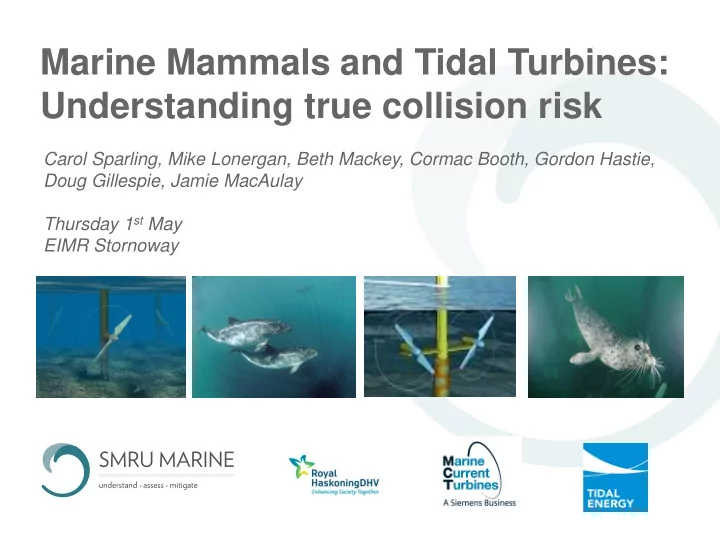
Marine Mammals and Tidal Turbines: Understanding true collision risk
Carol Sparling, Mike Lonergan, Beth Mackey, Cormac Booth, Gordon Hastie, Doug Gillespie, Jamie MacAulay Thursday 1st May EIMR Stornoway
SLIDE 2
SLIDE 3
SeaGen, Strangford Lough, Northern Ireland DeltaStream, Tidal Energy Ltd, Ramsey Sound
SLIDE 4 SeaGen, Strangford Lough, Northern Ireland
- Installed and commissioned in 2008
- Generates at currents >1m/s;
- Rotors diameter 16m ;
- Rotates at a maximum speed of 14RPM;
- Maximum tip speed is 12m/s;
SLIDE 5
SeaGen, Strangford Lough, Northern Ireland
SLIDE 6
Step 1: Conclusions of EMP: no significant impacts on marine mammals as a result of installation or operation of the turbine
AS LONG AS MITIGATION IN PLACE
Step 2: reassess risk of collision after 5 years of operation Step 3: carry out a Habitats Regulation Assessment
SLIDE 7 Step 2: reassess risk of collision after 5 years
What is the close range encounter rate between seals and the turbine? Data sources:
- Super SeaKing Sonar
- Gemini Multibeam Sonar
- Seal telemetry study
SLIDE 8
Super SeaKing ‘mitigation’ scanning sonars Since August 2009
SLIDE 9 Gemini Multibeam deployment May-July 2011
https://www.gov.uk/government/uploads/system/uploads/attachment_data/file/232963/OESEA2_SMRU_tracki ng_marine_mammals_around_renewable_devices.pdf
SLIDE 10
Seal telemetry study March-July 2010
12 tagged harbour seals: rate of close transit
SLIDE 11 10 20 30 40 50 60
usage (%) depth (m)
SLIDE 12
Encounter rates -
SLIDE 13
SLIDE 14
Taking most precautionary encounter rates and collision probability, Non uniform depth distribution, 50% avoidance Estimated collision risk = 1 seal per month in summer 0.3 seals per month in winter
SLIDE 15
How much can the population sustain?
Population now appears to be increasing Calculated PBR is 3.6 seals HRA ‘allows’ a 3 month trial over the summer
SLIDE 16
- Four Gemini multibeam sonars mounted on the cross beam
(to maximise vertical coverage of rotors).
- Data on passage rates in the presence of an operating turbine (compare
these with previously estimated –refine collision risk
- Evidence for evasion/avoidance???
70m 40m Side view Plan view
SLIDE 17
Tidal Energy Ltd’s DeltaStream unit being deployed in Ramsey Sound
SLIDE 18
Passive acoustic monitoring:
3D Hydrophone array: detection and localisation (tracking) of echolocating cetaceans around the device
SLIDE 19 Active acoustic monitoring:
MULTIBEAM SONAR
Side view Plan view
SLIDE 20 Dr Carol Sparling Principal Scientist
T: +44 (0) 1334 479100 M: +44 (0) 785 634 942 E: ces@smrumarine.com