
SLIDE 1
Markets as incentives for sustainable models
- f on farm diversity in production systems –
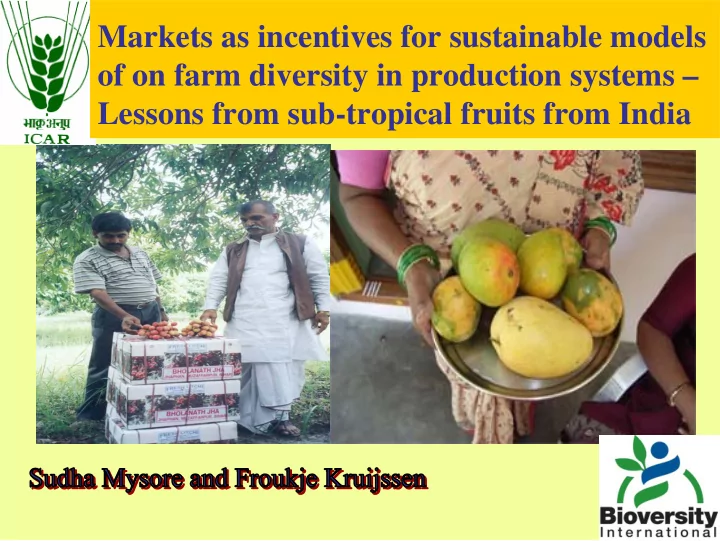
Markets as incentives for sustainable models of on farm diversity in - - PowerPoint PPT Presentation
Markets as incentives for sustainable models of on farm diversity in production systems Lessons from sub-tropical fruits from India CROP WISE AREA UNDER MAJOR FRUITS IN INDIA TFT Diversity status TFT Diversity status APPLE MANGO 8% 50%
CROP WISE AREA UNDER MAJOR FRUITS IN INDIA
APPLE 8% BANANA 16% CITRUS 18% MANGO 50% LITCHI 2% GUAVA 5% GRAPES 1%
PRODUCTION SHARE OF MAJOR FRUITS IN INDIA
A PPLE 2 % B A N A N A 3 7% C ITR U S 10 % LITC HI 1% M A N GO 2 3 % OTHER S 2 0 % GR A PES 3 % GU A V A 4 %
Crop Area (‘000 ha) Production (‘000 t) Productivity (t / ha) Highest productivity in India (t /ha) Apple 193 1348 7.0 10.1 ( J & K) Banana 475 13304 28.0 62.9 (Mah) Citrus 563 5677 10.1 22.7 (Kar) Grape 52 1248 24.0 28.1 (Mah) Guava 155 1793 11.6 20.0 (Chat) Litchi 54 476 8.8 1.6 (Bih) Mango 1623 12733 7.8 16.3 (U.P.) Papaya 68 2147 31.6 82.0 (T.N.) Pineapple 80 1172 14.7 40.4 (Kar) Pomegranate 107 743 9.5 10.5 (Kar) Sapota 84 913 10.8 25.0 (T.N.)
Fruit name Intra specific / Inter generic diversity
In active commercial cultivation Remarks Mango Intra specific 30 Largest producer with well developed markets for conservation through utilisation Citrus Inter specific 25 Grape Inter specific 20 and above Banana Intra specific 9 Litchi Intra specific 33 Absence of efforts
Mango
Chittoor has 55 000 ha, with 427 000 t production, 70% is from totapuri, houses over 47 semi- processing units Alphanso from West (Ratnagiri from Maharashtra) and Totapuri from South (Chittoor in Andhra Pradesh) are main sources of mango pulp for export and domestic use.
Farmers maintain about ten varieties on farm. While totapuri accounts for 50 % of the farm area, others like neelam, beneshan and badami also hold significant farm area Totapuri is mainly processed Export of mango pulp recorded a growth
Of the total Rs.2 970 million earned, 50 % is from totapuri Different varieties are grown for different purposes. Neelam being late fetches a premium price
Trend of mango pulp export quantity and value from india 10000 20000 30000 40000 50000 60000 70000 80000 90000 100000 1995- 96 1996- 97 1997- 98 1998- 99 1999- 00 2000- 01 2001- 02 2002- 03 years Q u a n t i t y ( M t ) 5000 10000 15000 20000 25000 30000 35000 V a l u e R s . l a k h s Quantity Value
Totapuri 50% Neelam
20%
Dasheri 5% Badami 10% Benishan
10%
Local 5% 0.00 1.00 2.00 3.00 4.00 5.00 6.00 1 2 3 4 5 6 Cluster landholding mango N u m b e r o f v a r ie tie s Total Per acre
Proportion of varieties/farm Distribution of diversity across farms
Producer Pre-harvest contractor Wholesaler / commission agent Processor Exporter Consumer Retailer
fresh processed Product flow: Information & monetary flow:
Semi-processor
Source: own data
Number of players Pre Harvest Contractor is the most prominent player Wholesaler/ Commission agent dominant actor Information flow is weak across the chain
Contractor (PHC)- Wholesaler/commission agent (WS/CA) – Retailer (R) – Consumer (C) : >60 %
– C : 15 %
Contractor (PHC)- Wholesaler/commission agent (WS/CA) – processor- Retailer (R)- Consumer (C) : >40 %
processing) – Exporter – Foreign market : 40 %
Three months in a year
material and packing material provided by the buyer, Rs. 2250/t for converting to pulp.
exporters
5 10 15 20 V a l u e ( R s / K g ) Processing sale Fresh sale
Costs and margins of mango fresh Vs processing sale
P/R margin P/R cost Ws margin WS cost PHCs margin PHCs cost Farmers margin Farmers cost
Processed (Totapuri) Fresh (Neelam) Farmer Net gain Costs 17.8% 14.8% 22.9% 7.4% PHC Margin Costs 15.2% 9.1% 10.8% 4.5% WS Margin Costs 8% 8% 14% 3.5% Pro/ret Margin Costs 4.9% 22% 21% 16%
20% 10% 9% 59% 2% 1% 60% 3% 3% 33% 5% 4% 5% 37% 49% 0% 10% 20% 30% 40% 50% 60% 70% Totapuri Neelam Malgova Banganpalli Others Percentage in total Nr of trees Yield Gross returns
world next to China (56,000 ha and 460000 t)
available for two months in a year ( mid May to Early July)
exploited.
are commercially grown
production centres and exploitative middlemen and marketing practices
States Varieties Bihar Deshi, Purbi, China, Kasba, Bedana, Early Bedana, Late Bedana, Dehra Rose, Shahi, Manragi, Maclean, Longia, Kaselia and Swarna Rupa Uttar Pradesh Early Large Red, Early Bedana, Late Large Red, Rose Scented, Late Bedana, Calcuttia, Extra Early, Gulabi, Pickling, Khatti, Dehra Dun, Piyazi West Bengal Bombai, Ellaichi Early, China, Deshi, Purbi and Kasba Haryana / Punjab Early Seedless, Late Seedless, Seedless-1, Seedless-2 Varietal Distribution across growing regions
Shahi 50% China 42% Bedana 2% Longia 3% Kasba 3%
Litchi arrivals into the Litchi arrivals into the mandi mandi Exploitative Under Cover auction in Exploitative Under Cover auction in progress progress
Sl No Particulars Channel I (Sale Through PHC) Channel II (Self-Marketing) ) Price (Rs/Kg) Percent to Total Price (Rs/Kg) Percent to Total 1 Price realised by the Producer 10.5 17.5 20.00 33.33 2 Cost for PHC/grower 2.5 4.17 8.00 13.33 3 PHCs margin 15.00 25.00
Commission agents price 28.00 46.67 28.00 46.67 6 CA s Margin 6.00 10.00 6.00 10.00 7 Stockists price 34.00 56.67 34.00 56.67 8 Cost and Margin of the Stockist 7.00 11.67 7.00 11.67 9 Retailers Price 41.00 68.33 41.00 68.33 10 Retailers Cost 7.00 11.67 7.00 11.67 11 Retailers margin 12.00 20.00 12.00 20.00 12 Consumers Price 60.00 100.00 60.00 100.00 Price Spread 49.5 82.5 40.00 66.66