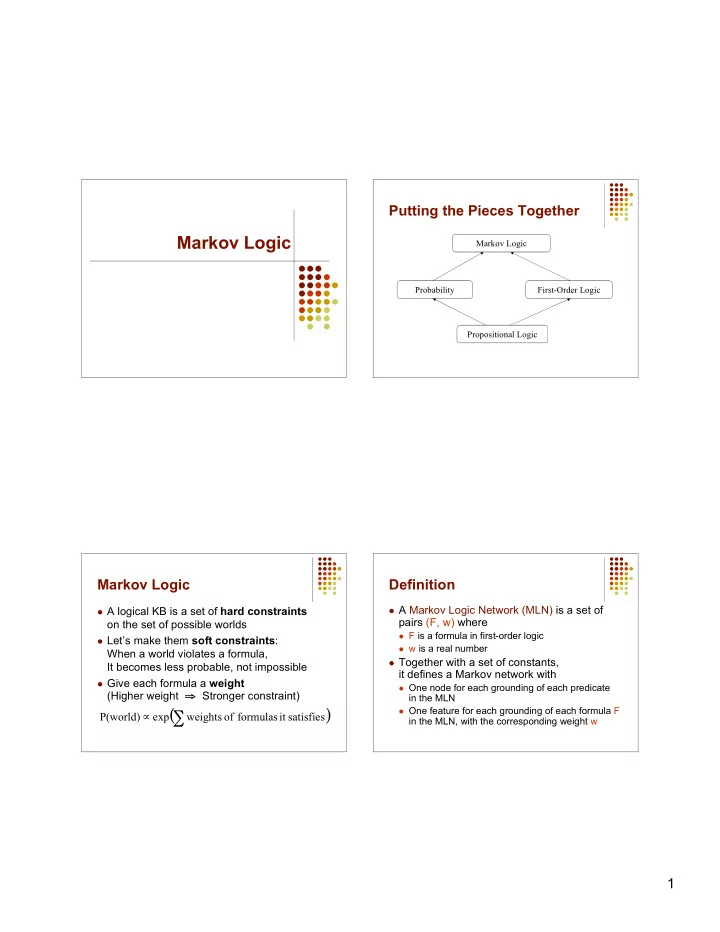
Markov Logic Markov Logic Probability First-Order Logic - - PDF document

markov logic
SMART_READER_LITE
LIVE PREVIEW

Markov Logic Markov Logic Probability First-Order Logic - - PDF document

Putting the Pieces Together Markov Logic Markov Logic Probability First-Order Logic Propositional Logic Markov Logic Definition A Markov Logic Network (MLN) is a set of A logical KB is a set of hard constraints pairs (F, w) where on


slide-1
SLIDE 1

1

Markov Logic

Putting the Pieces Together

Propositional Logic Probability First-Order Logic Markov Logic

Markov Logic

 A logical KB is a set of hard constraints

  • n the set of possible worlds

 Let’s make them soft constraints:

When a world violates a formula, It becomes less probable, not impossible

 Give each formula a weight

(Higher weight ⇒ Stronger constraint)

( )

  • satisfies

it formulas

  • f

weights exp P(world)

Definition

 A Markov Logic Network (MLN) is a set of

pairs (F, w) where

 F is a formula in first-order logic  w is a real number

 Together with a set of constants,

it defines a Markov network with

 One node for each grounding of each predicate

in the MLN

 One feature for each grounding of each formula F

in the MLN, with the corresponding weight w

slide-2
SLIDE 2

2

Example: Friends & Smokers

habits. smoking similar have Friends cancer. causes Smoking

Example: Friends & Smokers

( )

) ( ) ( ) , ( , ) ( ) ( y Smokes x Smokes y x Friends y x x Cancer x Smokes x

  • Example: Friends & Smokers

( )

) ( ) ( ) , ( , ) ( ) ( y Smokes x Smokes y x Friends y x x Cancer x Smokes x

  • 1

. 1 5 . 1

Example: Friends & Smokers

( )

) ( ) ( ) , ( , ) ( ) ( y Smokes x Smokes y x Friends y x x Cancer x Smokes x

  • 1

. 1 5 . 1 Two constants: Anna (A) and Bob (B)

slide-3
SLIDE 3

3

Example: Friends & Smokers

( )

) ( ) ( ) , ( , ) ( ) ( y Smokes x Smokes y x Friends y x x Cancer x Smokes x

  • 1

. 1 5 . 1

Cancer(A) Smokes(A) Smokes(B) Cancer(B)

Two constants: Anna (A) and Bob (B)

Example: Friends & Smokers

( )

) ( ) ( ) , ( , ) ( ) ( y Smokes x Smokes y x Friends y x x Cancer x Smokes x

  • 1

. 1 5 . 1

Cancer(A) Smokes(A) Friends(A,A) Friends(B,A) Smokes(B) Friends(A,B) Cancer(B) Friends(B,B)

Two constants: Anna (A) and Bob (B)

Example: Friends & Smokers

( )

) ( ) ( ) , ( , ) ( ) ( y Smokes x Smokes y x Friends y x x Cancer x Smokes x

  • 1

. 1 5 . 1

Cancer(A) Smokes(A) Friends(A,A) Friends(B,A) Smokes(B) Friends(A,B) Cancer(B) Friends(B,B)

Two constants: Anna (A) and Bob (B)

Example: Friends & Smokers

( )

) ( ) ( ) , ( , ) ( ) ( y Smokes x Smokes y x Friends y x x Cancer x Smokes x

  • 1

. 1 5 . 1

Cancer(A) Smokes(A) Friends(A,A) Friends(B,A) Smokes(B) Friends(A,B) Cancer(B) Friends(B,B)

Two constants: Anna (A) and Bob (B)

slide-4
SLIDE 4

4 Markov Logic Networks

 MLN is template for ground Markov nets  Probability of a world x:  Typed variables and constants greatly reduce

size of ground Markov net

 Functions, existential quantifiers, etc.  Open question: Infinite domains

Weight of formula i

  • No. of true groundings of formula i in x
  • =
  • i

i i

x n w Z x P ) ( exp 1 ) (

Relation to Statistical Models

 Special cases:

 Markov networks  Markov random fields  Bayesian networks  Log-linear models  Exponential models  Max. entropy models  Gibbs distributions  Boltzmann machines  Logistic regression  Hidden Markov models  Conditional random fields

 Obtained by making all

predicates zero-arity

 Markov logic allows

  • bjects to be

interdependent (non-i.i.d.)

 Discrete distributions

Relation to First-Order Logic

 Infinite weights ⇒ First-order logic  Satisfiable KB, positive weights ⇒

Satisfying assignments = Modes of distribution

 Markov logic allows contradictions between

formulas

MAP/MPE Inference

 Problem: Find most likely state of world

given evidence

) | ( max x y P

y

Query Evidence

slide-5
SLIDE 5

5 MAP/MPE Inference

 Problem: Find most likely state of world

given evidence

  • i

i i x y

y x n w Z ) , ( exp 1 max

MAP/MPE Inference

 Problem: Find most likely state of world

given evidence

  • i

i i y

y x n w ) , ( max MAP/MPE Inference

 Problem: Find most likely state of world

given evidence

 This is just the weighted MaxSAT problem  Use weighted SAT solver

(e.g., MaxWalkSAT [Kautz et al., 1997] )

 Potentially faster than logical inference (!)

  • i

i i y

y x n w ) , ( max

The MaxWalkSAT Algorithm

for i ← 1 to max-tries do solution = random truth assignment for j ← 1 to max-flips do if ∑ weights(sat. clauses) > threshold then return solution c ← random unsatisfied clause with probability p flip a random variable in c else flip variable in c that maximizes ∑ weights(sat. clauses) return failure, best solution found

slide-6
SLIDE 6

6 But … Memory Explosion

 Problem:

If there are n constants and the highest clause arity is c, the ground network requires O(n ) memory

 Solution:

Exploit sparseness; ground clauses lazily

→ LazySAT algorithm [Singla & Domingos, 2006]

c

Computing Probabilities

 P(Formula|MLN,C) = ?  MCMC: Sample worlds, check formula holds  P(Formula1|Formula2,MLN,C) = ?  If Formula2 = Conjunction of ground atoms

 First construct min subset of network necessary

to answer query (generalization of KBMC)

 Then apply MCMC (or other)

 Can also do lifted inference [Braz et al, 2005]

Ground Network Construction

network ← Ø queue ← query nodes repeat node ← front(queue) remove node from queue add node to network if node not in evidence then add neighbors(node) to queue until queue = Ø

But … Insufficient for Logic

 Problem:

Deterministic dependencies break MCMC Near-deterministic ones make it very slow

 Solution:

Combine MCMC and WalkSAT

→ MC-SAT algorithm [Poon & Domingos, 2006]