Martingales Again As in discrete time, we need a probability space ( - - PowerPoint PPT Presentation

martingales again as in discrete time we need a
SMART_READER_LITE
LIVE PREVIEW

Martingales Again As in discrete time, we need a probability space ( - - PowerPoint PPT Presentation

Martingales Again As in discrete time, we need a probability space ( , F , P ) and a filtration {F t } t 0 : F t is a sub- -field of F and for 0 s < t , F s F t . The natural filtration generated by a stochastic process


slide-1
SLIDE 1

Martingales Again

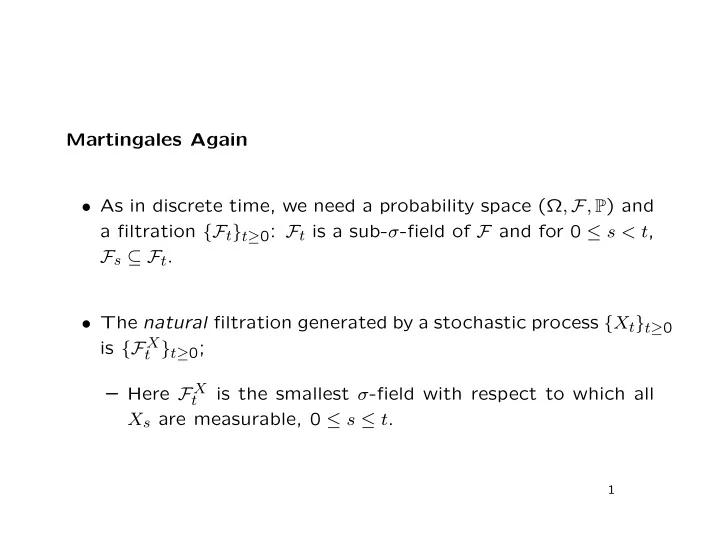
  • As in discrete time, we need a probability space (Ω, F, P) and

a filtration {Ft}t≥0: Ft is a sub-σ-field of F and for 0 ≤ s < t, Fs ⊆ Ft.

  • The natural filtration generated by a stochastic process {Xt}t≥0

is {FX

t }t≥0;

– Here FX

t

is the smallest σ-field with respect to which all Xs are measurable, 0 ≤ s ≤ t.

1

slide-2
SLIDE 2
  • {Mt}t≥0 is a
  • P, {Ft}t≥0
  • martingale if

EP[|Mt|] < ∞ for all t ≥ 0, and for any 0 ≤ s ≤ t, EP[Mt|Fs] = Ms.

  • More generally, {Mt}t≥0 is a local
  • P, {Ft}t≥0
  • martingale if

there exists a sequence of stopping times {Tn}n≥1 such that: – {Mt∧Tn}t≥0 is a

  • P, {Ft}t≥0
  • martingale for each n, and

– P[Tn → ∞ as n → ∞] = 1.

2

slide-3
SLIDE 3
  • Suppose that {Wt}t≥0 is standard Brownian motion, and

{Ft}t≥0 is the natural filtration. Then: – {Wt}t≥0 is a

  • P, {Ft}t≥0
  • martingale;

  • W 2

t − t

  • t≥0 is a
  • P, {Ft}t≥0
  • martingale;

  • exp
  • σWt − σ2

2 t

  • t≥0

is a

  • P, {Ft}t≥0
  • martingale.

3

slide-4
SLIDE 4
  • Optional Stopping Theorem: if {Mt}t≥0 is a continuous
  • P, {Ft}t≥0
  • martingale (or more generally, almost surely c`

adl` ag), and if τ1 ≤ τ2 are two bounded stopping times, then E

|Mτ2| < ∞,

and E

Mτ2| Fτ1 = Mτ1,

with P-probability 1.

4

slide-5
SLIDE 5
  • We can use this theorem for instance to find the moment

generating function (Laplace transform) of the distribution

  • f the hitting time Ta,

E

  • e−θTa

.

  • Suppose that a > 0; recall that

Mt = exp

  • σWt − σ2

2 t

  • is a martingale.
  • Take τ1 = 0 and τ2 = Ta.

5

slide-6
SLIDE 6
  • So

1 = M0

?

= E

  • MTa
  • = eσaE
  • e−σ2

2 Ta

  • .
  • The argument fails at “ ?

=”, because Ta is not bounded.

  • It can be fixed by taking τ2 = Ta ∧ n, and letting n → ∞.
  • Correct:

1 = M0 = E

  • MTa∧n
  • = E
  • MTa∧n1{Ta≤n}
  • + E
  • MTa∧n1{Ta>n}
  • = E
  • MTa1{Ta≤n}
  • + E
  • Mn1{Ta>n}
  • → E
  • MTa
  • + 0.

6

slide-7
SLIDE 7
  • So

E

  • e−σ2

2 Ta

  • = e−σa,
  • r

E

  • e−θTa

= e−

√ 2θa.

  • For a < 0, we use

Mt = exp

  • −σWt − σ2

2 t

  • as the martingale, and find the general result

E

  • e−θTa

= e−

√ 2θ|a|.

7