Master of Science Degree in Civil Engineering Speciality: Mechanics - - PDF document

master of science degree in civil engineering speciality
SMART_READER_LITE
LIVE PREVIEW

Master of Science Degree in Civil Engineering Speciality: Mechanics - - PDF document

Master of Science Degree in Civil Engineering Speciality: Mechanics of Materials and Structures for Civil Engineering and Transportation Systems Graduate Officer : Prof. Johann Guilleminot Email: johann.guilleminot@u-pem.fr Graduate Office :


slide-1
SLIDE 1

Master of Science Degree in Civil Engineering Speciality: Mechanics of Materials and Structures for Civil Engineering and Transportation Systems

Graduate Officer:

  • Prof. Johann Guilleminot

Email: johann.guilleminot@u-pem.fr Graduate Office:

  • Ms. Cecile Amphiarus

Lavoisier - Room 106 Université Paris-Est Marne-la-Vallée 5 boulevard Descartes 77 420 Champs-Sur-Marne, France Telephone: +33 160 957 768 E-mail: cecile.amphiarus@u-pem.fr

slide-2
SLIDE 2
  • 1. Overview and key features of the Master program

The Master Mechanics of Materials and Structures for Civil Engineering and Transportation Systems (MMSCT) is a one-year program offered at UPEM – Université Paris-Est Marne-la-Vallée (see http://www.u-pem.fr/fileadmin/public/UPEMLV/Guides-Plaquettes/PlaquetteUPEMGB-p-WEB.pdf for a description). The program aims at providing the students with deep scientific and technical knowledge about the multiscale modelling, over a broad range of scales, of complex materials and

  • structures. The centrepiece of the program is a mixture between advanced aspects of theoretical

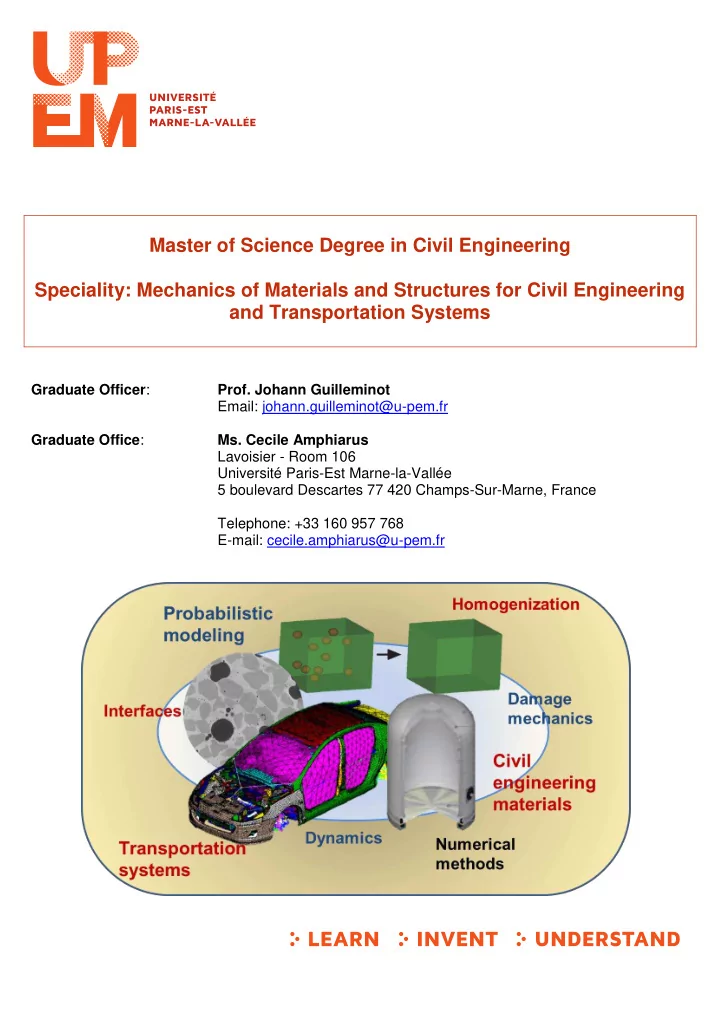
modelling and practical use and/or implementation of state-of-the-art computational approaches, both exposed within deterministic and probabilistic frameworks. Typical covered applications are the multiscale and multiphysical modelling of highly heterogeneous linear and non-linear microstructures (see e.g. the figure below) – such as concrete or polymer-based materials – and the simulation of damage evolution in random media. A list of advantages offered by this program includes:  A series of courses covering the mechanics of materials from nanoscale up to the structural level, with a specific emphasis on new multiscale and computational approaches.  Interactions with internationally recognized faculty members affiliated with the Mechanics group from the Multiscale Modelling and Simulation Laboratory (MSME laboratory; see http://msme.u- pem.fr/homepage/?L=1), as well as with members from other research groups (Biomechanics, Computational Chemistry and Fluid Mechanics) at MSME laboratory.  Closed contact with leading industries in Civil Engineering and Transportation systems.  All courses taught in English. Practical advantages include, in a non-exhaustive manner:  Low tuition fees (261 Euros) and attractive health insurance programs (full coverage at 215 Euros per year).  A prime campus location, 15 kilometres away from the heart of Paris (the one-way trip takes about twenty minutes by using the RER A train) and 35 kilometres away from the international Paris – Charles de Gaulle Airport (also reachable via direct public transportation).  Numerous on- or off-campus housing options. Career opportunities include jobs in industry (mostly in R&D sector, either in small to large high-tech companies, or in multinational companies) or academia. Almost fifty percent of the students enrol for PhD programs at MSME laboratory or elsewhere.

  • 2. Entrance requirements and admission for foreign students

International applications to the Master program are accepted from persons who have completed (or will have completed upon arrival) a Master’s degree (or equivalent, like an engineering diploma) in a foreign country. Candidates who have completed (or are about to complete) a first year in a Master’s program, or are currently enrolled in a PhD program and are seeking for complementary skills, are also encouraged to apply. Although most successful applicants graduated in mechanical engineering, applicants from other related branches of science and engineering (such as applied mathematics, material science or physics) may also gain entry. Applications must be sent, in electronic form, to the graduate officer. The Admissions Committee is composed of faculty members who review eligible applications and recommend admission. Please contact the graduate officer for further information and queries.

slide-3
SLIDE 3

ADMISSION PROCEDURE (Foreign students) 1- Before January February 15th : Send application file including CV, marks and one recommendation letter from a professor or a program coordinator to the Graduate Officer (johann.guilleminot@u-pem.fr) 2- March: Skype/visio conference interviews (in English or French) for selected candidates 3- Decision: a few days after the interviews. Accepted candidates will be contacted for administrative procedures. Admitted international students will be notified of available external fellowships. For French students, applicants must register to the website of the University, a different selection procedure will be conducted.

  • 3. Description

3.1. Program of courses

The Master program runs over two regular terms (fall and spring). The first term is dedicated to traditional courses (see below) given in a chalk talk format, whereas the second one is concerned with the completion of the SM thesis (this completion takes from four to six months). All courses are taught and evaluated in English. Most of the courses involve five to seven three-hour theoretical lectures given by the instructor, as well as a term project illustrating the salient features of classroom instruction. Core courses are listed below:  Numerical methods and finite element analysis for multiphysics and non-linear problems.  Damage mechanics.  Finite elasticity.  Homogenization in continuum mechanics.  Probabilistic modelling of uncertainties in mechanics.  English for scientific communication.

FE simulation of heat flux in a periodic microstructure (extracted from a student’s technical report)

In addition to these subjects, at least four additional courses must be selected among the following ones:  Mechanical modelling of manufacturing processes and thermal coupling.  Dynamics and wave propagation in complex structures.  Interface problems.  Computational homogenization

  • f

heterogeneous materials.  Reliability analysis of mechanical systems.

slide-4
SLIDE 4

 Stochastic modelling and computational analysis for random media.

Atomistic modelling of an amorphous polymer reinforced by a nanoscopic filler

The SM thesis is supervised by a faculty member or by a research engineer in case the project is completed in a private company. The thesis defence is a thirty-five-minute exam in which the student presents and is questioned on his/her research project.

3.2. Validation

The program consists in sixty ECTS credits. Thirty ECTS credits are granted in the first term and correspond to ten three-credits courses (three ECTS credits are granted for each subject), and thirty ECTS credits are obtained after thesis completion.

Picture of Descartes campus

.

slide-5
SLIDE 5

3.3. Detailed description of courses

COURSE Nb. Hours Description/content Semester 1 Numerical simulation methods for multiphysics problems 21 Finite difference/finite elements methods for transient/stationary diffusion/thermal problems; finite elements method for linear/non-linear problems; finite elements method for coupled problems: poroelasticity, elasticity/diffusion coupling. Damage mechanics 21 Phenomenological aspects for damage modeling. Damage

  • variables. Effective stresses. Damage measures. Elementary

laws and damage criterion; Thermodynamic formulation. Dimensional representation of damage. Isotropic and anisotropic damage theories; Specific models. Plastic ductile

  • damage. Creep damage. Fatigue damage. Interaction effects;

Deformation/damage coupling. Elasticity(resp. Plasticity)/Damage coupling; Application to the modeling the behavior of concrete. Behavior in tensile and compression. Relationship between damage and anelastic strains. Strain localization. Finite strains continuum mechanics 21 Definition of strains and stresses in a continuous medium undergoing finite transformations; Lee-Mandel decomposition; notion of relaxed configuration; case of isotropic and linearized elasticity; rate-dependent formulation for constitutive laws; analytical solving of simple boundary value problems; numerical approaches and implementation. Analytical homogenization methods 21 Definition of scales in heterogeneous solids; notion of Representative Volume Element(RVE); Kinematically or Statically Uniform Boundary Conditions; RVE stiffness or compliance tensor; Voigt and Reuss bounds, Hashin- Shtrikman bounds, case of unidirectional composite; approximations at low volume fractions, self-consistent methods; case of periodic media. Probabilistic modeling of uncertatinties in mechanics 15 Introduction; probabilistic models for vector-valued random variables; construction of probability laws; stochastic fields; methods for solving equations with random parameters; nonparametric probabilistic models for uncertainties in dynamics. English for scientific communication 21 English for oral presentation in international scientific events; English for writing scientific articles. Mechanics of forming processes and thermal 21 Modelling and identification of highly viscous behaviors; nonlinear viscosity and flow approximation; numerical modelling of viscous flows; thermal aspects (WLF law, self-

slide-6
SLIDE 6

coupling heating, exchange with tools); visco-elastic behavior in large deformations. Dynamics and wave propagation in structures 21 Elasto-acoustic waves, exterior Neumann problem, integral representation, integral equation, Green function, boundary element method Mechanics of interfaces 21 Perfect thermal interfaces. Hadamard relation for temperature jump. Continuity and discontinuity conditions for temperature/heat flux gradients. Fourier's law for perfect interfaces; Perfect elastic interface. Hadamard compatibility condition for displacements. Continuity/discontinuity conditions for displacements and stresses. Hooke's law for perfect interfaces; Perfect multi physical interface. Hadamard compatibility equation. Generalized Hill interface operators. Solution for perfect interfaces in a composite (multi-physical framework). Homogenization of laminates ; Asymptotic analysis for imperfect interfaces in a multi-physical context. General forms for displacement vectors and generalized constraints jumps. Special cases (Kapitza law, Gurtin- Murdoch relation, ...); Application of imperfect interface models in micromechanics and nanomechanics. Homogenization of heterogeneous media with finite elements 21 Computation

  • f

effective properties for linear diffusion/elasticity problems; numerical homogenization of coupled problems: thermoelasticity, poroelasticity and electromechanical coupling; Introduction to advanced techniques for the homogenization

  • f

nonlinear heterogeneous structures Fiability 21 Basics in probability theory, utility function and limit states, structural reliability, numerical simulations, simplified methods and reliability index, applications. Stochastic modeling of random media 21 Introduction to mathematical morphology (theory and simulations) and geometry of random fields, description of random sets, concept of periodization, Gaussian random fields, transformations of Gaussian fields, simulation of random fields. Semester 2 Research training period 4 to 6 months Internship.