Math 217 - November 5, 2010 1 n ! L { e at } = L { t n } = s n +1 s - PowerPoint PPT Presentation
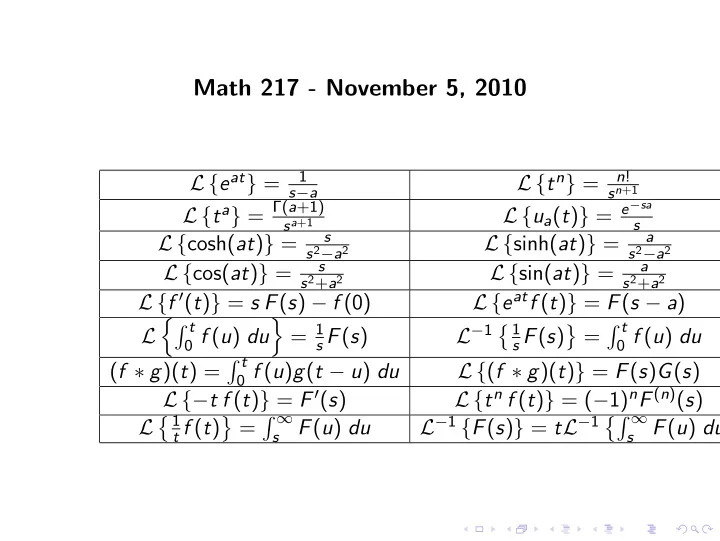
Math 217 - November 5, 2010 1 n ! L { e at } = L { t n } = s n +1 s a L { t a } = ( a +1) L { u a ( t ) } = e sa s a +1 s L { cosh( at ) } = s L { sinh( at ) } = a s 2 a 2 s 2 a 2 L { cos( at ) } = s L { sin( at ) } = a s 2 +
Math 217 - November 5, 2010 1 n ! L { e at } = L { t n } = s n +1 s − a L { t a } = Γ( a +1) L { u a ( t ) } = e − sa s a +1 s L { cosh( at ) } = s L { sinh( at ) } = a s 2 − a 2 s 2 − a 2 L { cos( at ) } = s L { sin( at ) } = a s 2 + a 2 s 2 + a 2 L { f ′ ( t ) } = s F ( s ) − f (0) L { e at f ( t ) } = F ( s − a ) L − 1 � 1 �� t � t � = 1 � L 0 f ( u ) du s F ( s ) s F ( s ) = 0 f ( u ) du � t ( f ∗ g )( t ) = 0 f ( u ) g ( t − u ) du L { ( f ∗ g )( t ) } = F ( s ) G ( s ) L { t n f ( t ) } = ( − 1) n F ( n ) ( s ) L {− t f ( t ) } = F ′ ( s ) � 1 � ∞ L − 1 { F ( s ) } = t L − 1 �� ∞ � L t f ( t ) = F ( u ) du F ( u ) du s s
1. Set up the partial fractions for the following. (If you run out of things to be doing, work on the solutions). (a) 1 s 3 ( s − 3) = (b) 3 s 2 + 5 ( s 2 + 4 s + 5)( s − 2) = 2. Find the inverse Laplace transforms for the previous problems. (At least get the ones you know how to do!)
1. Set up the partial fractions for the following. (If you run out of things to be doing, work on the solutions). (a) 1 1 1 1 1 s 3 ( s − 3) = − 27 s − 9 s 2 − 3 s 3 + 27 ( s − 3) (b) 3 s 2 + 5 2 s 1 ( s 2 + 4 s + 5)( s − 2) = s 2 + 4 s + 5 + s − 2 2. Find the inverse Laplace transforms for the previous problems. (At least get the ones you know how to do!)
Lecture Problems �� t � = 1 3. Find the inverse transforms using: L 0 f ( u ) du s F ( s ). (a) � 1 � L − 1 = s − 3 (b) � 1 � L − 1 = s ( s − 3) (c) � � 1 L − 1 = s 2 ( s − 3) (d) � � 1 L − 1 = s 3 ( s − 3)
Lecture Problems �� t � = 1 3. Find the inverse transforms using: L 0 f ( u ) du s F ( s ). (a) � 1 � L − 1 = e 3 t s − 3 (b) � t � 1 � e 3 u du = 1 3( e 3 t − 1) L − 1 = s ( s − 3) 0 (c) � t 3( e 3 u − 1) du = e 3 t � 1 � 1 3 − 1 9 − t L − 1 = s 2 ( s − 3) 9 0 (d) = e 3 t 27 − t 2 � � 1 6 − t 9 − 1 L − 1 s 3 ( s − 3) 27
4. Find the inverse transforms using: L { e at f ( t ) } = F ( s − a ). (a) � 1 � L − 1 = ( s − 3) 2 + 9 (b) � � s L − 1 = ( s − 3) 2 + 9 (c) � s + 1 � L − 1 = s 2 + 4 s + 5 (d) � 2 − 3 s � L − 1 = 4 s 2 − 24 s + 37
4. Find the inverse transforms using: L { e at f ( t ) } = F ( s − a ). (a) � 1 � = 1 3 e 3 t sin 3 t L − 1 ( s − 3) 2 + 9 (b) � � s = e 3 t (sin (3 t ) + cos (3 t )) L − 1 ( s − 3) 2 + 9 (c) � s + 1 � = e − 2 t ( cos ( t ) − sin ( t )) L − 1 s 2 + 4 s + 5 (d) � t � t = e 3 t � � �� − 14 sin − 3 cos � 2 − 3 s � L − 1 2 2 4 s 2 − 24 s + 37 4
5. Homework problems (not to turn in, but you definitely should do these!). Solve the differential equations using Laplace (a) y ′′ + 2 y ′ + 5 y = 0 , y (0) = 1 , y ′ (0) = 2. (b) y ′′ + 8 y ′ + 25 y = 0 , y (0) = − 1 , y ′ (0) = 1.
5. Homework problems (not to turn in, but you definitely should do these!). Solve the differential equations using Laplace (a) y ′′ + 2 y ′ + 5 y = 0 , y (0) = 1 , y ′ (0) = 2. Solution: y = e − t � � 3 sin(2 t ) + cos (2 t ) 2 (b) y ′′ + 8 y ′ + 25 y = 0 , y (0) = − 1 , y ′ (0) = 1. Solution: y = e − 4 t ( − sin (3 t ) − cos (3 t ))
Recommend
More recommend
Explore More Topics
Stay informed with curated content and fresh updates.