Mathematical Virology Viruses under the mathematical microscope: An - - PowerPoint PPT Presentation

mathematical virology
SMART_READER_LITE
LIVE PREVIEW

Mathematical Virology Viruses under the mathematical microscope: An - - PowerPoint PPT Presentation

Mathematical Virology Viruses under the mathematical microscope: An opportunity to demonstrate the impact of in the classroom mathematics in biology in the classroom environment Reidun Twarock Departments of Mathematics and Biology York


slide-1
SLIDE 1

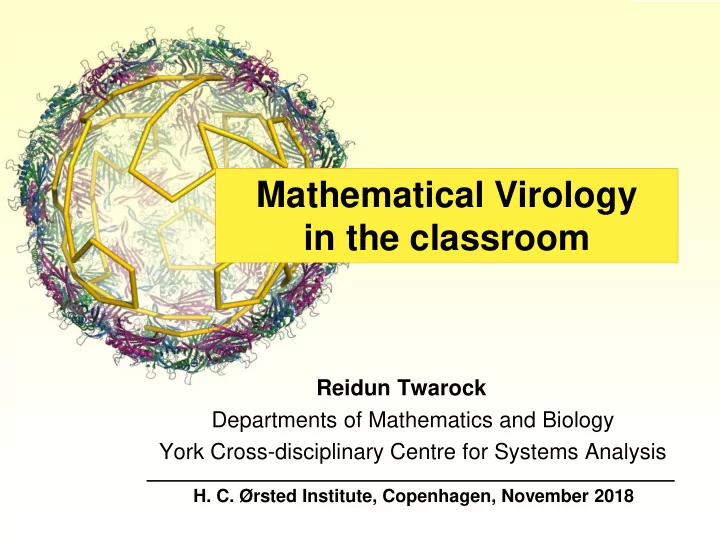
Reidun Twarock

Departments of Mathematics and Biology York Cross-disciplinary Centre for Systems Analysis

Viruses under the mathematical microscope: An opportunity to demonstrate the impact of mathematics in biology in the classroom environment

Mathematical Virology in the classroom

  • H. C. Ørsted Institute, Copenhagen, November 2018
slide-2
SLIDE 2

Central Questions

  • 1. How can mathematics help to make discoveries

in virology and find novel anti-viral solutions?

  • 2. Which aspects can be covered in the

classroom?

  • > Suggestions are given in the Teacher’s Packs
slide-3
SLIDE 3

The biological challenge

Viruses are responsible for a wide spectrum of devastating diseases in humans animals and plants. Examples:

  • HIV
  • Hepatitis C
  • Cancer-causing viruses
  • Picornaviruses linked with

type 1 diabetes

  • Common Cold
  • Options for anti-viral interventions are limited.
  • Therapy resistant mutant strains provide a challenge for therapy
slide-4
SLIDE 4

Protein Containers

Challenges:

  • What are the mathematical rules underpinning their structure?
  • Can this insight be used to combat viruses by preventing their formation?

=

Viral capsids are like Trojan horses, hiding the genome from the defense mechanisms of their host.

slide-5
SLIDE 5

Viruses and Geometry

An understanding of Viral Geometry enables discovery in virology and creates new opportunities in bionanotechnology and anti-viral therapy

Symmetry in Virology

slide-6
SLIDE 6

What is icosahedral symmetry?

The icosahedron has

  • 6 axes of 5-fold symmetry
  • 10 axes of 3-fold symmetry
  • 15 axes of 2-fold symmetry
slide-7
SLIDE 7

Part I: What are the mathematical rules?

slide-8
SLIDE 8

The architecture of larger viruses

Caspar and Klug’s Theory of Quasiequivalence (1962): ``The local environments of all capsid proteins look similar.’’ ’’ Dots mark the positions of capsid proteins

slide-9
SLIDE 9

Which triangulations are the right ones to use?

slide-10
SLIDE 10

Surface of an icosahedron

http://agrega.educacion.es/repositorio/24052014/07/es_2014052412_9134736/poliedros_regulares.html

slide-11
SLIDE 11

Virus architecture according to Caspar and Klug

planar representation superposition icosahedron

slide-12
SLIDE 12

Surface lattices predicting virus architecture

slide-13
SLIDE 13

Application of Pythagoras’ Theorem

Question: In how many different ways can this be done?

T=S2=(H+K/2)2+3/4K2= H2+HK+K2

Caspar and Klug (1962) predict virus architecture based only on geometrical considerations

slide-14
SLIDE 14

Meaning of the T-number

4 T S Area =

T=4: 80 small triangles; 60T=240 proteins T counts the number of small triangles per triangular face of the icosahedron The T-number can be used to enumerate different virus structures

slide-15
SLIDE 15

Examples

  • Find the icosahedral triangle.
  • What is the T-number of this virus?

Chikungunya virus (T=4; H=2, K=0) Herpes Simplex virus (T=16; H=4, K=0) Rotavirus (T=13; H=3, K=1)

slide-16
SLIDE 16

Viral designs are picked up in architecture

Large viruses look like Buckminster Fuller’s Domes

slide-17
SLIDE 17

Why is new mathematics needed?

  • 1. Caspar-Klug Theory

is too restrictive to capture all virus architectures

  • 2. It does not provide

information at different radial levels The cancer-causing papilloma virus falls

  • ut of this remit

Pariacoto virus

slide-18
SLIDE 18

The mathematical problem

You cannot tile your bathroom with pentagons without gaps and overlaps There are no lattices with 5-fold symmetry! Sir Roger Penrose

The solution: Viral Tiling Theory

slide-19
SLIDE 19

Quasi-lattices via projection

5D Lattice 2D Quasilattice 3D “Control Space” 6D Lattice 3D Quasilattice 3D “Control Space” depends on lattice type 6D - minimal embedding dimension for icosahedral symmetry

slide-20
SLIDE 20

Emilio Zappa

A New Group Theoretical Approach

  • R. Twarock, M. Valiunas & E. Zappa (2015) Acta Cryst. A71, 569-582.

Construct point arrays from orbits in the hyperoctahedral group B6 via projection

Classification of subgroups of B6 containing the icosahedral group as a subgroup.

slide-21
SLIDE 21

Virus structure at different radial levels

Pariacoto virus

2D 3D

Develop new (affine extended) group structures and 3D tilings

slide-22
SLIDE 22

Applications

Vaccine Design: Predict the structures of self-assembling protein nanoparticles Fullerenes: Model the structures of carbon onions

Adapted from Chemistryworld (June 2014)

C60 C240 C540

Sir Harald Kroto Nobel Prize in Chemistry 1996

With Peter Burkhard CEO AOPeptides (vaccine design)

slide-23
SLIDE 23

Why do viruses use symmetry?

Crick and Watson, 1956: The principle of genetic economy

Viruses code for a small number of building blocks that are repeatedly used to form containers with symmetry. Containers with icosahedral symmetry are largest given fixed protein size, thus viruses minimise the length of the genome required to code for a protein container of sufficient volume to fit the genome. If the position of one red disk is known, then the positions of all others are implied by symmetry.

  • F. Crick and J.D. Watson, Structure of Small Viruses, Nature 177 (1956), 473-475.
slide-24
SLIDE 24

Part II

Can we understand the mechanisms by which viruses form, and then use this to inhibit it or repurpose them for therapy?

slide-25
SLIDE 25

A simple model of virus assembly

Assemble an icosahedron from 20 triangles: 20 x

slide-26
SLIDE 26

Enumerate assembly pathways

Characterise each assembly pathway by a Hamiltonian paths (a connected path visiting every vertex precisely once) on the inscribed polyhedron: 1 2 3 4 5 1 2 3 4 5 1 2 3 4 5 2 1 3 4 5

slide-27
SLIDE 27

Viruses play the Icosian Game

A board game designed by Hamilton in 1857 based on the concept of Hamiltonian circuit (cycle)

slide-28
SLIDE 28

Opportunity for the classroom

  • Find connected paths on the Schlegel diagram of

the dodecahedron that visit every vertex precisely

  • nce (Hamiltonian paths)
  • Find circular paths of this type.
slide-29
SLIDE 29

The Hamiltonian Paths Approach

+

Viral genome Viral capsid

slide-30
SLIDE 30

Viral geometry and code breaking

Viral Enigma Machine

There is an “assembly code” hidden in the viral genome (i.e. in the code for the protein components)

Hamiltonian Paths Analysis enabled a discovery Note: This is challenging via bioinformatics alone due to the sequence/structure variation of the capsid protein recognition motif.

Prevelige (2015) Follow the Yellow Brick Road: A Paradigm Shift in Virus

  • Assembly. JMB
slide-31
SLIDE 31

A paradigm shift in our understanding of virus assembly

Viral genomes play vital roles in the formation of viral capsids

slide-32
SLIDE 32

=

The mechanism: Viruses behave like “self-packing suitcases”

Article by Prof Peter Stockley, Leeds – Huffington Post

slide-33
SLIDE 33

Anti-viral strategies

Can we break the mechanism?

slide-34
SLIDE 34

Opportunities for translation 1: drug treatment

PS-binding drugs are distinguished by:

  • the speed of viral clearance
  • large numbers of misencapsidated cellular

RNAs

  • a high barrier to drug resistance

Richard Bingham Eric Dykeman

  • R. Bingham, E.C. Dykeman & R. Twarock (2017) RNA virus evolution via a quasispecies-based model

reveals a drug target with high barrier to resistance. Viruses 9, 347.

Small molecular weight compounds inhibiting assembly:

Ligands binding HBV PS1 inhibit virus formation

Example: Hepatitis B virus

slide-35
SLIDE 35

Drug delivery

Can we customise the mechanism to fulfill a specific purpose?

slide-36
SLIDE 36

Opportunities for translation 2: VLP production

Cooperativity can be optimised: Example: STNV RNAs with optimised initiation cassette outcompete viral particles in a ratio 2:1

Develop stable particles as vaccines and for drug/gene delivery:

  • Lentiviral vectors (with Greg Towers)
  • Picornaviruses (with Peter Stockley)
  • E.C. Dykeman, P.G. Stockley, R Twarock, PNAS 2014
  • N. Patel, E. Wroblewski, G. Leonov, S.E.V. Phillips, R. Tuma, R. Twarock and P.G. Stockley, PNAS 2017.

Combine geometry with biophysical modelling:

Cooperative action of packaging signals enables selective and efficient genome packaging

slide-37
SLIDE 37

New opportunities for therapy

  • Hepatitis C
  • Hepatitis B
  • HIV
  • Human Parechovirus
  • A number of plant and bacterial viruses

Viruses covered by our patents (with experimental collaborators at the Universities of Leeds and Helsinki) include: Opportunities:

  • New drugs
  • Virus-like particles for vaccine

design & drug delivery With Prof Peter Stockley Astbury Centre for Structural Molecular Biology University of Leeds

slide-38
SLIDE 38

A webpage for teachers:

More material is available for download from our Teacher’s Resource Pack website: www-users.york.ac.uk/~rt507/teaching_resources.html

We would like to hear from you!

We would be very grateful for any comments and suggestions, as this will enable us to improve our content and apply for more funding to keep this initiative going!

Mathematical Virology in the classroom

slide-39
SLIDE 39

Summary

Our interdisciplinary approach (iterative theory-experiment cycles) has uncovered a new virus assembly paradigm.

  • It occurs across different viral families
  • It is highly conserved

⇒New applications:

  • Drug design – inhibit virus assembly
  • Nanotechnology – VLP production
slide-40
SLIDE 40

The Team & Funding

Collaborators: Wellcome Investigator Team at the Astbury Centre in Leeds: The York team: Eric Dykeman Richard Bingham German Leonov Pierre Dechant Giuliana Indelicato Eva Weiss Conor Haydon Funding is gratefully acknowledged from:

Peter Stockley Rebecca Chandler- Bostock Leeds: Neil Ranson, Dave Rowlands, Roman Tuma, Amy Barker, Dan Maskell, Simon White (now U Conn.) Helsinki University: Sarah Butcher, Shabih Shakeel (now Cambridge) NIH: Fardokht Abulwerdi, Stuart LeGrice Imperial College: Marcus Dorner UCL: Greg Towers, Lucy Thorne Rockefeller: Paul Bieniasz London School of Hygiene and Tropical Medicine: Polly Roy Nikesh Patel