
SLIDE 1
1
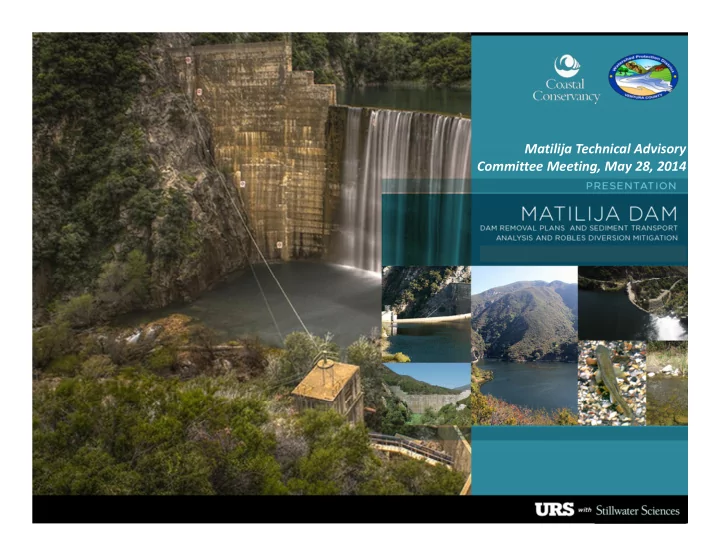
Matilija Technical Advisory Committee Meeting, May 28, 2014
Matilija Technical Advisory Committee Meeting, May 28, 2014 1 - - PowerPoint PPT Presentation
Matilija Technical Advisory Committee Meeting, May 28, 2014 1 Agenda 1. Meeting Purpose 2. Concept Matrix Presentation & Discussion a) Previous Concepts b) New Concepts c) Stakeholder Additional Concepts 3. Initial Screening Process
1
Matilija Technical Advisory Committee Meeting, May 28, 2014
2
3
4
5
6
Fine Sediment Coarse Sediment Casitas Water Diversion
AP-Alt. 1A Move Sediment Upstream
(Alt. 1A) Sediment moved to the right side of the reservoir and stabilized/restored. River channel graded and restored on left side of
removed in parallel with the sediment excavation/placement. Appraisal Report USBR 2000
with dam removal. High flow sediment bypass at Robles Diversion to flush chronic sediment. AP-Alt. 1A
Partial Dam Removal & Move Sediment Upstream
Partial dam removal with a fish ladder over the lowered dam. Sediment moved (down to revised dam elevation) to the right side of the reservoir and stabilized/restored. River channel graded and restored on left side of reservoir. Appraisal Report USBR 2000 Similar to AP-Alt. 1A AP-Alt. 1B Move Sediment to a Site or Sites Downstream by Trucking (Alt. 1B) Sediment would be excavated and hauled downstream (ocean or other site) by truck. The dam would be completely removed, but in stages. Appraisal Report USBR 2000 Fine material (accumulated) removed from the river system. Material would be excavated and hauled to either a downstream permanent disposal site, downstream temporary disposal site, or the ocean. Coarse material (accumulated) removed from the river system. Material would be excavated and hauled to either a downstream permanent disposal site, downstream temporary disposal site, or the ocean. Material could be processed for commercial sale. No sediment modeling of this alternative.
with dam removal. High flow sediment bypass at Robles Diversion to flush chronic sediment. AP-Alt. 1BB Remove Sediment to Ocean by Slurry Pipeline and Conveyor/Trucking (Alt. 1BB) Fine sediment (<=1mm) would be slurry dredged and piped to the ocean and coarse material would be excavated and conveyor/trucked to the ocean (or other downstream disposal location). Dependent
Appraisal Report USBR 2000 Fine material (accumulated) removed from the river system by hydraulic dredging and slurry
hauled to the ocean for beach replenishment. Coarse material (accumulated) removed from the river system using a conveyor belt and trucking system to transport to ocean or downstream temporary disposal site.
with dam removal. High flow sediment bypass at Robles Diversion to flush chronic sediment.
ID Concept Name General Description Reference Detailed Technical Analysis (Previously Documented)
Accumulated sediment is removed from the river system by stabilizing onsite. No sediment modeling of this alternative. Accumulated sediment is removed from the river system by stabilizing onsite. No sediment modeling of this alternative.
7
Fine Sediment Coarse Sediment Casitas Water Diversion
AP-Alt. 2 Phased Natural Transport
Dam would be removed in 9 separated phases (2-3 years btwn). Sediment would be sluiced by natural creek flow. Appraisal Report USBR 2000 Accumulated reservoir area fines allowed to erode without other stabilization during various
Silt/clay: 38% of reservoir sediment; assumed transport £ 200,000 mg/l. Accumulated coarse material allowed to erode without other stabilization during various
Total natural transport limited by sand transport using Yang (1973). Sediment deposition at Robles Diversion will increase. Sediment removal at diversion may need to occur more frequently. Turbidity a water quality problem in Casitas Reservoir; would need to restrict diversions during high turbidity periods. No mitigation provided. AP-Alt. 3 Combination of Alts. 1 & 2 (Alt. 3) Combination of Alts. 1 & 2 - not carried forward in Appraisal Study Appendix E, Appraisal Report USBR 2000 Not addressed Not addressed Not addressed AP-Alt. 4 Complete Removal of Dam in 1 Phase with Uncontrolled Natural Erosion of Sediment (Alt. 4) Minimal removal of sediment to allow full single-phase dam removal. Sediment would be left to erode slowly until large events carry the sediment downstream. This was not carried forward in Appraisal Study. Appendix E, Appraisal Report USBR 2000 Sediment deposition at Robles Diversion may increase. AP-Alt. 5 Construction of Fish Ladder or Bypass with No Dam Removal (Alt. 5) Fish ladder or bypass would be constructed to allow upstream passage of steelhead past the dam. Appendix E, Appraisal Report USBR 2000 Not addressed AP-Alt. 6 No Action (Alt. 6) Leave the dam and sediment in place. Sediment would continue to accumulate in the reservoir until storage is gone, at which point the sediment load would be transported downstream. Appendix E, Appraisal Report USBR 2000 Not addressed
ID Concept Name General Description Reference Detailed Technical Analysis (Previously Documented)
Accumulated sediment stabilized in place by dam. As sediment accumulates behind the dam, eventually it would begin passing naturally over the dam. No modeling of this alternative. 6 MCY of sediments eroded during one or more high flow seasons. Accumulated sediment stabilized in place by dam. As sediment accumulates behind the dam, eventually it would begin passing naturally over the dam. No modeling of this alternative.
8
Fine Sediment Coarse Sediment Casitas Water Diversion
EIS-Alt. 1 Full Dam Removal/ Mechanical Sediment Transport: Slurry 'Reservoir Area' Sediment to Disposal Site/Sell Coarse from Dam Full single phase dam removal and mechanical removal of all accumulated
dredged and piped to downstream disposal
"lower level "downstream flood control protection improvements. Draft and Final EIS/R and Feasibility Study 2004 2.1 MCY accumulated reservoir area fines hydraulic dredged and piped to downstream Baldwin Road disposal area (118-acre floodplain). Residual fines (800K CY) from onsite material processing hauled to Baldwin Road disposal area. Slurry would be contained and dried, then a portion would be allowed to mobilize into the river system during larger storms. 3.8 MCY of accumulated delta area sediments to be excavated and processed onsite (east side of channel). Approximately 3 MCY coarse material sold as aggregate, and 800Kresidual fines hauled to Baldwin Road disposal area. Source of water for slurry (4,500 ac-ft) would be pumped from Lake Casitas. Increased sediment at Casitas Robles Diversion (2x existing - see "downstream flooding"). EIS-Alt. 2a Full Dam Removal/ Natural Sediment Transport: Slurry 'Reservoir Area' Sediment OffSite Full single phase dam removal and partial removal of accumulated sediment (reservoir area fines) to downstream disposal site. Coarse material allowed to mobilize naturally with storm flows. Requires "higher level "downstream flood control protection improvements. Draft and Final EIS/R and Feasibility Study 2004 2.1 MCY accumulated reservoir area fines hydraulic dredged and piped to downstream Baldwin Road disposal area (118-acre floodplain). Material would be contained and dried, then a portion would be allowed to mobilize into the river system during larger storms. 3.8 MCY (includes 800K CY of residual fines) of accumulated coarse material allowed to erode without other stabilization. Source of water for slurry (4,500 ac-ft) would be pumped from Lake Casitas. Increased sediment at Casitas Robles Diversion (8x existing - see "downstream flooding"). 11- 14 AC desilting basin offline of river and Robles-Casitas Canal to allow fines to settle before entering canal. EIS-Alt. 2b Full Dam Removal / Natural Sediment Transport: Natural Transport of 'Reservoir Area' Sediment Full single phase dam removal and natural transport of the majority of accumulated sediments (fine and coarse). Requires "higher level "downstream flood control protection improvements. Draft and Final EIS/R and Feasibility Study 2004 2.1 MCY accumulated reservoir area fines allowed to erode without other stabilization. In
removal, approximately 0.5 MCY sediment behind dam excavated and stockpiled in reservoir using clam-shell dredges. 3.8 MCY (includes 800K CY of residual fines) of accumulated coarse material allowed to erode without other stabilization. Increased sediment at Casitas Robles Diversion (9x existing - see "downstream flooding"). Increased impacts at Casitas diversion resulting in missed water diversion opportunities (for up to 8 yrs) to Lake Casitas necessitates procurement of 48,000 acre-feet of water from other water sources.
ID Concept Name General Description Reference Detailed Technical Analysis (Previously Documented)
9
Fine Sediment Coarse Sediment Casitas Water Diversion
EIS-Alt. 3a Incremental Dam Removal / Natural Sediment Transport: Slurry "Reservoir Area" Sediment Off Site Two-phase dam removal and partial removal
fines) to downstream disposal site. Fine material hydraulically dredged and piped to downstream disposal site. After fine sediment removal, dam is removed to elevation 1000 feet. Coarse material allowed to mobilize naturally with storm flows. After reaching equilibrium, remainder of dam is removed and coarse material allowed to mobilize naturally downstream with storm
flood control protection improvements. Draft and Final EIS/R and Feasibility Study 2004 2.1 MCY accumulated fines hydraulic dredged and piped to downstream Baldwin Road disposal area (118-acre floodplain). Material would be contained and dried, then a portion would be allowed to mobilize into the river system during larger storms. 3.8 MCY (includes 800K CY of residual fines) of accumulated coarse material allowed to erode without other stabilization over two phases of dam removal. Excavate pilot channel from each incremental notch through remaining sediments. Stockpile excavated material in reservoir. Source of water for slurry (4,500 ac-ft) would be pumped from Lake Casitas. Increased sediment at Casitas Robles Diversion (6x existing - see "downstream flooding"). 11- 14 AC desilting basin offline of river and Robles-Casitas Canal to allow fines to settle before entering canal. EIS-Alt. 3b Incremental Dam Removal / Natural Sediment Transport - Natural Transport of "Reservoir Fines" Two-phase dam removal and natural transport of the majority of accumulated sediments (fine and coarse). After minimal fine sediment removal, dam is removed to elevation 1030 feet. Accumulated sediment allowed to mobilize naturally with storm
accumulated sediment allowed to mobilize naturally downstream with storm flows. Requires "higher level "downstream flood control protection improvements. Draft and Final EIS/R and Feasibility Study 2004 2.1 MCY accumulated reservoir area fines allowed to erode without other stabilization. For each of two phases of dam removal, approximately 300K CY
would be excavated and placed upstream to complete phased removal. 3.8 MCY (includes 800K CY of residual fines) of accumulated coarse material allowed to erode without other stabilization over two phases of dam removal. Excavate pilot channel from each incremental notch through remaining sediments. Stockpile excavated material in reservoir. Increased sediment at Casitas Robles Diversion (6x existing - see "downstream flooding"). Increased impacts at Casitas Robles diversion resulting in missed water diversion opportunities (for up to 8 yrs) to Lake Casitas necessitates procurement of 48,000 acre-feet of water from other water sources. EIS-Alt. 4a Full Dam Removal/Long- Term Sediment Transport - Long-Term Transport Period Full single phase dam removal with removal
to downstream disposal site, and stabilization of coarse sediment onsite. Requires "lower level" downstream flood control protection improvements. Draft and Final EIS/R and Feasibility Study 2004 2.1 MCY accumulated reservoir area fines hydraulic dredged and piped to downstream Baldwin Road disposal area (118-acre floodplain). Material would be contained and dried, then a portion would be allowed to mobilize into the river system during larger storms. 3.8 MCY (includes 800K CY of residual fines) of accumulated coarse sediment stabilized within reservoir (to be eroded by events ³ 50-100 year return). 1.2 MCY coarse sediments excavated during initial construction to create channel, and subsequently stabilized onsite. Source of water for slurry (4,500 ac-ft) would be pumped from Lake Casitas. Increased sediment at Casitas Robles Diversion (2x existing - see "downstream flooding").
ID Concept Name General Description Reference Detailed Technical Analysis (Previously Documented)
10
Fine Sediment Coarse Sediment Casitas Water Diversion
EIS-Alt. 4b Full Dam Removal/Long- Term Sediment Transport - Short-Term Transport Period Full single phase dam removal with removal
to downstream disposal site, and temporary stabilization of the coarse sediments onsite. Stabilized sediment would be allowed to slowly erode and mobilize over time during large storms. Requires "higher level" downstream flood control protection improvements. Draft and Final EIS/R and Feasibility Study 2004 2.1 MCY accumulated reservoir area fines hydraulic dredged and piped to downstream Baldwin Road disposal area (118-acre floodplain). Material would be contained and dried, then a portion would be allowed to mobilize into the river system during larger storms. Excavate channel in remaining coarse sediments. Stabilize sediments (coarse and residual fines) within reservoir with soil- cement revetment along sediment storage areas; to be eroded by events ³ 2-10 year return (short-tern natural transport). Source of water for slurry (4,500 ac-ft) would be pumped from Lake Casitas. Increased sediment at Casitas Robles Diversion (6x existing - see "downstream flooding"). NP No Project/No Action Alternative Models and analysis show over time the reservoir behind the Matilija Dam will completely fill with fines and other
water and fines will over top the Dam. This
effect of the Dam will be nullified except for its physical presence. Draft and Final EIS/R and Feasibility Study 2004 Estimated >50 AF of remaining reservoir capacity in 2020 Scr1 Full Dam Removal/Pool and Riffle System Sediment stabilized into steps for fish passage; only fines would be removed. Final EIS/R 2004 Not applicable. Screened prior to analysis. Not applicable. Screened prior to analysis. Not applicable. Screened prior to analysis. Scr2 Partial Dam Removal / Restoration, with Fish Ladder Remove part of dam, stabilize rest; remove all sediment either mechanically or naturally; add a fish ladder; restore water supply and storage functions. Final EIS/R 2004 Not applicable. Screened prior to analysis. Not applicable. Screened prior to analysis. Not applicable. Screened prior to analysis. Scr3 Partial Dam Removal / No Restoration, with Fish Ladder Remove part of dam, stabilize rest; remove all sediment (mechanical or natural) to new top elevation; add a fish ladder. Final EIS/R 2004 Not applicable. Screened prior to analysis. Not applicable. Screened prior to analysis. Not applicable. Screened prior to analysis.
ID Concept Name General Description Reference Detailed Technical Analysis (Previously Documented)
Estimated additional 3.5 MCY of sediment, beyond the 6 MCY currently trapped, could continue to accumulate. Eventually, more sediment will pass over the dam and be deposited along the river and then carried to the ocean.
11
Fine Sediment Coarse Sediment Casitas Water Diversion
FSSG 1 Optimize Alternative 4b Optimize to reduce costs and improve
promote rapid erosion and transport from BRDA. FSSG Final Report 2011 High costs for slurry of fine sediment due to long drying times and uncertainties would be mitigated by phasing the slurry
allowing erosion of fines from disposal areas Not addressed Not addressed FSSG 2 Hybrid Option Hybrid of Alternatives 2a and 4b. Modify Alt 4b to reduce the amount of water and sediment that must be slurried to BRDA by a combination of fines management techniques. FSSG Final Report 2011 Combination of management techniques: slurry a portion of fine sediment, notch dam to 2011 sediment level, notch dam and meter fine sediment transport
sediment upstream Not addressed Not addressed FSSG 3 Full notching and phased natural transport Notch dam in phases to complete removal. Phased/metered transport of fine sediment. Reduce risk to water supply by various techniques. FSSG Final Report 2011 Meter release of fine sediment to reduce risks to water supply Not addressed Manage impacts through: diverting flows upstream of reservoir, infiltration gallery below dam, treat upstream bypass as a manifold to inject supply wells, enhance desilting basin, divert less water through conservation
ID Concept Name General Description Reference Detailed Technical Analysis (Previously Documented)
12
Fine Sediment Coarse Sediment Casitas Water Diversion
FSSG 4 Matilija Canyon Restoration and Hybrid Alternative Analysis Naturally stabilize a major volume of fine sediments within the footprint of the restoration effort for Matilija Canyon. FSSG Final Report 2011 Secure more fines upstream and revegetate in appropriate locations as part of the natural restoration of the floodplain, upland terraces, and adjacent canyons of the creek. Restore Matilija Cr channel to promote controlled natural release from these temporary storage areas
Not addressed Not addressed FSSG 5 Interim Notch Design Notch dam to the existing sediment level. FSSG Final Report 2011 Not addressed DBBP Double-barrel bypass Two bypass pipes upstream of the reservoir installed to (1) provide clean water to Robles Diversion and (2) permit slurrying of fine sediment to a temporary disposal site or downstream of the diversion point for natural river transport to the estuary. March 12, 2011 memo from Stoeker Environmental: http://matilijadam.o rg/documents/Com ments/DoubleBarrel ByPass.MS.3-12- 11.pdf Transported via slurry pipeline using Matilija Creek water during high flows; at lower flows, diversion around reservoir area would minimize transport. Additional fine sediment in "delta" area under gravel cap would transport naturally over time, during multiple subsequent flood events. Leave in place for natural transport. Supplied by bypass pipeline from Matilija Creek above reservoir during periods of moderate and high flow. USA Upstream Disposal Areas Excavate fine ad residual coarse sediments and dispose in upstream disposal areas. Fine sediments would be protected from erosion by soil cement along the rive bank and covered by coarse sediment. DOG Presentation, January 14, 2010 Fine sediment removed and permanently stored in upstream disposal areas Majority of coarse material left in place for natural transport, residual fines placed in upstream disposal areas. Not addressed
ID Concept Name General Description Reference
Intent is to prevent additional accumulation (and future costs for removal) of sediment
Detailed Technical Analysis (Previously Documented)
13
14
Fine Sediment Coarse Sediment Casitas Water Diversion
New-01 Slurry fine sediment to the
for slurry source; one season dam removal Slurry fine sediment to the ocean, remove dam in one season, natural transport of coarse sediment. Incoming water from Matilija Creek Upstream is diverted around the dam and returned to the river just downstream of the dam. Similar concept came up during feasibility but was dismissed due to cost and risk of introducing sea water into the riverine environment. New Alternative Construct two pipes (one pipe pumps sea water upstream, one pumps slurry to ocean) to transport fine sediment directly to the ocean. Fine sediment removal will be accomplished within one dry season. Additional fine sediment in "delta" area under gravel cap would transport naturally over time, during multiple subsequent flood events. Leave in place for natural transport. Lost diversion for approximately 1 day (or a few hours) - this alternative provides the least loss of water diversion among all the possible alternatives. New-02 One phase removal, quick erosion of sediment Construct cofferdam upstream and large water diversion around the reservoir Remove dam. Construct a berm downstream
slide from upstream of the dam. Connect diversion downstream of downstream berm. Allow only high flows to pass into reservoir area. New Alternative Leave in place for natural transport. Leave in place for natural transport. Clear water diversion around reservoir area during flows up to ~ 2000 cfs. Casitas continues operation at Robles Diversion until high flow event occurs. Lost water diversion for approximately one storm event.
Detailed Technical Analysis ID Concept Name General Description Reference
15
Fine Sediment Coarse Sediment Casitas Water Diversion
New-03 Alternative water diversion, one time dam removal Establish alternative water diversion for Casitas, remove dam in one season by first blast open a tunnel on the base of the dam to drain the reservoir followed by structure removal. New Alternative Leave in place for natural transport. Leave in place for natural transport. New diversion for Casitas from Matilija Cr upstream of reservoir and from N.F. Matilija
New-04 Delayed one time dam removal Installation of large sluice gates at bottom of dam to allow rapid sediment removal during large storm events (requires emptying of reservoir prior to large event). Sediment transport would only be effective while flows are less than the open channel capacity
been removed from reservoir then demolish dam in a single season -or- potentially remove a portion of dam as fine sediment is removed. New Alternative Leave in place for natural
face of dam would likely be needed to install gates. Leave in place for natural transport. Robles diversions able to b made during all storms, except those storms that are determined to be of such a size that gates would be opened for sediment flushing. New-05 Gated notching and phased natural transport Notch dam in phases to complete removal. Gate would be installed in notch to limit when fine sediment would be transported. Phased/metered transport of fine sediment during storm events in excess of some predetermined size. New Alternative (similar to FSSG-3) Leave in place for natural
face of dam would likely be needed to install notched. Leave in place for natural transport. Robles diversions able to made during all storms, except those storms that are determined to be of such a size that gates would be opened for sediment flushing.
Detailed Technical Analysis ID Concept Name General Description Reference
Dam: Remove after FS & CS removal Dam: Remove after FS & CS removed Dam: Remove after FS removal FS: Move u/s and stabilize FS: Slurry to d/s disposal FS: Slurry to ocean w/ ocean water CS: Move u/s and stabilize CS: Excavate/process onsite/sell CS: Natural transport Casitas: Minimal impact to diversion Casitas: Slurry water from Lake Casitas Casitas: Minimal impact to diversion Dam: Remove after FS & CS removed Dam: Remove after FS & CS removed FS: Excavate/slurry/haul to d/s disposal/ocean FS: Slurry to d/s disposal Dam: Remove prior to sediment removal CS: Excavate/haul to d/s disposal CS: Natural transport FS: Temp. containment; natural transport, single event Casitas: Diversion reduced by slurry during construction Casitas: Slurry water from Lake Casitas; desilting basin CS: Natural transport Casitas: Temp. diversion around reservoir; minimal Dam: Remove after FS & CS removed impact - no diversion during large event FS: Slurry to d/s, then ocean Dam: Remove prior to sediment removal CS: Excavate/haul to d/s disposal FS: Natural transport Dam: Remove prior to sediment removal Casitas: Diversion reduced by slurry during construction CS: Natural transport FS: Natural transport Casitas: High turbidity precludes diversion CS: Natural transport Casitas: New upstream diversion(s) Dam: Remove prior to sediment removal FS: Natural transport Dam: Remove after FS removed & CS stabilized CS: Natural transport FS: Slurry to d/s disposal Casitas: High turbidity precludes diversion CS: Permanently stabilized onsite Casitas: Slurry water from Lake Casitas Dam: Remove after FS removed & CS stabilized FS: Slurry to d/s disposal CS: Temporarily stabilized onsite Casitas: Slurry water from Lake Casitas Dam: Remove after FS removed & CS stabilized FS: Phased slurry to d/s disposal CS: Temporarily stabilized onsite Casitas: Slurry water from Lake Casitas Dam: Remove after FS removed/stabilized & CS stabilized
Legend & Notes
FS: Partial u/s temp. stabilization; partial slurry AP Appraisal Report (2000) CS: Temporarily stabilized onsite CS Coarse Sediment Casitas: TBD DBBP Double Barrel Bypass EIS EIS/R & Feasibility Study (2004) Dam: Remove after FS removed FS Fine Sediment FS: Excavate and permanent u/s disposal FSSG Fine Sediment Study Group CS: Natural transport USA Upstream Disposal Areas Casitas: TBD Notes: 1) Casitas designations only address fine sediment issues Dam: Remove after FS removed 2) AP-Alts. 1A-future and 3 not defined enough to include FS: Slurry to d/s disposal 3) AP-Alts. 5 & 6 not included (Dam stays and No Action) CS: Natural transport 4) Screened Alts. From 2004 Feasibility Study not included Casitas: New u/s diversion 5) FSSG-5 Interim notch not included
USA New-03 FSSG-4 DBBP EIS-Alt.4b Single-phase dam removal EIS-Alt.4a FSSG-1 AP-Alt.1A EIS-Alt.1 AP-Alt.4 New-01 AP-Alt.1B EIS-Alt.2a New-02 AP-Alt.1BB EIS-Alt.2b Refined Refined Refined Refined Refined
16
Dam phase 1: Initial notch Dam phase 1: Lowered to 1000 ft elev. Dam phase 1: Orifice with gate at base to transport fines Dam future phase(s): 9 incremental notches Dam future phase(s): full removal after equilibrium Dam future phase(s): Remove after FS removal FS: Natural transport FS: Slurry to d/s disposal FS: Natural transport, selective storms CS: Natural transport CS: Phased natural transport CS: Natural transport Casitas: Diversion reduced during high turbidity periods Casitas: Slurry water from Lake Casitas; desilting basin Casitas: Minimal impact - no diversion during large event Dam phase 1: Lowered to 1030 ft elev. Dam phase 1: Gated notches installed Dam future phase(s): full removal after equilibrium Dam future phase(s): Remove after multiple gated notches FS: Phased natural transport FS: Natural transport, selective storms CS: Phased natural transport CS: Natural transport Casitas: High turbidity precludes diversion Casitas: Minimal impact - no diversion during large event Dam phase 1: notch after partial FS removal Dam future phase(s): progressive notching to meter FS FS: Slurry portion; Phased natural transport remaining CS: Temporarily stabilized onsite
Legend & Notes
Casitas: TBD AP Appraisal Report (2000) CS Coarse Sediment Dam phase 1: notch to manage FS DBBP Double Barrel Bypass Dam future phase(s): progressive notching to meter FS EIS EIS/R & Feasibility Study (2004) FS: Phased natural transport FS Fine Sediment CS: Phased natural transport FSSG Fine Sediment Study Group Casitas: New u/s and d/s diversions Notes: 1) Casitas designations only address fine sediment issues Dam: Phased removal after phased FS removal 2) AP-Alts. 1A-future and 3 not defined enough to include FS: Phased slurry to d/s disposal 3) AP-Alts. 5 & 6 not included (Dam stays and No Action) CS: Phased natural transport 4) Screened Alts. From 2004 Feasibility Study not included Casitas: New u/s diversion 5) FSSG-5 Interim notch not included
Multiple-phase dam removal DBBP AP-Alt.2 EIS-Alt.3a New-04 EIS-Alt.3b New-05 FSSG-2 FSSG-3 Refined
17
EIS-Alt. 3b New-04 AP-Alt.1BB New-05 EIS-Alt.1 AP-Alt.1BB FSSG-2 USA FSSG-2 AP-Alt.4 EIS-Alt.2a New-01 AP-Alt.1B FSSG-4 AP-Alt.1A FSSG-3 EIS-Alt.2b EIS-Alt.3a . DBBP AP-Alt.2 New-03 New-02 EIS-Alt.4a EIS-Alt.4b FSSG-1 Legend & Notes FSSG-2
AP Appraisal Report (2000)
FSSG-4
CS Coarse Sediment
DBBP
DBBP Double Barrel Bypass EIS EIS/R & Feasibility Study (2004) FS Fine Sediment FSSG Fine Sediment Study Group USA Upstream Disposal Areas Notes: 2) AP-Alts. 1A-future and 3 not defined enough to include 3) AP-Alts. 5 & 6 not included (Dam stays and No Action) 4) Screened Alts. From 2004 Feasibility Study not included 5) FSSG-5 Interim notch not included
Excavate/Haul Handle
Ocean Uncontrolled Natural Release Leave in Place (natural transport) Phased Natural Release Slurry
FINE SEDIMENT
Permanent Upstream <5 Phases >5 Phases Multiple Storms Single Storm
Ocean
18
19
20
21
22
1. With natural erosion of reservoir material 2. With 2 MCY fine sediment removal 3. With some natural erosion and some fine sediment removal 4. Natural erosion with an upstream clean water diversion 5. 2 MCY fine sediment removal with an upstream clean water diversion 6. Some natural erosion and some fine sediment removal with an upstream clean water diversion
7. Uncontrolled orifice 8. Orifice with sluice gate (to reduce turbidity at low flows) 9. Moderately slow progressive notching (less than approximately 5 stages) 10. Slow progressive notching (more than approximately 5 stages) 11. Moderately slow or slow progressive notching with gate (to reduce turbidity at low flows)
23
EIS-Alt. 3b New-04 AP-Alt.1BB New-05 EIS-Alt.1 AP-Alt.1BB FSSG-2 USA FSSG-2 AP-Alt.4 EIS-Alt.2a New-01 AP-Alt.1B FSSG-4 AP-Alt.1A FSSG-3 EIS-Alt.2b EIS-Alt.3a . DBBP AP-Alt.2 New-03 New-02 EIS-Alt.4a EIS-Alt.4b FSSG-1 FSSG-2 FSSG-4 DBBP Excavate/Haul Handle
Ocean Uncontrolled Natural Release Leave in Place (natural transport) Phased Natural Release Slurry
FINE SEDIMENT
Permanent Upstream <5 Phases >5 Phases Multiple Storms Single Storm
Ocean
24
EIS-Alt. 3b New-04 AP-Alt.1BB New-05 EIS-Alt.1 AP-Alt.1BB FSSG-2 USA FSSG-2 AP-Alt.4 EIS-Alt.2a New-01 AP-Alt.1B FSSG-4 AP-Alt.1A FSSG-3 EIS-Alt.2b EIS-Alt.3a . DBBP AP-Alt.2 New-03 New-02 EIS-Alt.4a EIS-Alt.4b FSSG-1 FSSG-2 FSSG-4 DBBP Excavate/Haul Handle
Ocean Uncontrolled Natural Release Leave in Place (natural transport) Phased Natural Release Slurry
FINE SEDIMENT
Permanent Upstream <5 Phases >5 Phases Multiple Storms Single Storm
Ocean
Fine Sediment Category ID Previous ID Description Initial Option-01 Initial Option-02 Initial Option-03 Initial Option-04 Initial Option-05 Initial Option-06 Initial Option-07 Initial Option-08 Initial Option-09 Initial Option-10 25
EIS-Alt. 3b New-04 AP-Alt.1BB New-05 EIS-Alt.1 AP-Alt.1BB FSSG-2 USA FSSG-2 AP-Alt.4 EIS-Alt.2a New-01 AP-Alt.1B FSSG-4 AP-Alt.1A FSSG-3 EIS-Alt.2b EIS-Alt.3a . DBBP AP-Alt.2 New-03 New-02 EIS-Alt.4a EIS-Alt.4b FSSG-1 FSSG-2 FSSG-4 DBBP Excavate/Haul Handle
Ocean Uncontrolled Natural Release Leave in Place (natural transport) Phased Natural Release Slurry
FINE SEDIMENT
Permanent Upstream <5 Phases >5 Phases Multiple Storms Single Storm
Ocean
Fine Sediment Category ID Previous ID Description Natural Transport – Single Storm Initial Option-01 New-02 Single-phase dam removal with temp. sediment containment structure Initial Option-02 Initial Option-03 Initial Option-04 Initial Option-05 Initial Option-06 Initial Option-07 Initial Option-08 Initial Option-09 Initial Option-10 26
EIS-Alt. 3b New-04 AP-Alt.1BB New-05 EIS-Alt.1 AP-Alt.1BB FSSG-2 USA FSSG-2 AP-Alt.4 EIS-Alt.2a New-01 AP-Alt.1B FSSG-4 AP-Alt.1A FSSG-3 EIS-Alt.2b EIS-Alt.3a . DBBP AP-Alt.2 New-03 New-02 EIS-Alt.4a EIS-Alt.4b FSSG-1 FSSG-2 FSSG-4 DBBP Excavate/Haul Handle
Ocean Uncontrolled Natural Release Leave in Place (natural transport) Phased Natural Release Slurry
FINE SEDIMENT
Permanent Upstream <5 Phases >5 Phases Multiple Storms Single Storm
Ocean
Fine Sediment Category ID Previous ID Description Natural Transport – Single Storm Initial Option-01 New-02 Single-phase dam removal with temp. sediment containment structure Natural Transport – Multiple Storm Initial Option-02 New-03 Uncontrolled large orifice; followed by full dam removal Initial Option-03 Initial Option-04 Initial Option-05 Initial Option-06 Initial Option-07 Initial Option-08 Initial Option-09 Initial Option-10 27
EIS-Alt. 3b New-04 AP-Alt.1BB New-05 EIS-Alt.1 AP-Alt.1BB FSSG-2 USA FSSG-2 AP-Alt.4 EIS-Alt.2a New-01 AP-Alt.1B FSSG-4 AP-Alt.1A FSSG-3 EIS-Alt.2b EIS-Alt.3a . DBBP AP-Alt.2 New-03 New-02 EIS-Alt.4a EIS-Alt.4b FSSG-1 FSSG-2 FSSG-4 DBBP Excavate/Haul Handle
Ocean Uncontrolled Natural Release Leave in Place (natural transport) Phased Natural Release Slurry
FINE SEDIMENT
Permanent Upstream <5 Phases >5 Phases Multiple Storms Single Storm
Ocean
Fine Sediment Category ID Previous ID Description Natural Transport – Single Storm Initial Option-01 New-02 Single-phase dam removal with temp. sediment containment structure Natural Transport – Multiple Storm Initial Option-02 New-03 Uncontrolled large orifice Natural Transport – Multiple Phases Initial Option-03 New-04 Gated large orifice with timed fines release during large storms Initial Option-04 Initial Option-05 Initial Option-06 Initial Option-07 Initial Option-08 Initial Option-09 Initial Option-10 28
EIS-Alt. 3b New-04 AP-Alt.1BB New-05 EIS-Alt.1 AP-Alt.1BB FSSG-2 USA FSSG-2 AP-Alt.4 EIS-Alt.2a New-01 AP-Alt.1B FSSG-4 AP-Alt.1A FSSG-3 EIS-Alt.2b EIS-Alt.3a . DBBP AP-Alt.2 New-03 New-02 EIS-Alt.4a EIS-Alt.4b FSSG-1 FSSG-2 FSSG-4 DBBP Excavate/Haul Handle
Ocean Uncontrolled Natural Release Leave in Place (natural transport) Phased Natural Release Slurry
FINE SEDIMENT
Permanent Upstream <5 Phases >5 Phases Multiple Storms Single Storm
Ocean
Fine Sediment Category ID Previous ID Natural Transport – Single Storm Initial Option-01 New-02 Single-phase dam removal with temp. sediment containment structure Natural Transport – Multiple Storm Initial Option-02 New-03 Uncontrolled large orifice Natural Transport – Multiple Phases Initial Option-03 New-04 Gated large orifice with timed fines release during large storms Natural Transport – Multiple Phases Initial Option-04 New-05/ FSSG-3 Gated notch(es) with timed fines release during large storms Initial Option-05 Initial Option-06 Initial Option-07 Initial Option-08 Initial Option-09 Initial Option-10 29
EIS-Alt. 3b New-04 AP-Alt.1BB New-05 EIS-Alt.1 AP-Alt.1BB FSSG-2 USA FSSG-2 AP-Alt.4 EIS-Alt.2a New-01 AP-Alt.1B FSSG-4 AP-Alt.1A FSSG-3 EIS-Alt.2b EIS-Alt.3a . DBBP AP-Alt.2 New-03 New-02 EIS-Alt.4a EIS-Alt.4b FSSG-1 FSSG-2 FSSG-4 DBBP Excavate/Haul Handle
Ocean Uncontrolled Natural Release Leave in Place (natural transport) Phased Natural Release Slurry
FINE SEDIMENT
Permanent Upstream <5 Phases >5 Phases Multiple Storms Single Storm
Ocean
Fine Sediment Category ID Previous ID Description Natural Transport – Single Storm Initial Option-01 New-02 Single-phase dam removal with temp. sediment containment structure Natural Transport – Multiple Storm Initial Option-02 New-03 Uncontrolled large orifice Natural Transport – Multiple Phases Initial Option-03 New-04 Gated large orifice with timed fines release during large storms Natural Transport – Multiple Phases Initial Option-04 New-05/ FSSG-3 Gated notch(es) with timed fines release during large storms Remove D’stream – Optimize BRDA Initial Option-05 FSSG-1 Remove fines: optimize slurry to downstream location (BRDA) Initial Option-06 Initial Option-07 Initial Option-08 Initial Option-09 Initial Option-10 30
EIS-Alt. 3b New-04 AP-Alt.1BB New-05 EIS-Alt.1 AP-Alt.1BB FSSG-2 USA FSSG-2 AP-Alt.4 EIS-Alt.2a New-01 AP-Alt.1B FSSG-4 AP-Alt.1A FSSG-3 EIS-Alt.2b EIS-Alt.3a . DBBP AP-Alt.2 New-03 New-02 EIS-Alt.4a EIS-Alt.4b FSSG-1 FSSG-2 FSSG-4 DBBP Excavate/Haul Handle
Ocean Uncontrolled Natural Release Leave in Place (natural transport) Phased Natural Release Slurry
FINE SEDIMENT
Permanent Upstream <5 Phases >5 Phases Multiple Storms Single Storm
Ocean
Fine Sediment Category ID Previous ID Description Natural Transport: Single Storm Initial Option-01 New-02 Single-phase dam removal with temp. sediment containment structure Natural Transport: Multiple Storm Initial Option-02 New-03 Uncontrolled large orifice Natural Transport: Multiple Phases Initial Option-03 New-04 Gated large orifice with timed fines release during large storms Natural Transport: Multiple Phases Initial Option-04 New-05/ FSSG-3 Gated notch(es) with timed fines release during large storms Remove D’stream: Optimize BRDA Initial Option-05 FSSG-1 Remove fines: optimize slurry to d’stream location (BRDA) Remove D’Stream: Slurry to Ocean Initial Option-06 New-01 Use ocean water for slurry; Remove fines by slurrying to ocean outfall Initial Option-09 Initial Option-10 31
EIS-Alt. 3b New-04 AP-Alt.1BB New-05 EIS-Alt.1 AP-Alt.1BB FSSG-2 USA FSSG-2 AP-Alt.4 EIS-Alt.2a New-01 AP-Alt.1B FSSG-4 AP-Alt.1A FSSG-3 EIS-Alt.2b EIS-Alt.3a . DBBP AP-Alt.2 New-03 New-02 EIS-Alt.4a EIS-Alt.4b FSSG-1 FSSG-2 FSSG-4 DBBP Excavate/Haul Handle
Ocean Uncontrolled Natural Release Leave in Place (natural transport) Phased Natural Release Slurry
FINE SEDIMENT
Permanent Upstream <5 Phases >5 Phases Multiple Storms Single Storm
Ocean
Fine Sediment Category ID Previous ID Description Natural Transport: Single Storm Initial Option-01 New-02 Single-phase dam removal with temp. sediment containment structure Natural Transport: Multiple Storm Initial Option-02 New-03 Uncontrolled large orifice Natural Transport: Multiple Phases Initial Option-03 New-04 Gated large orifice with timed fines release during large storms Natural Transport: Multiple Phases Initial Option-04 New-05/ FSSG-3 Gated notch(es) with timed fines release during large storms Remove D’stream: Optimize BRDA Initial Option-05 FSSG-1 Remove fines: optimize slurr y to d’stream location (BRDA) Remove D’Stream: Slurry to Ocean Initial Option-06 New-01 Use ocean water for slurry; Remove fines by slurrying to ocean outfall Remove U’Stream: Fines Upstream Initial Option-07 FSSG-4 Temporarily place fines upstream; diversion flows through new channel Initial Option-08 Initial Option-09 Initial Option-10 32
EIS-Alt. 3b New-04 AP-Alt.1BB New-05 EIS-Alt.1 AP-Alt.1BB FSSG-2 USA FSSG-2 AP-Alt.4 EIS-Alt.2a New-01 AP-Alt.1B FSSG-4 AP-Alt.1A FSSG-3 EIS-Alt.2b EIS-Alt.3a . DBBP AP-Alt.2 New-03 New-02 EIS-Alt.4a EIS-Alt.4b FSSG-1 FSSG-2 FSSG-4 DBBP Excavate/Haul Handle
Ocean Uncontrolled Natural Release Leave in Place (natural transport) Phased Natural Release Slurry
FINE SEDIMENT
Permanent Upstream <5 Phases >5 Phases Multiple Storms Single Storm
Ocean
Fine Sediment Category ID Previous ID Description Natural Transport: Single Storm Initial Option-01 New-02 Single-phase dam removal with temp. sediment containment structure Natural Transport: Multiple Storm Initial Option-02 New-03 Uncontrolled large orifice Natural Transport: Multiple Phases Initial Option-03 New-04 Gated large orifice with timed fines release during large storms Natural Transport: Multiple Phases Initial Option-04 New-05/ FSSG-3 Gated notch(es) with timed fines release during large storms Remove D’stream: Optimize BRDA Initial Option-05 FSSG-1 Remove fines: optimize slurr y to d’stream location (BRDA) Remove D’Stream: Slurry to Ocean Initial Option-06 New-01 Use ocean water for slurry; Remove fines by slurrying to ocean outfall Remove U’Stream: Fines Upstream Initial Option-07 FSSG-4 Temporarily place fines upstream; diversion flows through new channel Combo: D’stream + natural transport Initial Option-08 FSSG-2 Slurry to d’stream; phased notching to sluice fines; upstream temp. disposal Initial Option-09 Initial Option-10 33
EIS-Alt. 3b New-04 AP-Alt.1BB New-05 EIS-Alt.1 AP-Alt.1BB FSSG-2 USA FSSG-2 AP-Alt.4 EIS-Alt.2a New-01 AP-Alt.1B FSSG-4 AP-Alt.1A FSSG-3 EIS-Alt.2b EIS-Alt.3a . DBBP AP-Alt.2 New-03 New-02 EIS-Alt.4a EIS-Alt.4b FSSG-1 FSSG-2 FSSG-4 DBBP Excavate/Haul Handle
Ocean Uncontrolled Natural Release Leave in Place (natural transport) Phased Natural Release Slurry
FINE SEDIMENT
Permanent Upstream <5 Phases >5 Phases Multiple Storms Single Storm
Ocean
Fine Sediment Category ID Previous ID Description Natural Transport: Single Storm Initial Option-01 New-02 Single-phase dam removal with temp. sediment containment structure Natural Transport: Multiple Storm Initial Option-02 New-03 Uncontrolled large orifice Natural Transport: Multiple Phases Initial Option-03 New-04 Gated large orifice with timed fines release during large storms Natural Transport: Multiple Phases Initial Option-04 New-05/ FSSG-3 Gated notch(es) with timed fines release during large storms Remove D’stream: Optimize BRDA Initial Option-05 FSSG-1 Remove fines: optimize slurr y to d’stream location (BRDA) Remove D’Stream: Slurry to Ocean Initial Option-06 New-01 Use ocean water for slurry; Remove fines by slurrying to ocean outfall Remove U’Stream: Fines Upstream Initial Option-07 FSSG-4 Temporarily place fines upstream; diversion flows through new channel Combo: D’stream + natural transport Initial Option-08 FSSG-2 Slurry to d’stream; phased notching to sluice fines; upstream temp. disposal Combo: Double Barrel Bypass Initial Option-09 DBBP Remove some fines (slurry to d’stream); phased notching to remove remaining fines Initial Option-10 34
EIS-Alt. 3b New-04 AP-Alt.1BB New-05 EIS-Alt.1 AP-Alt.1BB FSSG-2 USA FSSG-2 AP-Alt.4 EIS-Alt.2a New-01 AP-Alt.1B FSSG-4 AP-Alt.1A FSSG-3 EIS-Alt.2b EIS-Alt.3a . DBBP AP-Alt.2 New-03 New-02 EIS-Alt.4a EIS-Alt.4b FSSG-1 FSSG-2 FSSG-4 DBBP Excavate/Haul Handle
Ocean Uncontrolled Natural Release Leave in Place (natural transport) Phased Natural Release Slurry
FINE SEDIMENT
Permanent Upstream <5 Phases >5 Phases Multiple Storms Single Storm
Ocean
Fine Sediment Category ID Previous ID Description Natural Transport: Single Storm Initial Option-01 New-02 Single-phase dam removal with temp. sediment containment structure Natural Transport: Multiple Storm Initial Option-02 New-03 Uncontrolled large orifice Natural Transport: Multiple Phases Initial Option-03 New-04 Gated large orifice with timed fines release during large storms Natural Transport: Multiple Phases Initial Option-04 New-05/ FSSG-3 Gated notch(es) with timed fines release during large storms Remove D’stream: Optimize BRDA Initial Option-05 FSSG-1 Remove fines: optimize slurr y to d’stream location (BRDA) Remove D’Stream: Slurry to Ocean Initial Option-06 New-01 Use ocean water for slurry; Remove fines by slurrying to ocean outfall Remove U’Stream: Fines Upstream Initial Option-07 FSSG-4 Temporarily place fines upstream; diversion flows through new channel Combo: D’stream + natural transport Initial Option-08 FSSG-2 Slurry to d’stream; phased notching to sluice fines; upstream temp. disposal Combo: Double Barrel Bypass Initial Option-09 DBBP Remove some fines (slurry to d’stream); phased notching to remove remaining fines No Action Initial Option-10 For comparison 35
1. With natural erosion of reservoir material - New-02 2. With 2 MCY fine sediment removal FSSG-1 New-01 FSSG-4 3. With some natural erosion and some fine sediment removal FSSG-2 4. Natural erosion with an upstream clean water diversion New-03 5. 2 MCY fine sediment removal with an upstream clean water diversion DBBP 6. Some natural erosion and some fine sediment removal with an upstream clean water diversion
7. Uncontrolled orifice – New-03 8. Orifice with sluice gate (to reduce turbidity at low flows) New-04 9. Moderately slow progressive notching (less than approximately 5 stages) – FSSG-3 10. Slow progressive notching (more than approximately 5 stages) 11. Moderately slow or slow progressive notching with gate (to reduce turbidity at low flows) – New-05
36
ID Previous ID Description Fine Sediment Casitas – Fine Sediment Issues NA No Action
New-02 Single-phase dam removal with temp. sediment containment structure Natural Transport: Single Storm Minimize and mitigate impacts IO-02 New-03 Uncontrolled large orifice Natural Transport: Multiple Storm Upstream clean water diversion IO-03 New-04 Gated large orifice with timed fines release during large storms Natural Transport: Multiple Phases Minimize and mitigate impacts IO-04 New-05/ FSSG-3 Gated notch(es) with timed fines release during large storms Natural Transport: Multiple Phases Minimize and mitigate impacts IO-05 FSSG-1 Remove fines: optimize slurry to d’stream location (BRDA) Remove D’stream: Optimize BRDA Lower impacts IO-06 New-01 Use ocean water for slurry; Remove fines by slurrying to ocean outfall Remove D’Stream: Slurry to Ocean Lower impacts IO-07 FSSG-4 Excavate and temporarily place fines upstream Remove U’Stream: Fines to Upstream Minimize and mitigate impacts IO-08 FSSG-2 Slurry to d’stream; phased notching to sluice fines; upstream temp. disposal Combo: D’stream + natural transport Minimize and mitigate impacts IO-09 DBBP Remove some fines (slurry to d’stream); phased notching to remove remaining fines Combo: Double Barrel Bypass Upstream clean water diversion 37
38