
Maximum likelihood parameter estimation
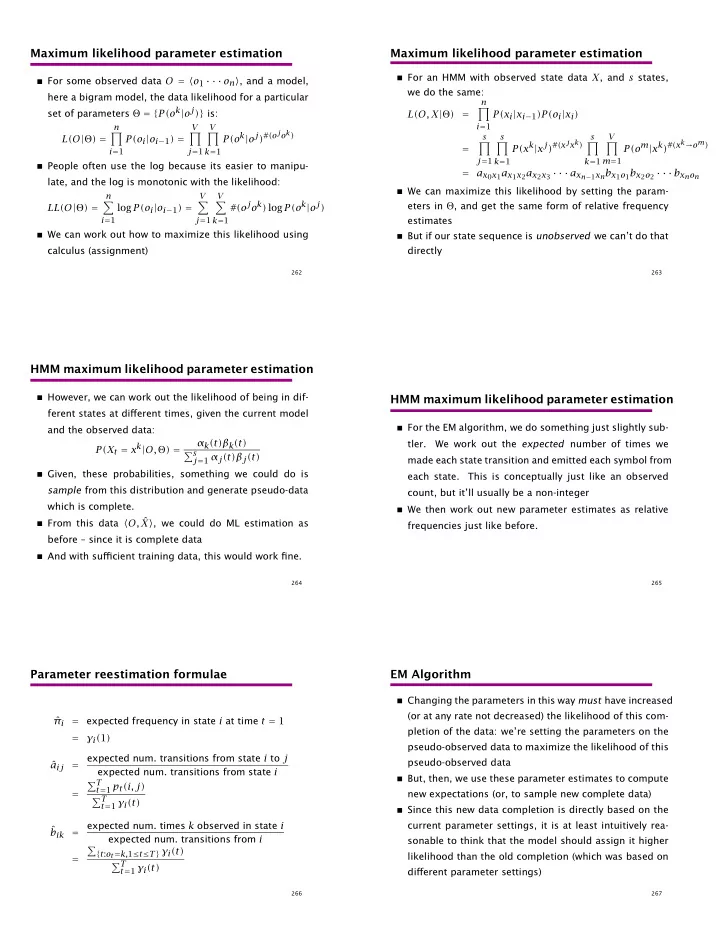
For some observed data O = o1 · · · on, and a model,
here a bigram model, the data likelihood for a particular set of parameters Θ = {P(ok|oj)} is: L(O|Θ) =
n
- i=1
P(oi|oi−1) =
V
- j=1
V
- k=1
P(ok|oj)#(ojok)
People often use the log because its easier to manipu-
late, and the log is monotonic with the likelihood: LL(O|Θ) =
n
- i=1
log P(oi|oi−1) =
V
- j=1
V
- k=1
#(ojok) log P(ok|oj)
We can work out how to maximize this likelihood using
calculus (assignment)
262
Maximum likelihood parameter estimation
For an HMM with observed state data X, and s states,
we do the same: L(O, X|Θ) =
n
- i=1
P(xi|xi−1)P(oi|xi) =
s
- j=1
s
- k=1
P(xk|xj)#(xjxk)
s
- k=1
V
- m=1
P(om|xk)#(xk→om) = ax0x1ax1x2ax2x3 · · · axn−1xnbx1o1bx2o2 · · · bxnon
We can maximize this likelihood by setting the param-
eters in Θ, and get the same form of relative frequency estimates
But if our state sequence is unobserved we can’t do that
directly
263
HMM maximum likelihood parameter estimation
However, we can work out the likelihood of being in dif-
ferent states at different times, given the current model and the observed data: P(Xt = xk|O, Θ) = αk(t)βk(t) s
j=1 αj(t)βj(t) Given, these probabilities, something we could do is
sample from this distribution and generate pseudo-data which is complete.
From this data O, ˆ
X, we could do ML estimation as before – since it is complete data
And with sufficient training data, this would work fine.
264
HMM maximum likelihood parameter estimation
For the EM algorithm, we do something just slightly sub-
tler. We work out the expected number of times we made each state transition and emitted each symbol from each state. This is conceptually just like an observed count, but it’ll usually be a non-integer
We then work out new parameter estimates as relative
frequencies just like before.
265
Parameter reestimation formulae
ˆ πi = expected frequency in state i at time t = 1 = γi(1) ˆ aij = expected num. transitions from state i to j expected num. transitions from state i = T
t=1 pt(i, j)
T
t=1 γi(t)
ˆ bik = expected num. times k observed in state i expected num. transitions from i =
- {t:ot=k,1≤t≤T} γi(t)
T
t=1 γi(t)
266
EM Algorithm
Changing the parameters in this way must have increased
(or at any rate not decreased) the likelihood of this com- pletion of the data: we’re setting the parameters on the pseudo-observed data to maximize the likelihood of this pseudo-observed data
But, then, we use these parameter estimates to compute
new expectations (or, to sample new complete data)
Since this new data completion is directly based on the
current parameter settings, it is at least intuitively rea- sonable to think that the model should assign it higher likelihood than the old completion (which was based on different parameter settings)
267