Mbone Jitter Characteristics Media Repair Taxonomy Media Repair - - PDF document

mbone jitter characteristics media repair taxonomy
SMART_READER_LITE
LIVE PREVIEW

Mbone Jitter Characteristics Media Repair Taxonomy Media Repair - - PDF document

Overview A Survey of Packet-Loss Recovery Techniques Colin Perkins, Orion Hodson and Vicky Hardman Department of Computer Science University College London (UCL) Development of IP Multicast London, UK Light-weight session


slide-1
SLIDE 1

1

A Survey of Packet-Loss Recovery Techniques

Colin Perkins, Orion Hodson and Vicky Hardman Department of Computer Science University College London (UCL) London, UK

IEEE Network Magazine Sep/Oct, 1998

Overview

  • Development of IP Multicast
  • “Light-weight session”

– Scale to 1000’s of participants

  • How to handle packet loss?

– Repair

Overview

  • This paper:

– Loss characteristics of Mbone – Techniques to repair loss in a ‘light-weight’ manner

+ Concentrate on audio

– Recommendations

  • Other papers:

– Fully-reliable (every bit must arrive), but not real- time – Real-time, but not receiver based approaches

Outline

  • Overview
  • Multicast Channel Characteristics
  • Sender Based Repair
  • Receiver Based Repair
  • Recommendations

IP Multicast Characteristics

  • Group address

– Client receives to address – Sender sends to address, without client knowledge

  • Loosely coupled connections

– Not-two way (‘extension to’ UDP) – Makes it scalable – Allows clients to do local-repair

  • Multicast router shared with unicast traffic

– Can have high loss

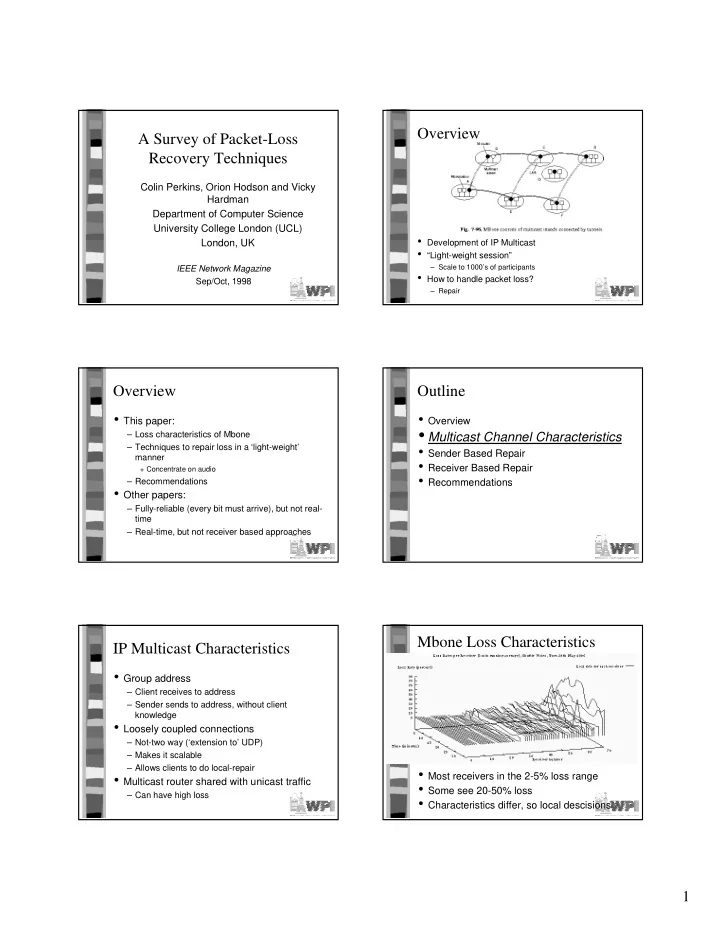
Mbone Loss Characteristics

  • Most receivers in the 2-5% loss range
  • Some see 20-50% loss
  • Characteristics differ, so local descisions
slide-2
SLIDE 2

2

Mbone Jitter Characteristics

  • High jitter

– If too late, will be discarded and look like loss

  • Interactive applications need low latency

– Influence repair scheme

Media Repair Taxonomy

Media Repair Sender Based Receiver Based

Sender Based Repair Taxonomy

  • Work from right to left
  • Unit of audio data vs. a packet

– Unit may be composed of several packets

Forward Error Correction (FEC)

  • Add data to stream
  • Use repair data to recover lost packets
  • Two classes:

– Media independent (not multimedia specific) – Media dependent (knowledge of audio or video)

Media Independent FEC

  • Given k data packets
  • Generate n-k check packets
  • Transmit n packets
  • Schemes originally for bits (like checksum)

– Applied to packets – So i’th bit of check packet, checks i’th bit of each associated packet

FEC Coding

XOR operation across all packets Transmit 1 parity packet every n data packets If 1 loss in n packets, can fully recover Reed-Solomon treat as polynomial

slide-3
SLIDE 3

3

Media Independent FEC Advantages and Disadvantages

  • Advantages

– Media independent

+ Audio, video, different compression schemes

– Computation is small and easy to implement

  • Disadvantages

– Add delay (repair wait for all n packets) – Add bandwidth (causing more loss?) – Add decoder complexity

Sender Based Repair Taxonomy Media Specific FEC

  • Multiple copies of data
  • Quality of secondary frames?

Media Specific FEC Secondary Frame

  • Send packet energy and zero crossing rate

– 2 numbers, so small – Interpolate from missing packet – Coarse, effective for small loss

  • Low bit-rate encoded version of primary

– Lower number of sample bits audio sample, say

  • Full-version of secondary

– Effective if primary is small (low bandwidth)

Media Specific FEC Discussion

  • Typical overhead 20-30% for low-quality

– [HSK98]

  • Media specific FEC can repair various

amounts by trading off quality of repair

– Media independent FEC has fixed number of bits for certain amount of repair

  • Can have adaptive FEC

– When speech changes (cannot interpolate) – Add when increase in loss [PCM00] – Delay more than 1 packet when bursty loss

Media Specific FEC Advantages and Disadvantages

  • Advantages

– Low latency

+ Only wait a single packet to repair + Multiple if adapted to bursty losses

– Can have less bandwidth than independent FEC

  • Disadvantages

– Computation may be more difficult implement – Still add bandwidth – Add decoder complexity – Lower quality

slide-4
SLIDE 4

4

Sender Based Repair Taxonomy Interleaving

  • Disperse the effects of packet loss
  • Many audio tools send 1 phoneme (40 ms of sound)

Interleaving Advantages and Disadvantages

  • Advantages

– Most audio compression schemes can do interleaving without additional complexity – No extra bandwidth added

  • Disadvantages

– Delay of interleaving factor in packets

+ Even when not repairing!

Sender Based Repair Taxonomy Retransmission

  • If delays less than 250 ms, can do

retransmission (LAN, faster Internet)

  • Scalable Reliable Multicast (SRM)

– Hosts time-out based on distance from sender

+ To avoid implosion

– Mcast repair request to all – All hosts can reply (timers again stop implosion)

Retransmission Discussion

  • In a typical multicast session, can have every

packet usually lost by some receiver

– Will always retransmit at least once – FEC may save bandwidth

  • Typically, crossover point to FEC based on

loss rate

  • Some participants may not be interactive

– Use retransmission – Others use FEC

slide-5
SLIDE 5

5

Retransmission Advantages and Disadvantages

  • Advantages

– Well understood – Only add additional data ‘as needed’

  • Disadvantages

– Potentially large delay

+ not usually suitable for interactive applications

– Large jitter (different for different receivers) – Implosion (setting timers difficult)

Media Repair Taxonomy

  • Do not require assistance of Sender

– Receiver recover as best it can

  • Often called Error Concealment
  • Work well for small loss (<15%), small

packets (4-40 ms)

  • Not a substitute for sender-based

– Rather use both – Receiver based can conceal what is less

Media Repair Sender Based Receiver Based

Taxonomy of Error Concealment

  • When packet is lost, replace with fill-in

Splicing

  • Splice together stream on either side

– Do not preserve timing

  • Advantage

– “Easy, peasy smudge” – Works ok for short packets of 4-16 ms

  • Disadvantage

– Crappy for losses above 3% – Interfere with delay buffering

Silence Substitution

  • Fill the gap left by lost packet with silence

– Preserve timing

  • Advantage

– Still easy, peasy smudge – Works good for low loss (< 2%) – Works ok for short packets of 4-16 ms

  • Disadvantage

– Crappy for higher losses (3%+) – Ineffective with 40ms packets (typical)

Noise Substitution

  • Human psych says can repair if sound, not

silence (phonemic restoration)

– Replace lost packet with “white noise”

+ Like static on radio

– Still preserve timing

  • Similar to silence substitution
  • Sender can have “comfort noise” so receiver

gets white-noise volume right

slide-6
SLIDE 6

6

Repetition

  • Replace missing packet with previous packet
  • Can “fade” if multiple repeats over time

– Decrease signal amplitude to 0

  • Still pretty easy, but can work better
  • A step towards interpolation techniques (next)

Taxonomy of Error Concealment

  • When packet is lost, reproduce a packet based
  • n surrounding packets.

Interpolation Based Repair

  • Waveform substitution

– Use waveform repetition from both sides of loss – Works better than repetition (that uses one side)

  • Pitch waveform replication

– Use repetition during unvoiced speech and use additional pitch length during voiced speech – Performs marginally better than waveform

  • Time scale modifications

– “Stretch” the audio signal across the gap – Generate a new waveform that smoothly blends across loss – Computationally heavier, but performs marginally better than others

Taxonomy of Error Concealment

  • Use knowledge of audio compression to derive

codec parameters

Regeneration Based Repair

  • Interpolation of transmitted state

– State-based decoding can then interpret what state codec should be in – Reduces boundary-effects – Typically high processing

  • Model-Based recovery

– Regenerate ‘speech’ to fit with speech on either side

Summary of Receiver Based Repair

  • Quality increase decreases at high complexity
  • Repetition is at ‘knee’ in curve
slide-7
SLIDE 7

7

Original Loss Repetition Wave Substitution (Boundaries better) (Both bad at C)

Groupwork

  • Consider:

– Interactive voice from Europe to U.S. – Multicast broadcast video of taped lecture – Multicast replicated database update – Interactive voice across city

  • Choose a repair technique and why:

– Interleaving – Retransmission – Media Specific FEC – Media Independent FEC

Recommendations: Non- Interactive Applications

  • Latency less important
  • Bandwidth a concern (mcast has various

bwidth)

  • ! use interleaving
  • ! repetition for concealment
  • Retransmission does not scale

– Ok for unicast

  • Media independent FEC may be ok

Recommendations: Interactive Applications

  • Want to minimize delay

– ! Interleaving delay is large – ! retransmission delay can be large – ! media independent FEC usually large

+ (Or computationally expensive)

  • Use media specific FEC

– Approximate repair ok

Recommendations: Error Concealment

  • Will be some residual error at receiver
  • Silence substitution not acceptable

!Use packet repetition !Others can be used, but more costly and not

necessarily worthwhile

Evaluation of Science?

  • Category of Paper
  • Science Evaluation (1-10)?
  • Space devoted to Experiments?