MEASURED VISUALIZATIONS of the CAMBIE CORRIDOR PLAN Council - - PowerPoint PPT Presentation

measured visualizations
SMART_READER_LITE
LIVE PREVIEW

MEASURED VISUALIZATIONS of the CAMBIE CORRIDOR PLAN Council - - PowerPoint PPT Presentation

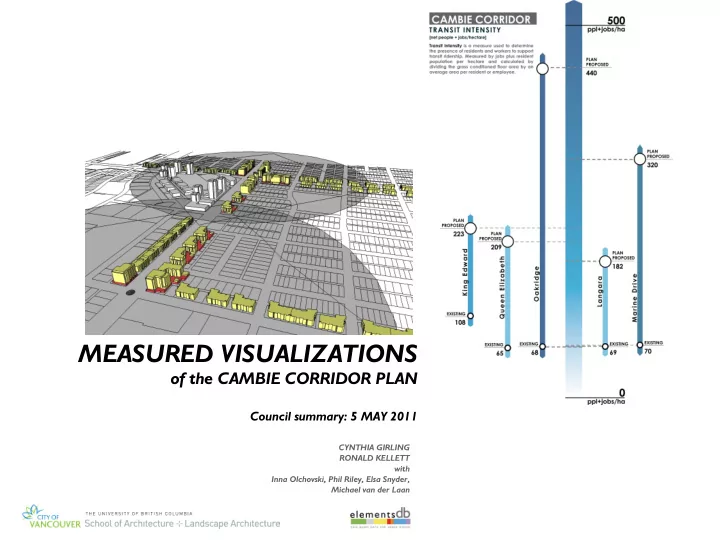
MEASURED VISUALIZATIONS of the CAMBIE CORRIDOR PLAN Council summary: 5 MAY 2011 CYNTHIA GIRLING RONALD KELLETT with Inna Olchovski, Phil Riley, Elsa Snyder, Michael van der Laan We create tools and methods to inform urban planning

slide-1
SLIDE 1

MEASURED VISUALIZATIONS

  • f the CAMBIE CORRIDOR PLAN

Council summary: 5 MAY 2011

CYNTHIA GIRLING RONALD KELLETT with Inna Olchovski, Phil Riley, Elsa Snyder, Michael van der Laan

slide-2
SLIDE 2

We create tools and methods to inform urban planning processes

slide-3
SLIDE 3

highrise midrise

lowrise

attached detached

mixed use 4storey 2.33far 250uph 65people / 35jobs 90%impervious 2.13GWh/ha

words + images + numbers which can be . . .

are (mostly)built from familiar, replicable, measurable components that can be translated as . . .

Cities . . .

“Tribeca” at 11th and Arbutus

slide-4
SLIDE 4

parcels blocks

To simulate the appearance of planning and design alternatives

. . . aggregated and . . .

neighbourhoods

slide-5
SLIDE 5

. . . measured

To generate evidence of performance

slide-6
SLIDE 6

KEY QUESTIONS

Cambie Corridor: contemplated land use/building heights City of Vancouver Planning, May 2010

1.How much land use intensification ? 2.How distributed ? 3.How supportive of transit ? 4.How supportive of community energy ?

slide-7
SLIDE 7

Case-based modeling

Oakridge - Langara, for example Equivalent Vancouver cases May 2010 sketch

slide-8
SLIDE 8

ON CORRIDOR areas Case-based new buildings + Census + BCAA UNIQUE areas Census + BCAA + project proposals OFF CORRIDOR areas Census + BCAA

measuring . . .

All corridor study areas EXCEPTIONS Large ‘to be developed’ parcels not included

slide-9
SLIDE 9

MIXED USE CASES RESIDENTIAL CASES OAKRIDGE Mall

Oakridge Policy Document 3 dwellings per parcel average

measuring . . .

Oakridge-Langara, for example

1 On-corridor areas 3 Off-corridor areas

Unique areas 2 WITHIN 500m + data

slide-10
SLIDE 10

reporting results . . .

Reference points

  • r benchmarks

Existing condition in pictures and numbers Proposed condition in pictures and numbers Relative change to study area

Built 3-d model of the corridor from 16th to Marine Drive Calculated land use intensification, population and job change and thermal energy intensity for each block Aggregated block results by ‘study area’ and ‘whole corridor’

by study area

slide-11
SLIDE 11

by study area . . .

by whole corridor . . .

Reference points

  • r benchmarks

Existing condition in pictures and numbers Proposed condition in pictures and numbers Relative change to study area Whole corridor reference scale

slide-12
SLIDE 12

1.How much land use intensification ? 2.How distributed ?

slide-13
SLIDE 13

Dwelling intensity

measures residential land use intensity in net units per hectare(estimated number of dwelling units divided by land area exclusive of street rights of way)

All study areas more than doubled dwelling density Most roughly equal to Joyce-Collingwood Oakridge intensifies the most (7.3x) King Edward and Marine Drive** intensify the least (<2.5x) ~ Joyce - Collingwood

*Langara excludes significant pending off- corridor development ** Marine Drive study area includes significant non-residential land uses

slide-14
SLIDE 14

Floor space intensity

measures development intensity in average FAR (estimated conditioned floor area divided by parcel area — only on corridor parcels)

All study areas more than doubled floor area intensity (FAR) Marine Drive intensifies the most (9.3x) King Edward intensifies the least (2.3x)

slide-15
SLIDE 15
  • 3. How supportive of transit ?

KEY FACTORS: Density (ridership potential) Distance (pedestrian accessibility) Diversity (destination / origin balance) Design (vitality, livability)

slide-16
SLIDE 16

Transit intensity

measures the number of residents and jobs (estimated population and jobs within 500m of Cambie)

All study areas achieve neighbourhood TOD threshold within 500m Greatest concentration and closest jobs / housing balance at key nodes — Oakridge and Marine Drive ~ 150 p+j/ha lower range threshold at ~30% mode split neighbourhood TOD ~ 250 p+j/ha mid-range threshold urban TOD

slide-17
SLIDE 17
  • 4. How supportive of community energy ?

KEY FACTORS: Land use intensity (load potential) Land use diversity (load balance) Proximity (distribution efficacy) Building type and scale (connection efficacy)

slide-18
SLIDE 18

Thermal energy intensity

was benchmarked against local examples actual feasibility requires site-specific analysis Dockside Green ~1.75 GWh/ha/year SEFC ~3.00 GWh/ha/year

slide-19
SLIDE 19

Thermal energy intensity

measures heat energy density (space heating and hot water per hectare) — an indicator of community energy system potential

Dockside Green ~1.75 GWh/ha/year SEFC ~3.00 GWh/ha/year Langara study area achieves thermal energy density of SEFC All study areas achieve thermal energy density of Dockside Green

slide-20
SLIDE 20

MEASURED VISUALIZATIONS

  • f the CAMBIE CORRIDOR PLAN

Council summary: 5 MAY 2011

CYNTHIA GIRLING RONALD KELLETT with Inna Olchovski, Phil Riley, Elsa Snyder, Michael van der Laan