Measurement of Free Volume in Polyethylene Terephthalate Using - - PDF document

measurement of free volume in polyethylene terephthalate
SMART_READER_LITE
LIVE PREVIEW

Measurement of Free Volume in Polyethylene Terephthalate Using - - PDF document

Transactions of the Korean Nuclear Society Virtual Spring Meeting July 9-10, 2020 Measurement of Free Volume in Polyethylene Terephthalate Using Positron Annihilation Lifetime Spectroscopy Chaewon Lee a, b , Wonjin Kim a, b , Jaegi Lee a * ,


slide-1
SLIDE 1

Measurement of Free Volume in Polyethylene Terephthalate Using Positron Annihilation Lifetime Spectroscopy

Chaewon Lee a, b, Wonjin Kim a, b, Jaegi Lee a*, Young Rang Uhm a, Gwang-Min Sun a

aKorea Atomic Energy Research Institute, Daejeon, Republic of Korea, 34057 bDepartment of NanoPhysics, Gachon University, 1342 Seongnamdaero, Sujeong-gu, Seongnam-si, Gyeonggi-do,

Republic of Korea, 21936 Corresponding author: jgl@kaeri.re.kr

  • 1. Introduction

Positrons annihilate with electrons in materials, and emit pairs of gamma-rays. Positron annihilation spectroscopy (PAS) is sensitive to detect defects in metals or semiconductors, and widely used to calculate the free volume of polymers. Among several PAS methods, positron annihilation lifetime spectroscopy (PALS) measures the size and amount of defects or free volume by measuring the time difference between gamma-ray from positron generating isotope and annihilation gamma-ray. Positrons injecting into the materials form positronium (Ps) with electrons. It has previously been reported that Ps can be classified into p-Ps (antiparallel spins, para positronium) and o-Ps (parallel spins, ortho positronium) depending on the electron and positron spin [1]. p-Ps has a short lifetime

  • f τ ≈ 0.125 ns. o-Ps disappears with peripheral electrons

belonging to pick-off annihilation, emits gamma-rays, and has a lifetime component of τ ≈ 1~5 ns. According to Buttafava et al. [2], correlation between the size of the free volume and the lifetime of o-Ps can be modeled and expressed quantitatively. In this study, we determined the lifetime component of o-Ps and analyzed the tendency of the free volume with the change of the thickness of polyethylene terephthalate (PET).

  • 2. Materials and Methods

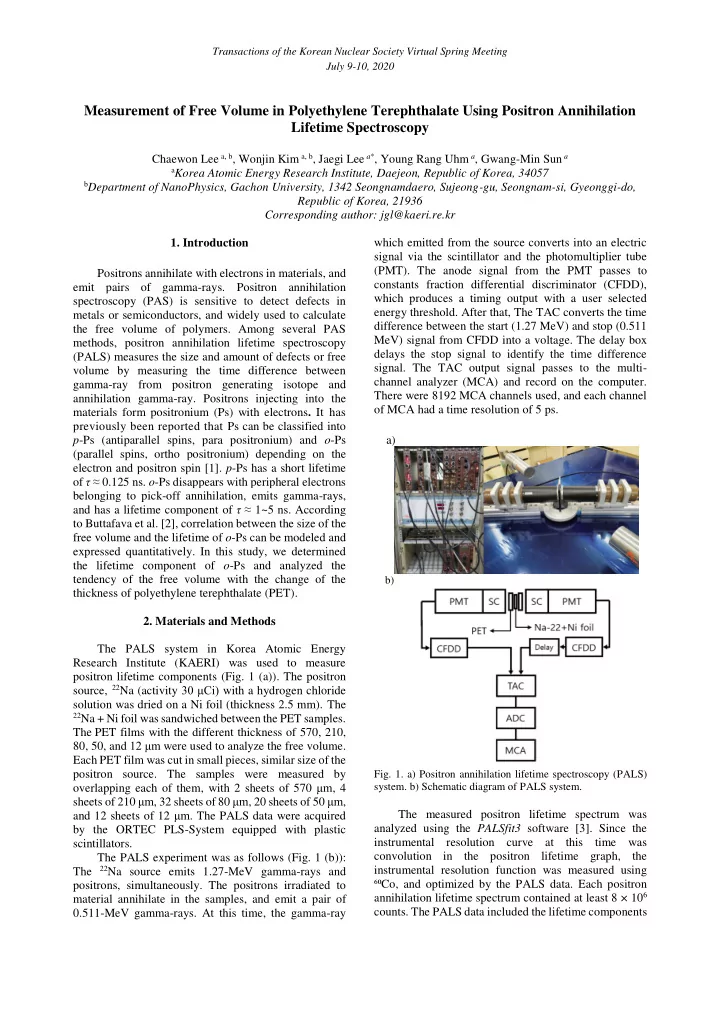
The PALS system in Korea Atomic Energy Research Institute (KAERI) was used to measure positron lifetime components (Fig. 1 (a)). The positron source, 22Na (activity 30 μCi) with a hydrogen chloride solution was dried on a Ni foil (thickness 2.5 mm). The

22Na + Ni foil was sandwiched between the PET samples.

The PET films with the different thickness of 570, 210, 80, 50, and 12 μm were used to analyze the free volume. Each PET film was cut in small pieces, similar size of the positron source. The samples were measured by

  • verlapping each of them, with 2 sheets of 570 μm, 4

sheets of 210 μm, 32 sheets of 80 μm, 20 sheets of 50 μm, and 12 sheets of 12 μm. The PALS data were acquired by the ORTEC PLS-System equipped with plastic scintillators. The PALS experiment was as follows (Fig. 1 (b)): The 22Na source emits 1.27-MeV gamma-rays and positrons, simultaneously. The positrons irradiated to material annihilate in the samples, and emit a pair of 0.511-MeV gamma-rays. At this time, the gamma-ray which emitted from the source converts into an electric signal via the scintillator and the photomultiplier tube (PMT). The anode signal from the PMT passes to constants fraction differential discriminator (CFDD), which produces a timing output with a user selected energy threshold. After that, The TAC converts the time difference between the start (1.27 MeV) and stop (0.511 MeV) signal from CFDD into a voltage. The delay box delays the stop signal to identify the time difference

  • signal. The TAC output signal passes to the multi-

channel analyzer (MCA) and record on the computer. There were 8192 MCA channels used, and each channel

  • f MCA had a time resolution of 5 ps.

a)

b)

  • Fig. 1. a) Positron annihilation lifetime spectroscopy (PALS)
  • system. b) Schematic diagram of PALS system.

The measured positron lifetime spectrum was analyzed using the PALSfit3 software [3]. Since the instrumental resolution curve at this time was convolution in the positron lifetime graph, the instrumental resolution function was measured using ⁶⁰Co, and optimized by the PALS data. Each positron annihilation lifetime spectrum contained at least 8 × 10⁶

  • counts. The PALS data included the lifetime components

Transactions of the Korean Nuclear Society Virtual Spring Meeting July 9-10, 2020

slide-2
SLIDE 2

from the source supporting foil so that it needed a source

  • correction. Based on the past data, 8.6% of the lifetime
  • f the foil were removed [4]. We optimized the time-zero

value by shifting one channel until p-Ps lifetime became the theoretical value of 0.125 ns.

  • 3. Results
  • Fig. 2 shows each positron annihilation lifetime

spectrum was unfolded into a total of four lifetime

  • components. The shortest lifetime component emerged

from the disappearance of p-Ps. The second lifetime component was considered to be free positron lifetime

  • component. The third and longest lifetime components

came from o-Ps decay in the crystalline and amorphous regions, respectively.

  • Fig. 2. A positron lifetime spectrum of a PET sample with a

thickness of 570 μm. The x-axis of both graphs are channel

  • number. The y-axis of the above graph is count in log scale.

The below graph is residual plot.

According to the data listed in Table. 1, the value of τ₄ increased as the thickness of the measured sample decreased, and I₄ tended to decrease.

Table 1. Lifetime and intensity of ortho-positronium (τ4, I4) of PET samples

Thickness (μm) τ₄ (ns) I₄ (%) Sample #1 570 1.74 ± 0.02 18.3 ± 0.7 Sample #2 210 1.73 ± 0.01 17.6 ± 0.2 Sample #3 80 1.77 ± 0.02 16.1 ± 0.4 Sample #4 50 1.80 ± 0.03 15.9 ± 0.7 Sample #5 50 1.79 ± 0.01 14.9 ± 0.2 Sample #6 12 1.82 ± 0.02 10.6 ± 0.2 Sample #7 12 1.83 ± 0.02 10.4 ± 0.2

These data could be transformed into the radius of the free volume using the Tao-Eldrup equation [2]. The formula considered the distance between the positron and the dissipating electron in the pick-off annihilation as the radius of the defect (R). Ps trap had a finite depth

  • f a potential well, however, we assumed it had an

infinite depth for convenience. The radius of free volume increased to R + ΔR (electron layer thickness, ΔR = 1.66 Å). The relational expression between R and τ₄ was as follows:

𝜐4 = 0.5 × [1 −

R R+Δ𝑆 + 1 2𝜌 sin ( 2𝜌R 𝑆+Δ𝑆)] −1

. (1)

Table 2. Radius of free volume in Polyethylene Terephthalate (PET) samples (R) calculated by the Tao-Eldrup model [2].

Thickness (μm) R (Å) Sample #1 570 2.58-2.62 Sample #2 210 2.58-2.59 Sample #3 80 2.61-2.65 Sample #4 50 2.63-2.68 Sample #5 50 2.64-2.66 Sample #6 12 2.66-2.70 Sample #7 12 2.67-2.71

As a result of calculating the radius of free volume (Table. 2), the difference between the thickest and thinnest samples was only 0.09 Å so that the range of PET thickness in this study did not significantly change the permeability of light atoms.

  • 4. Conclusions

PALS could distinguish the positron annihilation lifetime components in the PET films. By analyzing the longest lifetime component, the radius of the free volume could be obtained. In this paper, the thickness of the PET samples did not bring significant change in the size of the free volume. The radius of the free volume of the PET films was 2.64 Å on average. Acknowledgement We would like to thank to Toray Advanced Materials Korea Inc. for providing PET samples. This work was supported by the National Research Foundation of Korea (NRF) Grant funded by the Korea government (MSIT) (NRF-2017M2A2A6A05018529). REFERENCES

[1] M.D Harpen, Positronium: Review of symmetry, conserved quantities and decay for the radiological physicist.

  • Med. Phys., 31: 57-61, 2004

[2] A. Buttafava, G. Consolati, L. Di Landro, M. Mariani, γ- Irradiation effects on polyethylene terephthalate studied by positron annihilation lifetime spectroscopy, Polymer, Volume 43, Issue 26, ISSN 0032-3861, p.7477-4781, 2002 Transactions of the Korean Nuclear Society Virtual Spring Meeting July 9-10, 2020

slide-3
SLIDE 3

[3] P. Kirkegaard, J. V. Olsen, M. Eldrup, PALSfit3: A Software Package for Analysing Positron Lifetime Spectra, 2017 [4] M. Bertolaccini, L. Zappa, Source-supporting foil effect on the shape of positron time annihilation spectra. Nuovo Cimento B (1965-1970) 52, p. 487–494, 1967. Transactions of the Korean Nuclear Society Virtual Spring Meeting July 9-10, 2020