Measurement of SM Higgs boson couplings to bottom and top quarks - - PowerPoint PPT Presentation

measurement of sm higgs boson couplings to bottom and top
SMART_READER_LITE
LIVE PREVIEW

Measurement of SM Higgs boson couplings to bottom and top quarks - - PowerPoint PPT Presentation

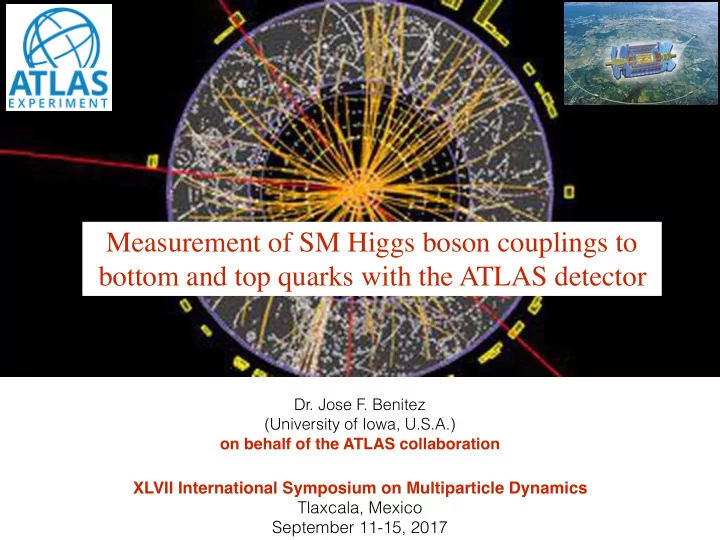
Measurement of SM Higgs boson couplings to bottom and top quarks with the ATLAS detector Dr. Jose F. Benitez (University of Iowa, U.S.A.) on behalf of the ATLAS collaboration XLVII International Symposium on Multiparticle Dynamics Tlaxcala,


slide-1
SLIDE 1
  • Dr. Jose F. Benitez

(University of Iowa, U.S.A.)

  • n behalf of the ATLAS collaboration

XLVII International Symposium on Multiparticle Dynamics Tlaxcala, Mexico September 11-15, 2017

Measurement of SM Higgs boson couplings to bottom and top quarks with the ATLAS detector

slide-2
SLIDE 2

Higgs couplings to bottom and top quarks, J. F. Benitez (ATLAS)

Introduction

  • The Higgs boson has been discovered in

decays to vector bosons (γγ,ZZ*,WW*).

  • Direct couplings to quarks are not yet
  • bserved.
  • The couplings should increase with the

mass of the quarks, making the bottom and top couplings the largest.

  • The b-H coupling is measured from VH

(V=W,Z) production and H→bb decays

  • The t-H coupling is measured in ttH

production combining several decay channels.

2

ZZ* γγ

Higgs “golden” channels

slide-3
SLIDE 3

Higgs couplings to bottom and top quarks, J. F. Benitez (ATLAS)

The LHC and ATLAS

  • The LHC Run II started in 2015 with an increased intensity delivering now about 40 proton

interactions per bunch crossing. The total delivered luminosity more than doubled the Run I amount.

3

ATLAS

~33 fb-1 ~3 fb-1 ~20 fb-1

slide-4
SLIDE 4

H→bb searches

4

slide-5
SLIDE 5

Higgs couplings to bottom and top quarks, J. F. Benitez (ATLAS)

VH(bb) analysis strategy

  • This search exploits a clean signature of leptons in the final state: large missing energy

(Z→vv), one isolated lepton (W→lv), or two isolated leptons (Z→ll)

  • At least two jets with pT>20 GeV are required in the central region and used for Higgs

reconstruction

5

Event recorded by ATLAS with one isolated electron and two b-tagged jets.

0-lepton channel 1-lepton channel 2-lepton channel

[arXiv:1708:03299]

slide-6
SLIDE 6

Higgs couplings to bottom and top quarks, J. F. Benitez (ATLAS)

VH(bb) MVA analysis

  • A multivariate discriminator (BDT) is trained using several event

variables, including m(bb), to score events depending how signal- like they are.

6

BDT response on simulation

background signal

slide-7
SLIDE 7

Higgs couplings to bottom and top quarks, J. F. Benitez (ATLAS)

m(bb) distributions

  • The signal contribution is small compared to the background from W/Z + jets

and t-t processes.

  • The observed data distributions are well modeled by the simulation of the

backgrounds.

7

0-lepton 1-lepton 2-lepton

[arXiv:1708:03299]

slide-8
SLIDE 8

Higgs couplings to bottom and top quarks, J. F. Benitez (ATLAS)

VH(bb) search results

  • A fit including all backgrounds is performed on the BDT distributions. The different colors

show the contributions from different backgrounds, mainly W/Z+jets and tt.

  • The data is in good agreement with the background plus signal model. A small excess of

signal-like events with a strength of μ=1.2 is observed, where μ is the ratio of the observed

  • ver the predicted SM rate.

8

0-lepton 1-lepton 2-lepton

[arXiv:1708:03299]

slide-9
SLIDE 9

Higgs couplings to bottom and top quarks, J. F. Benitez (ATLAS)

VH(bb) search results

  • To better observe the excess of events we combine all regions according to their log(S/B)

value (left plot below).

  • A cut-based analysis is also perfomed as a cross-check. The m(bb) distribution after

subtracting the background is shown in the right plot below.

9

[arXiv:1708:03299]

The red distribution is the excess above the background consistent with a Higgs

  • f mass 125 GeV.
slide-10
SLIDE 10

Higgs couplings to bottom and top quarks, J. F. Benitez (ATLAS)

VH(bb) signal strength

  • Signal strengths in each channel can be determiend from a fit with multiple floating

normalization parameters then a combined fit is also performed.

  • μVH is defined as the ratio of the observed signal strength over the expected SM prediction.

10

[arXiv:1708:03299]

The signal strength in all channels and the combination is within the expected value for the SM.

  • The data is compatible with the

background-only hypothesis with a probability of only 1.9x10⁻⁴. The excess has a significance of 3.5 sigma.

  • This is the first evidence at the LHC

for the Higgs-quark couplings.

slide-11
SLIDE 11

Higgs couplings to bottom and top quarks, J. F. Benitez (ATLAS)

VH(bb) combination: Run I+Run II

  • The 13 TeV results are combined with previous searches

using the 7 and 8 TeV data.

11

[arXiv:1708:03299]

  • The different data-sets are

compatible with 20% probability.

  • The result for the combined

signal strength is within the SM expected value.

  • We observe an excess with 3.6

sigma, driven by the new 13 TeV data.

slide-12
SLIDE 12

Higgs couplings to bottom and top quarks, J. F. Benitez (ATLAS)

VBF, H→bb

  • The search in the VBF production

mode requires 4 jets with pT>50 GeV.

  • The two forward jets are identified as

the VBF jets and the two central jets as the Higgs decay.

12

IV III I II

  • A multivariate algorithm (BDT) is used to

discriminate background using the measured Higgs and VBF candidate jet information.

  • Regions in the BDT discriminator are

separated based on the signal purity.

  • Contribution from ggF process is about 10%

in the IV region after full selection.

[JHEP11(2016)112]

slide-13
SLIDE 13

Higgs couplings to bottom and top quarks, J. F. Benitez (ATLAS)

VBF, H→bb results

  • The data are consistent with background events mainly from

QCD multijet processes.

  • An upper limit of 4.4 on the cross section for this process

with respect to the SM cross section is set at 95% CL.

13

[JHEP11(2016)112]

slide-14
SLIDE 14

Higgs couplings to bottom and top quarks, J. F. Benitez (ATLAS)

VBF+γ, H→bb results

  • The data are consistent with background-
  • nly hypothesis.
  • An upper limit of 4.0 with respect to the

SM predicted rate is placed at 95% CL

14

[ATLAS-CONF-2016-063]

  • A photon with pT>30 GeV and 4 jets with pT>40

GeV are required. Two central b-tagged jets are identified as the Higgs.

  • The energetic photon enables an efficient trigger

and leads to about one order of magnitude reduction in the non-resonant bb production compared to the inclusive VBF production.

slide-15
SLIDE 15

ttH searches

15

search modes:

  • H→bb
  • H→γγ
  • H→multilepton
slide-16
SLIDE 16

Higgs couplings to bottom and top quarks, J. F. Benitez (ATLAS)

ttH, H→bb

  • Events with one lepton or two leptons are selected
  • Exclusive regions are defined according to the number of leptons, jets, and b-tagged jets
  • # of jets: 4, 5, or >=6 (1-lepton), 3 or >= 4 (dilepton)
  • # of b-jets : 2 , 3 , >=4

16

ATLAS-CONF-2016-080

➝ W+b ➝ l+vb

signal background

➝ W-b➝ l-vb or qq’b

dilepton channel single lepton channel

13.2 fb-1

slide-17
SLIDE 17

Higgs couplings to bottom and top quarks, J. F. Benitez (ATLAS)

ttH, H→bb results

17

ATLAS-CONF-2016-080

  • A two-step multivariate

approach uses BDT’s

  • to reconstruct ttH event, and
  • to classify each event as

signal-like.

  • The observed signal strength 


μttH = 2.1 +1.0/-0.9
 is consistent with both background-only and background+signal hypotheses.

13.2 fb-1

slide-18
SLIDE 18

Higgs couplings to bottom and top quarks, J. F. Benitez (ATLAS)

ttH, H→γγ

  • The search is performed by requiring two isolated

photons with ET/mγγ>0.35 (0.25) for the leading (sub- leading) photon, driven by the trigger selection.

  • Events are categorized into events with leptons

(>=1 e or μ) or fully hadronic (>=3 jets).

  • In both cases, at least 1 b-jet is required. Fully

hadronic events are further categorized using BDT.

18

ATLAS-CONF-2017-045

36.1 fb-1

➝ W- b➝ l- vb ➝ qq’b ➝ W+b➝ l+vb ➝ qq’b

  • The observed signal strength is consistent

with both a background-only and a background+signal hypothesis 
 μttH = 0.5 +/-0.6

slide-19
SLIDE 19

Higgs couplings to bottom and top quarks, J. F. Benitez (ATLAS)

ttH, H→multilepton

  • The search targets the decays of the Higgs

boson to W bosons or tau leptons. In addition to the leptons, at least one b-tagged jet is required in the event.

  • Most categories are dominated by WW*, except

the 2l1τhad where ττ is of same size. The ZZ* channel contributes only a few %.

19

→WW*,τ+τ-,ΖΖ*

ATLAS-CONF-2016-058

  • The best-fit signal strength is consistent with

the SM expectation:
 μttH = 2.5 +1.3/-1.1

slide-20
SLIDE 20

Higgs couplings to bottom and top quarks, J. F. Benitez (ATLAS)

ttH combination results

  • The combined ttH signal strength is found to be consistent with the SM prediction

μttH = 1.8 +/- 0.7 and corresponds to a significance of 2.8σ .

  • The current combination uses only ~13 fb-1 of 36 fb-1 available.

20

ATLAS-CONF-2016-058

13.2 fb-1

slide-21
SLIDE 21

Higgs couplings to bottom and top quarks, J. F. Benitez (ATLAS)

Summary

  • The coupling of the Higgs to the quark sector is an

important part of the ATLAS program. The couplings to heavy quarks (top and bottom) are the most viable due to their large masses and coupling values.

  • We observe for the first time in the LHC evidence for direct

decays of H to bb.

  • Direct searches for the t-H coupling have been performed

using the ttH process and several Higgs decay modes. The sensitivity in this search is close to 3 sigma and will improve after updating to the full data-set.

  • Current results are consistent with the SM expectations.
  • More precise measurements are expected with new Run II

data in the near future and will probe the Higgs-quark sector for possible New Physics.

21

Thanks.

bb