Medicaid Childrens Oral Health September 26, 2013 Todays - - PowerPoint PPT Presentation

medicaid children s oral health
SMART_READER_LITE
LIVE PREVIEW

Medicaid Childrens Oral Health September 26, 2013 Todays - - PowerPoint PPT Presentation

Think Teeth: New Developments in Medicaid Childrens Oral Health September 26, 2013 Todays Presentation Discuss the value of Medicaid and CHIP and their role in oral health outcomes Learn about new oral health research Highlight


slide-1
SLIDE 1

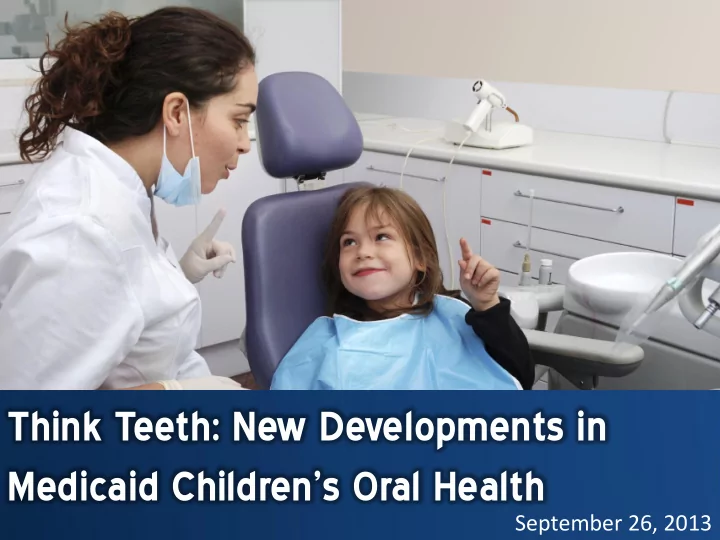
Think Teeth: New Developments in Medicaid Children’s Oral Health

September 26, 2013
slide-2
SLIDE 2

Today’s Presentation

  • Discuss the value of Medicaid and CHIP and

their role in oral health outcomes

  • Learn about new oral health research
  • Highlight CMS resources to help you share

key oral health messages with pregnant women and parents of young children

2

slide-3
SLIDE 3

Children’s Health Coverage: Moving in the Right Direction

  • Between 2008 and 2012, 1.7 million

children gained coverage, mainly through Medicaid and CHIP

  • Participation rate moved from 81.7% in

2008 to 87.2% in 2011

  • But there is still more work to do
  • Millions more children and teens are eligible but not

enrolled

Sources: HHS News Release http://www.hhs.gov/news/press/2013pres/07/20130702b.html Medicaid/CHIP Participation Among Children and Parents, 2012 http://www.urban.org/UploadedPDF/412719-Medicaid-CHIP-Participation-Among-Children-and-Parents.pdf

3

slide-4
SLIDE 4

Families Value Medicaid and CHIP

4

  • More than 90% of parents are satisfied with

their children’s coverage

  • Availability of dental care is a top factor

motivating enrollment

  • 68% of parents chose dental care as a top

reason for enrolling their child

  • 81% of Spanish-speaking parents chose

dental care as top reason

Source: Informing CHIP and Medicaid Outreach and Education. http://www.insurekidsnow.gov/professionals/CHIP-Medicaid-Survey-Topline.pdf

slide-5
SLIDE 5

Medicaid & CHIP Children’s Dental Benefits

  • Teeth cleanings
  • Check ups
  • X-rays
  • Fluoride treatments
  • Dental sealants
  • Fillings

5

slide-6
SLIDE 6

Steady Progress in Access to Dental Care

Changes in the Percentage of Children Ages 1–20 Covered by Medicaid and Receiving Dental Services, FY 2000–2010, National Averages

6

0.00% 5.00% 10.00% 15.00% 20.00% 25.00% 30.00% 35.00% 40.00% 45.00% 50.00% 2000 2001 2002 2003 2004 2005 2006 2007 2008 2009 2010 Any Dental Preventive Treatment

Source: Leighton Ku, et al., Increased Use of Dental Services by Children Covered by Medicaid: 2000- 2010, Medicare & Medicaid Research Review, Vol. 3, No. 3 (2013).

slide-7
SLIDE 7

CMS Children’s Oral Health Initiative

  • Goal #1 – Increase by 10 percentage points the proportion of

Medicaid and CHIP children ages 1 to 20 (enrolled for at least 90 days) who receive a preventive dental service.

  • Baseline year is FY 2011. National baseline is 42%.
  • Goal year is FY 2015. National goal is 52%.
  • Every state has its own baseline and goal.
  • Goal #2 – Increase by 10 percentage points the proportion of

Medicaid and CHIP children ages 6 to 9 (enrolled for at least 90 days) who receive a dental sealant on a permanent molar tooth.

  • Baselines and goals to be set soon.

7

slide-8
SLIDE 8

Percentage of children, age 1-20, enrolled in Medicaid for at least 90 days who received any preventive dental service, FY2011 (12b)

0.0% 10.0% 20.0% 30.0% 40.0% 50.0% 60.0% 70.0%

Vermont Connecticut Texas New Hampshire South Carolina Washington Massachusetts Colorado Alabama District of Columbia Maryland Illinois Idaho Georgia Utah Arkansas Virginia New Mexico Nebraska Louisiana Tennessee Arizona North Carolina Mississippi Oklahoma Delaware Ohio* South Dakota Kentucky New Jersey Alaska Rhode Island National West Virginia Hawaii Kansas Iowa Nevada Wyoming Oregon New York Minnesota California Michigan Pennsylvania Montana Missouri Maine Indiana North Dakota Wisconsin Florida

Source: FY 2011 CMS-416 reports, Line 1b, 12b Note: *FY 2011 data for Ohio are not yet available so FY 2010 data was substituted. Estimates for OH are included in the National figure for FY 2011.

slide-9
SLIDE 9

Dental Services for Children and Parents in the HUSKY Program: Utilization Continues to Increase Since Program Improvements in 2008

Mary Alice Lee, Ph.D.

Senior Policy Fellow Connecticut Voices for Children malee@ctvoices.org

http://www.ctvoices.org/sites/default/files/h13dentalcare11useincreasesfull.pdf

This report was prepared by Connecticut Voices for Children under a contract between the Department of Social Services and the Hartford Foundation for Public Giving, with data management and analyses by MAXIMUS, Inc.

9

slide-10
SLIDE 10

Connecticut’s HUSKY Program: Dental Services for Children and Parents

  • Connecticut’s Medicaid and CHIP programs cover

dental services for children and adults, including parents and pregnant women

  • Connecticut funds independent performance

monitoring in the HUSKY Program

  • Major program changes in 2008
  • Dental services: carved-out of managed care
  • Client and provider assistance: enhanced
  • Reimbursement for child services: increased

10

slide-11
SLIDE 11

Provider Reimbursement for Selected Dental Services

Procedure Fees for Children’s Services Fees for Adult Services

2005 2011 Increase 2005 2011 Increase

Periodic oral evaluation $18.80 $35.00 86% $10.34 $18.20 76% Limited evaluation-- problem $20.80 $48.00 131% $11.44 $24.96 118% Comprehensive oral evaluation $24.58 $65.00 164% $13.52 $33.80 150% Bitewings (2 views) $16.54 $32.00 94% $9.10 $16.64 83% Amalgam (1 surface) $30.82 $95.00 208% $16.96 $49.40 191% Amalgam (2 surfaces) $39.14 $114.00 191% $21.53 $59.28 175% Extraction-erupted tooth $34.44 $115.00 234% $18.94 $59.80 216%

11

not applicable

slide-12
SLIDE 12

12

34% 35% 38% 40% 40% 41% 45% 49% 48% 63% 59% 69% 20% 20% 21% 21% 21% 22% 23% 25% 24% 32% 33% 36%

0% 20% 40% 60% 80%

2000 2001 2002 2003 2004 2005 2006 2007 2008 2009 2010 2011 2000 2001 2002 2003 2004 2005 2006 2007 2008 2009 2010 2011

Dental Care for Children and Adolescents in HUSKY A (Medicaid): 2000-2011 Preventive Care Treatment

Percent of children 3 to 19 with care

slide-13
SLIDE 13

13

Insurekidsnow.gov

Additional Evidence of Improvement

Indicator 2008 2011

Young children with preventive care:

  • Age 1

8% 25%

  • Age 2

21% 51%

2+ preventive care visits : Ages 2-19

31% 50%

Sealants placed:

Ages 6-8 26% 33% Ages 9-11 25% 34% Ages 12-14 26% 37%

slide-14
SLIDE 14

Insurekidsnow.gov

14

32% 37% 40% 46% 48% 50% 50% 18% 23% 25% 28% 33% 32% 37% 21% 25% 26% 25% 33% 34% 33%

0% 20% 40% 60% 80% 2005 2006 2007 2008 2009 2010 2011 2005 2006

Percent of adults 21 and over with care

Any Dental Preventive Care Treatment

Dental Care for Parents in HUSKY A: 2005-2011

2007 2008 2009 2010 2011 2005 2006 2007 2008 2009 2010 2011

slide-15
SLIDE 15

Racial/Ethnic Differences Persist

15 40% 50% 60% 70%

2008 2009 2010 2011

Percent of children 3 to 19 with preventive care

White Non-Hispanic Black Non-Hispanic Other Non-Hispanic Hispanic

slide-16
SLIDE 16

The Relationship Between Medical Well Baby Visits and First Dental Checkups for Young Children in Medicaid

  • Dr. Donald L. Chi

Assistant Professor of Oral Health Sciences University of Washington School of Dentistry dchi@uw.edu

Supported by NIDCR/NIH Grant Numbers RC1DE020303 and K08DE020856

16

slide-17
SLIDE 17

Research Hypotheses

  • First dental visit for all children by age 12 months (AAPD 2012-13)
  • Medical well baby visit (WBVs) (Sieber & Mariotti 2011)
  • 10 WBVs by age 36 months (AAP)
  • WBVs as a conduit for earlier first dental visits for infants in

Medicaid

Two Hypotheses

Frequency of WBVs  earlier first dental visits Earlier first WBVs  earlier first dental visits

17

slide-18
SLIDE 18

Iowa Medicaid Data

  • Born in 2000 and enrolled in Medicaid for 41 months

(N=6,332)

  • Survival analysis

Outcome: Age at first dental visit (months)

Predictor 1: WBV Frequency Age Period Birth to 12 months 12 months to 24 months 24 months to 41 months AAP WBVs 1m, 2m, 4m, 6m, 9m 12m, 15m, 18m 24m, 36m Predictor 2: Age at first WBV (months)

18

slide-19
SLIDE 19

% of Medicaid-enrolled infants with specified number of WBVs by age

period

19

10 20 30 40 50 1 2 3 4 5

birth to 12m

10 20 30 40 50 1 2 3

12m to 24m

10 20 30 40 50 1 2

24m to 41m

slide-20
SLIDE 20

Results

WBV Variables Hazard Ratio 95% CI P-value WBV Frequency  Birth to 12 months 0.97 0.93, 1.02 0.20  12m to 36m 2.96 1.41, 6.15 0.004  36m to 41m 1.25 1.14, 1.36 <0.0001 Age at First WBV 6.07 0.79, 46.65 0.08

20

Not Applicable Not Applicable Not Applicable

  • Number of WBVs before age 12m not related to earlier first

dental visits

  • More WBVs age 12m to 41m related to earlier first dental visits
  • Age at first WBV not related to earlier first dental visits

Chi DL, Momany ET, Jones MP, Kuthy RA, Askelson NM, Wehby GL, Damiano PC. (2013). The relationship between medical well baby visits and first dental checkups for young children in Medicaid. American Journal of Public Health. Feb;103(2):347-354.

slide-21
SLIDE 21

Clinical, Policy and Public Health Implications

  • Emphasis on earlier first dental visits during

early life WBVs (birth to age 12m)

  • Medical and dental collaborations to ensure

consistent oral health messaging

  • STAY TUNED…

21

slide-22
SLIDE 22

Questions & Answers

slide-23
SLIDE 23

http://www.medicaid.gov/Medicaid-CHIP-Program-Information/By-Topics/Benefits/Dental-Care.html

23

slide-24
SLIDE 24

Materials to Promote Oral Health

24 Tear pad

http://www.insurekidsnow.gov/professionals/dental/index.html

slide-25
SLIDE 25

Materials to Promote Oral Health

25

Poster/Flyer

http://www.insurekidsnow.gov/professionals/dental/index.html

slide-26
SLIDE 26

Materials to Promote Oral Health

  • Facebook posts
  • Tweets
  • Newsletter/blog articles
  • Website buttons and

banners

  • Distribution tips

http://www.insurekidsnow.gov/professionals/dental/index.html

slide-27
SLIDE 27

27

Text4baby

  • A free service of the National Healthy

Mothers, Healthy Babies Coalition

  • Text messages for key points in pregnancy

and baby’s first year

  • “Babies eat about 6-8 times a day now. If

bottle feeding, don't prop bottle. It can cause choking, overeating & tooth decay.” week 14

  • “Keep brushing your child’s teeth each day

with a toothbrush & water. Ask your doctor or dentist what type of toothpaste baby should use.” week 45

  • Sign up by texting BABY (or BEBE for

Spanish) to 511411

slide-28
SLIDE 28

ACOG Remarks

  • Dr. Diana Cheng

Director of Women’s Health Maryland Department of Health and Mental Hygiene Vice-chair American College of Obstetricians and Gynecologists (ACOG) Committee on Health Care for Underserved Women diana.cheng@maryland.gov

28

slide-29
SLIDE 29

29 Number 569, August 2013

Committee on Health Care for Underserved Women Reviewed by the Oral Health Care During Pregnancy Advisory Committee. This committee is composed of representatives from the American College of Obstetricians and Gynecologists, the American Dental Association, and the Health Resources and Services Administration’s Maternal and Child Health Bureau and coordinated by the National Maternal and Child Oral Health Resource Center at Georgetown

  • University. The information should not be construed as dictating an exclusive course of treatment or

procedure to be followed.

Oral Health During Pregnancy and Through the Lifespan

www.acog.org/ Committee Opinions #569

slide-30
SLIDE 30

Oral Health During Pregnancy

  • Teeth cleaning, dental x-rays, local anesthesia

are safe during pregnancy

  • Delaying needed dental work is risky
  • Medicaid may cover oral health care during

pregnancy and postpartum

  • Decrease of cavity-causing bacteria from

mother to baby

  • Oral health is important
  • Do not neglect during pregnancy

30

slide-31
SLIDE 31

31

How You Can Help Next Steps

slide-32
SLIDE 32

You Have an Important Role to Play

  • Join us in spreading the word about:
  • Free and low-cost health insurance for

pregnant women, children and teens – and how they can apply

  • Importance of good oral health habits for

pregnant moms and kids up to age 3

32

slide-33
SLIDE 33

Tips for Providers

  • Display materials in clinics and offices
  • Send information home with patients
  • Harness local OBGYN and hospital networks
  • Distribute flyers in information packets
  • Send information with visiting nurses and
  • ther home visitors
  • Encourage childbirth or parenting

instructors to share materials in their classes

33

slide-34
SLIDE 34

34

Tips for Community Groups and Government Agencies

  • Share materials on website, Facebook, blogs
  • Use our drop-in newsletter articles
  • Display materials in waiting areas; distribute

at community events

  • Share with professional networks; create joint

planning opportunities for pediatricians and dentists or OBGYNs and dentists

  • Encourage eligible pregnant women and

children to enroll in Medicaid and CHIP for benefits including dental coverage

slide-35
SLIDE 35

Helpful Links

  • Visit www.insurekidsnow.gov
  • Download or order oral health education materials
  • Watch the TV PSA
  • Get ideas on how to help get eligible children enrolled
  • Visit www.medicaid.gov
  • Download Keep Kids Smiling
  • Subscribe to updates at https://public-

dc2.govdelivery.com/accounts/USCMS/subscriber/new

  • Call 1-855-313-KIDS or email

InsureKidsNow@fleishman.com to find out more about

  • utreach materials and activities

35

slide-36
SLIDE 36

Oral Health Social Media Blitz

  • Children’s Dental Health Project social

media blitz starts today (Thanks CDHP!)

  • Post or send messages on Twitter or

Facebook, please use the #CMS hashtag

  • To participate, send an email to Matt Jacob

at CDHP (mjacob@cdhp.org)

36

slide-37
SLIDE 37

Questions & Answers