Medicaid Update Rebecca Frechard, LCPC, Division Chief Medicaid - - PDF document

medicaid update
SMART_READER_LITE
LIVE PREVIEW

Medicaid Update Rebecca Frechard, LCPC, Division Chief Medicaid - - PDF document

5/8/2017 How does Medicaid Fit into the Health Insurance Puzzle? Medicaid is the payer of last resort Medicaid has one of the most comprehensive benefit packages Long-term services and supports (LTSS) EPSDT for children


slide-1
SLIDE 1

5/8/2017 1 Medicaid Update

Rebecca Frechard, LCPC, Division Chief Medicaid Behavioral Health Services

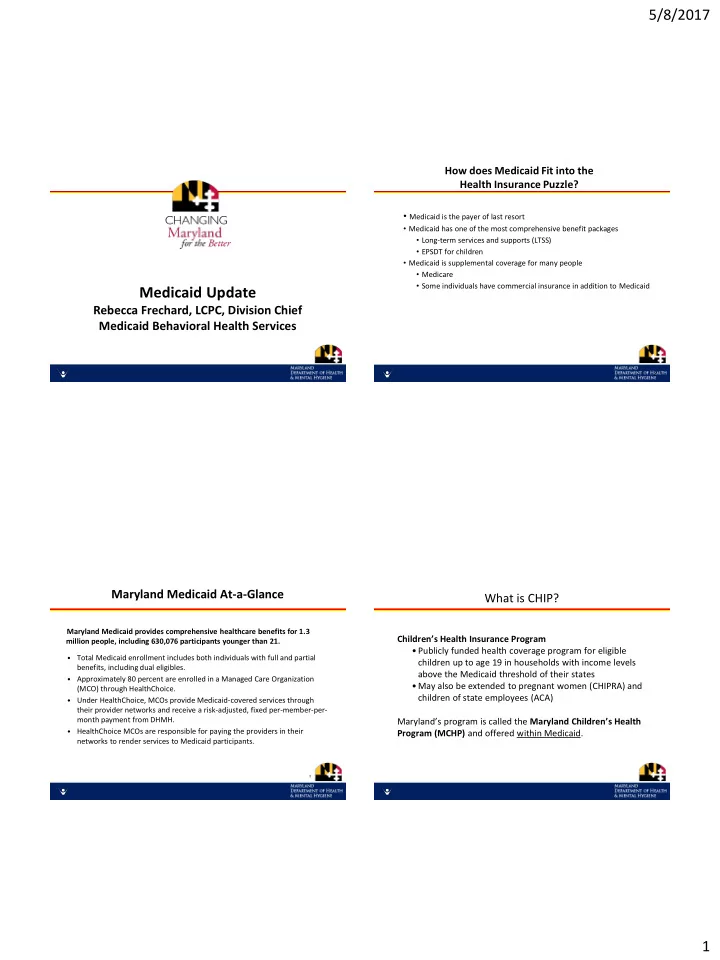
How does Medicaid Fit into the Health Insurance Puzzle?

  • Medicaid is the payer of last resort
  • Medicaid has one of the most comprehensive benefit packages
  • Long-term services and supports (LTSS)
  • EPSDT for children
  • Medicaid is supplemental coverage for many people
  • Medicare
  • Some individuals have commercial insurance in addition to Medicaid

2

Maryland Medicaid At-a-Glance

Maryland Medicaid provides comprehensive healthcare benefits for 1.3 million people, including 630,076 participants younger than 21.

  • Total Medicaid enrollment includes both individuals with full and partial

benefits, including dual eligibles.

  • Approximately 80 percent are enrolled in a Managed Care Organization

(MCO) through HealthChoice.

  • Under HealthChoice, MCOs provide Medicaid-covered services through

their provider networks and receive a risk-adjusted, fixed per-member-per- month payment from DHMH.

  • HealthChoice MCOs are responsible for paying the providers in their

networks to render services to Medicaid participants.

3

What is CHIP?

Children’s Health Insurance Program

  • Publicly funded health coverage program for eligible

children up to age 19 in households with income levels above the Medicaid threshold of their states

  • May also be extended to pregnant women (CHIPRA) and

children of state employees (ACA) Maryland’s program is called the Maryland Children’s Health Program (MCHP) and offered within Medicaid.

slide-2
SLIDE 2

5/8/2017 2

Snapshot: Medicaid & Medicare

President Lyndon Johnson signed the Social Security Amendments of 1965 creating both Medicaid and Medicare:

  • Both provide publicly-funded health coverage.
  • However, Medicare and Medicaid differ in many ways.

Medicaid: Federal-State Partnership

  • Medicaid is a federal-state partnership in almost every facet of the program.
  • In general, the federal government establishes the rules and guidelines of the

program, and the states administer its programs within these boundaries with federal approval.

  • This partnership has significant impact on a program’s:

– Funding (who pays, and how much do they pay?) – Eligibility (who gets covered, and what services do they qualify for?) – Benefit Package (what services are covered and to what degree?)

  • Federal Entities:

– Centers for Medicare and Medicaid Services (CMS) – Main regulating entity; the following fall under CMS – Center for Medicaid and CHIP Services (CMCS) – policy and operations – Center for Medicare and Medicaid Innovation (CMMI) – support innovative strategies/model

Within federal parameters, each state can design its own:

  • Eligibility standards;
  • Benefits package;
  • Provider requirements; and
  • Payment rates

Federal Rules for Services:

  • Services must be adequate in amount, duration, and scope;
  • Services must be statewide;
  • States cannot vary services based on individual’s diagnosis or condition;
  • States may impose nominal cost-sharing on some services (e.g., drugs);
  • Children, pregnant women, and nursing home residents are excluded;
  • Higher cost sharing amounts are allowed for individuals with income

above 100 percent of FPL

Federal Medicaid Basics

7

Federally Mandated Benefits

All states must cover, as part of their Medicaid benefits package:

8

– Inpatient and outpatient hospital services – Early Periodic Screening, Diagnosis, and Treatment Services – Nursing facility services – Home health services – Physician services; – Rural health clinic services; – FQHC services; – Laboratory and x-ray services; – Family planning services, including nurse midwife services;

(more)

slide-3
SLIDE 3

5/8/2017 3

Federally Mandated Benefits, Continued

All states must cover, as part of their Medicaid benefits package:

9

–Certified pediatric and family nurse practitioner services; –Freestanding birth center services (when licensed or otherwise recognized by the State); –Transportation to medical care; and –Tobacco cessation counseling for pregnant women.

Additional Services Covered in Maryland

Maryland Medicaid covers the following, in addition to the federally- mandated benefits package:

  • Pharmacy services (for beneficiaries not eligible for Medicare part D);
  • Clinic services;
  • Physical therapy;
  • Ambulatory surgical center services;
  • Diabetes care services;
  • Home and community-based waiver services;
  • Hospice care;
  • Kidney dialysis services;
  • Mental health services;
  • Long-term care services;
  • Respiratory equipment services;

10

(more)

Additional Services Covered in Maryland, Continued

Maryland Medicaid covers the following, in addition to the federally- mandated benefits package*:

  • Personal care services;
  • Podiatry services;
  • Substance use disorder services;
  • Targeted case management for HIV-infected individuals and other

targeted populations;

  • Vision care services (eye examination every two years); and
  • Dental coverage for pregnant women

*For beneficiaries younger than 21, Maryland Medicaid also covers dental services and dentures, speech and occupational therapy, eye glasses, hearing aids, private duty nursing, and school-based health services.

11

Maryland’s Income Criteria

Maryland leveraged the policy and financial levers under the Affordable Care Act to expand its program and provide health coverage to a greater number of its residents.

Coverage Group Pre-ACA Post-ACA Children (varies across age brackets and household income) 300% 322% Former Foster Care (under 26 years old) N/A No income limit Parents and Caretakers 116% 123% Pregnant Women 250% 264% Childless Adults 116% (only primary care) 138%

slide-4
SLIDE 4

5/8/2017 4

Affordable Care Act Medicaid Expansion

Enrollment in Maryland Medicaid expanded under the ACA*:

  • Over 260,000 adults are now enrolled as a result of the ACA Medicaid

expansion

  • 71,055 new individuals have enrolled in qualified health plans
  • 79,238 individuals, already enrolled in 2015, renewed their qualified

health plans for next year

  • 162,000 individual during 2016 open enrollment

13

* As of December 2015

HealthChoice Benefits

HealthChoice covers most hospital, pharmacy, and physician services, in addition to immunizations and screenings for children. Several services are excluded from the HealthChoice benefit package including: – Specialty mental health and substance use services; – Dental services; – Long term services and supports; and – Various waiver services.

14

Some individuals DO NOT qualify for HealthChoice and are enrolled in Medicaid on a fee-for-service (FFS) basis:

  • Dual eligibles;
  • Institutionalized;
  • Spend-down;
  • Participants in the Model Waiver for Medically Fragile Children;
  • Participants in the Family Planning program waiver;
  • New Medicaid eligibles (until enrolled in MCO); and
  • Enrollees in Rare and Expensive Case Management (REM) (within

HealthChoice program 20)

Populations Exempt from HealthChoice Enrollment

15

  • HealthChoice is Maryland Medicaid’s managed care program
  • About 84% of beneficiaries covered under managed care
  • Maryland requires most Medicaid participants to enroll in one of eight

participating MCOs – Amerigroup Community Care – Jai Medical Systems – Kaiser Permanente – Maryland Physicians Care – MedStar Family Choice – Priority Partners – University of Maryland Health Partners (f.k.a. Riverside Health) – United Healthcare

HealthChoice: Managed Care in Maryland

16

slide-5
SLIDE 5

5/8/2017 5

Implementing HealthChoice Waiver Initiatives

  • On June 30, Medicaid submitted its 1115 waiver renewal application to CMS.
  • The application was approved for a five-year period starting January 1, 2017 and includes:

– Continued implementation of ACA provisions – Initiatives to address evaluation results and continue improving quality of care

  • Provider Data Validation work
  • Value Based Purchasing (13 measures)
  • Colorectal Cancer Screening
  • Proposed changes for the renewal period 1/2017 – 12/2021 include expanding services under

the following programs: – Residential Treatment for Individuals with Substance Use Disorders – Community Health Pilots

  • Limited Housing to Support Services
  • Evidence-Based Home Visiting for High Risk Pregnant Women and Children up to Age

Two – Transitions for Criminal Justice Involved Individuals – Increased Community Services

17

1115 Waiver Renewal Initiatives

  • Residential Treatment for Substance Use Disorders

– Presently, CMS will not provide matching funds for state dollars that fund SUD treatment for individuals receiving care in a residential facility without a waiver. – Under the waiver, the State may use Medicaid funds to cover a continuum of SUD services.

  • Transitions for Criminal Justice Involved Individuals

– Connecting individuals to Medicaid coverage upon release is a key component of Gov. Hogan’s Justice Reinvestment Act – CMS advised the State to provide presumptive eligibility for Medicaid-eligible individuals leaving jails and prisons in the state through a State Plan Amendment (SPA)

18

Behavioral Health

20

Behavioral Health Program

Behavioral health services are carved out of the HealthChoice managed care program and managed by a behavioral health administrative services

  • rganization: Beacon Health Options.
  • Medicaid is the contract monitor for the Beacon Contract.
  • The program covers all Medicaid populations and also covers gray area

populations which allows for a seamless transition as people churn on and off Medicaid.

  • The program has spent a significant amount of energy and resources on

improving SUD services during the last six years. Examples – methadone rebundling and adding IMD services in July.

26

slide-6
SLIDE 6

5/8/2017 6

Medicaid Behavioral Health Key Updates

IMD Waiver Updates: Implementation Date is July 1, 2017 Regulations are currently being drafted Rates are in the final stages of development and will be released to stakeholders as soon as they are finalized Residential SUD means: 3.3, 3.5, 3.7, 3.7D clinical services will be able to be covered by Medicaid for adults. 3.1 will be developed for 2019 However there is no waiver from CMS on the requirement that Room and Board cannot be covered for adults. This burden falls to the states. (Medicaid already covers under the EPSDT services for under 21 which includes Room & Board)

21

(more)

Medicaid Behavioral Health Benefits, Continued

Rebundling: Changing the way Medicaid reimburses for Ongoing Methadone or Medication Assisted Treatment programs After a 3 year process of development including stakeholder input, the Department released the final version of the changes to the method of reimbursement. Some general Highlights:

  • OTPs will be able to claim separate reimbursement for Level 1 ASAM outpatient

services.

  • IOP will be able to be separately reimbursed to the IOP provider even while the

patient is in an OTP

  • Labs remain included in a weekly medication maintenance rate

For more information visit: http://dhmh.maryland.gov/bhd/pages/Home.aspx

22

Budget

Medicaid’s Financial Partnership

  • The federal government uses the FMAP formula to calculate the federal match
  • r federal monetary share for each state.

– Federal Medical Assistance Percentages (FMAP) = the proportion of Medicaid spending that the federal government allocates to states; percentages based on a state’s per capita income and other criteria

  • Under the ACA, the federal government provides a 100% FMAP for the

expansion population until 2017, when the rate will decrease annually

  • The ACA also enhanced CHIP’s FMAP by 23%. Maryland’s MCHP had a 65%

match prior to the enhancement.

2017 2018 2019 2020 2021 Traditional Medicaid 50 50 50 50 50 MCHP 88 88 88 70.8 65 ACA Expansion 97.5 94.5 93.5 91.5 90 Blended rate* 60.932 60.371 60.209 59.289 58.813

Maryland’s FMAP

* Blended rate based on outyear forecasted expenditures

slide-7
SLIDE 7

5/8/2017 7

Drawing Down Federal Funds

  • States receive its federal match by “drawing down” the agreed upon

federal allotment for the state’s Medicaid program

  • The Medicaid drawdown process

– States pay Medicaid provider and administrative expenses – States pull federal funds against a continuing letter of credit certified by the Secretary of Treasury – CMS evaluates state reports on actual spending to reconcile expenditures quarterly – The state submits reports of actual spending to CMS

  • In Maryland

– Uses MMIS and FMIS expenditure reports to drawdown – Creates a “Letter of Credit” memo with expenditure reporting data – Draws provider expenditures weekly – Draws administration expenditures bi-weekly – Average weekly Medical Assistance draw: $174 million

FY 2017 Average Enrollees and Expenditures

26

Medicaid Spending

*Behavioral Health includes SUD services and admin contracts

FY16 Actual FY17 Projected Medicaid CHIP Medicaid CHIP Hospitals 841,893,621 19,943,509 880,717,810 26,574,762 Physician Office 116,129,378 2,945,888 129,424,638 4,742,402 Pharmacy 501,307,744 24,921,106 523,747,219 24,580,684 MCO 4,337,377,700 187,704,208 5,449,672,301 225,779,056 Long Term Care 1,788,302,917 4,471,407 1,924,304,295 5,037,530 Dental 119,783,309 41,712,550 121,970,886 49,600,233 Other Medical 472,036,412 (44,849,825) 480,096,034 (37,048,712) Behavioral Health* 1,032,238,554 43,449,624 1,153,302,991 62,703,304

The FY 2017 budget funds provider rate increases:

  • 2 percent for nursing homes, medical day care, and private duty nursing
  • 2 percent for mental health and substance use providers
  • 1.1 percent for both personal day care and home and community-based waiver

services The FY 2017 budget also:

  • Maintains physician E&M rates at 92 percent of Medicare rates
  • Effective 1/1/2017, funds ACA expansion at 95 percent federal match ($57M GF

impact)

  • Initiates funding for federally-mandated services for those with Autism Syndrome

Disorder

  • Funds increased expenditures for Part B premium cost sharing for Qualified

Medicare Beneficiaries and Specified Low Income Medicare Beneficiaries

  • Provides for a 7.3 percent MCO rate increase
  • Funds MMIS II improvements and infrastructure assessment

FY 2017 Governor’s Allowance

28

slide-8
SLIDE 8

5/8/2017 8 Priorities

Provider Enrollment Vendor

  • Automated Health Systems
  • Digital Harbor
  • Vendor scope of work

– Electronic portal for all 70+ Medicaid provider types – Enrollment – Re-enrollment – Re-validation – Updates/Demographic Changes – Automated database verification – Provider enrollment notifications – Call Center for Provider Enrollment w/ Customer Relationship Management (CRM) – Document management

  • Medicaid is actively working to strengthen links with DPSCS and local detention

centers to prevent new incarcerations and lower recidivism in order to save costs and reduce social burdens of crimes in communities

  • Goals and approaches:

– Improve eligibility and enrollment process/data analytic capability between programs.

  • Current data matching across Medicaid and correctional systems inconsistent or

non-existent

  • In discussions with private and public entities to discuss opportunities for data

sharing as close to “real time” as possible

– Improve post-release care and coverage connections.

  • Convening key stakeholders to evaluate Medicaid enrollment and care

coordination strategies prior to an individual’s reentry

  • Working with national consultants to better understand the scope of current

initiatives, gaps and challenges, priorities, and best practices

  • Implementing presumptive eligibility to allow state and local correctional

centers to conduct Maryland Medicaid presumptive eligibility determinations for justice-involved individuals leaving a correctional center; effective July 1, 2017

ENHANCING CORRECTIONS-MEDICAID CONNECTIONS

  • Lock-In Program: MCOs are required to participate in a Corrective Managed Care (CMC) Program; it monitors

for members receiving duplicate opioid prescriptions from multiple providers and locks them into a single pharmacy to prevent abuse

  • Medication-Assisted Treatment (MAT) Access: Medicaid beneficiaries have access to medication like

methadone, buprenorphine, and naloxone to assist with opioid addiction

  • Rebundling Methadone Payment: After significant consultation with stakeholders, DHMH is rebundling the

weekly reimbursement rate for methadone services to ensure OTP providers provide counseling with MAT as required; effective May 15, 2017.

  • Minimum Prescribing Standards: The Drug Utilization Review Workgroup, consisting of representatives from

DHMH and all 8 MCOs, reached consensus in establishing minimum opioid prescribing standards as well as its full implementation date of July 1, 2017.

  • SUD Waiver: Through the recently-approved HealthChoice waiver, Medicaid will pay for substance use

treatment services in Institute for Mental Disease (IMD) settings enhancing its already robust continuum of SUD care; effective July 1, 2017.

  • Pharmacy & Therapeutics Committee: Medicaid has used the P&T Committee as a forum for overdose

education and drug access/contraction.

  • Opioid Drug Utilization Review (DUR) Workgroup: As one of the largest payers in the state, in June of 2016,

Medicaid convened a DUR workgroup consisting of DHMH and the 8 HealthChoice MCOs representatives met to deliberate on and build consensus around minimum opioid prescribing rules and an implementation timeline.

EXPANDING MEDICAID OVERDOSE ACTIVITIES

slide-9
SLIDE 9

5/8/2017 9

  • Medicaid is actively working to strengthen links with DPSCS and local detention

centers to prevent new incarcerations and lower recidivism in order to save costs and reduce social burdens of crimes in communities

  • Goals and approaches:

– Improve eligibility and enrollment process/data analytic capability between programs.

  • Current data matching across Medicaid and correctional systems inconsistent or

non-existent

  • In discussions with private and public entities to discuss opportunities for data

sharing as close to “real time” as possible

– Improve post-release care and coverage connections.

  • Convening key stakeholders to evaluate Medicaid enrollment and care

coordination strategies prior to an individual’s reentry

  • Working with national consultants to better understand the scope of current

initiatives, gaps and challenges, priorities, and best practices

  • Implementing presumptive eligibility to allow state and local correctional

centers to conduct Maryland Medicaid presumptive eligibility determinations for justice-involved individuals leaving a correctional center; effective July 1, 2017

ENHANCING CORRECTIONS-MEDICAID CONNECTIONS OVERVIEW: CY 2017/FY 2018 PRIORITIES

  • New Federal Managed Care Regulations: Implementing key provisions of

new managed care regulations

  • Medicaid/DDA Waivers: With DDA, developing 2 new DD waivers and the

Community Pathways Waiver renewal (our largest waiver)

  • Community Options Waiver: Implementing a daily rate for the

Community Options waiver

  • OTP Reimbursement: Improving reimbursement methodology for opioid

treatment programs (OTP)

  • Provider enrollment and re-enrollment: streamline system and processes

INTERAGENCY COORDINATION—BHA

  • Oversight of the Public Behavioral Health System

– Medicaid oversees Medicaid funding and is contract monitor of ASO contract. – DHMH’s Behavioral Health Administration continues to provide clinical oversight of the system, and oversees funding for the uninsured and state funded services.

  • Workgroup participation

– Medicaid is represented on the Behavioral Health Advisory Council and the Forensics Workgroup – Behavioral health providers sit on the Medicaid Advisory Committee

  • Provider Rate Setting

– Residential Substance Use Treatment will become a Medicaid covered service effective July 1, 2017. – Medicaid and BHA staff are working to establish rates for these services.

  • Accreditation and Improve Quality

– Effective July 1, 2016 new regulations require behavioral health programs to become accredited by an approved national accrediting organization – All accreditation-based programs must have accreditation from a DHMH- approved accrediting body and must submit an application for licensure by December 31, 2017

Maryland Medicaid Telehealth Program

The Department combined the telemedicine and telemental health program in 2015 to streamline administrative oversight under Maryland Medicaid’s renamed “Telehealth Program”.

  • The program is a “hub-and-spoke” model.
  • The program will include substance use providers as distant sites as

early as October 2017.

  • In addition, the Department will clarify that we cover store and forward

technology under certain circumstances and will develop a Remote Patient Monitoring program by January 1, 2018.

36

slide-10
SLIDE 10

5/8/2017 10

Accomplishments:

  • In an effort to reduce the administrative burden on providers Medicaid:

– Simplified the telehealth provider application process; – Added additional provider types and services, most recently related to substance use disorder (SUD) and Buprenorphine counseling; and – Expanded on the programs technology requirements.

  • In an effort to better collect and analyze program data Medicaid:

– Updated telehealth registration forms; and – Created a new tracking and dashboard system that better allows the collection of real time information. Goal:

  • Conduct a survey of all currently registered providers to examine telehealth

models, partners, and how they foresee conducting telehealth in the future.

REFINING TELEHEALTH PROGRAM MANAGING COMPETING PRIORITIES

Federal regulatory requirements and state mandates will dominate implementation activities into FY 2018

  • LTC eligibility workgroup/reporting

(HB 1181)

  • Senior Rx Program Integration
  • JCRs including BH Integration
  • Managed care ‘mega regulation’
  • Mental health parity
  • Home health/ hearing aids
  • Access
  • Community rule

MERP Litigation

  • Private counsel to assist OAG
  • Significant SME involvement

anticipated in CY 2017 and 2018 Procurements

  • Provider enrollment/reenrollment
  • MMIS O&M
  • LTSS O&M
  • NCCI Edits
  • Accounting/Auditing for MCOs
  • Pharmacy

MANAGING COMPETING PRIORITIES

  • Federal-State ‘Partnership’
  • Space
  • Recruitment
  • Succession Planning

– NAMD National Workgroup to Support Maryland on Organizational Effectiveness and Succession Planning

  • Claims Processing / Crossover Claims
  • Audits, Audits, Audits

Acronym Lookup: https://www.macpac.gov/reference-guide-to-federal-medicaid-statute-and-regulations/macpac-acronyms-list/ 40

Key Reference

46

slide-11
SLIDE 11

5/8/2017 11 Questions?

41

47