MEDICAL MANAGEMENT OF NON-IGE MEDIATED CONDITIONS* IN INFANTS - - - PDF document

medical management of non ige mediated conditions in
SMART_READER_LITE
LIVE PREVIEW

MEDICAL MANAGEMENT OF NON-IGE MEDIATED CONDITIONS* IN INFANTS - - - PDF document

MEDICAL MANAGEMENT OF NON-IGE MEDIATED CONDITIONS* IN INFANTS - Prof. Y. Vandenplas * EXCEPT EOSINOPHILIC OESOPHAGITIS AND FOOD PROTEIN-INDUCED ENTEROCOLITIS SYNDROME Parallel to the 24 th Pediatrics Practical Seminars (Rencontres de Pdiatrie


slide-1
SLIDE 1

1/5

MEDICAL MANAGEMENT OF NON-IGE MEDIATED CONDITIONS* IN INFANTS

  • Prof. Y. Vandenplas

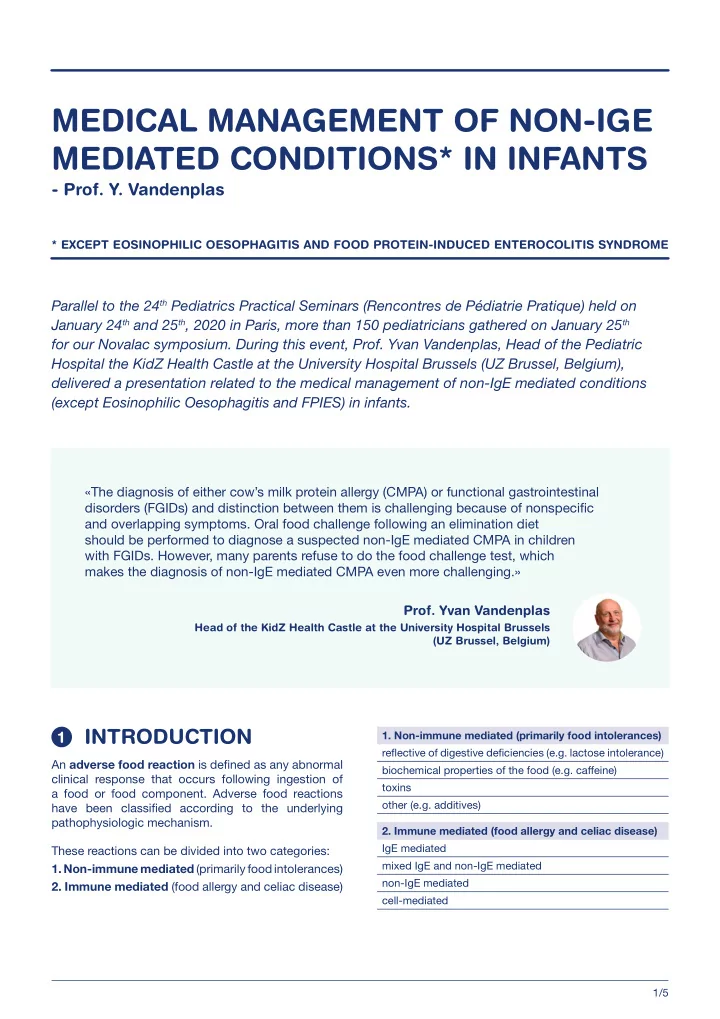
Parallel to the 24th Pediatrics Practical Seminars (Rencontres de Pédiatrie Pratique) held on January 24th and 25th, 2020 in Paris, more than 150 pediatricians gathered on January 25th for our Novalac symposium. During this event, Prof. Yvan Vandenplas, Head of the Pediatric Hospital the KidZ Health Castle at the University Hospital Brussels (UZ Brussel, Belgium), delivered a presentation related to the medical management of non-IgE mediated conditions (except Eosinophilic Oesophagitis and FPIES) in infants.

«The diagnosis of either cow’s milk protein allergy (CMPA) or functional gastrointestinal disorders (FGIDs) and distinction between them is challenging because of nonspecifjc and overlapping symptoms. Oral food challenge following an elimination diet should be performed to diagnose a suspected non-IgE mediated CMPA in children with FGIDs. However, many parents refuse to do the food challenge test, which makes the diagnosis of non-IgE mediated CMPA even more challenging.»

  • Prof. Yvan Vandenplas

Head of the KidZ Health Castle at the University Hospital Brussels (UZ Brussel, Belgium)

* EXCEPT EOSINOPHILIC OESOPHAGITIS AND FOOD PROTEIN-INDUCED ENTEROCOLITIS SYNDROME

1 INTRODUCTION

An adverse food reaction is defjned as any abnormal clinical response that occurs following ingestion of a food or food component. Adverse food reactions have been classifjed according to the underlying pathophysiologic mechanism. These reactions can be divided into two categories:

  • 1. Non-immune mediated (primarily food intolerances)
  • 2. Immune mediated (food allergy and celiac disease)
  • 1. Non-immune mediated (primarily food intolerances)

refmective of digestive defjciencies (e.g. lactose intolerance) biochemical properties of the food (e.g. caffeine) toxins

  • ther (e.g. additives)
  • 2. Immune mediated (food allergy and celiac disease)

IgE mediated mixed IgE and non-IgE mediated non-IgE mediated cell-mediated

slide-2
SLIDE 2

2/5

Medical management of non-IgE mediated conditions in infants - Prof. Y. Vandenplas - 06/2020

Signs of IgE-mediated allergies typically develop soon after exposure and are usually evident within

  • ne to two hours after consumption of the allergen. In

contrast, signs of non-IgE mediated food allergies typically occur several hours later and even up to several days after exposure1. Non-IgE gastrointestinal symptoms are typically chronic and occur as a result of repeated exposure to the food allergen, examples include vomiting, abdo- minal discomfort, altered stool habit (with and without blood) and with faltering growth1. These symptoms are the same in breastfed and formula-fed infants. Most common symptoms of non-IgE mediated cow’s milk protein allergy (CMPA) are:

  • GER(D)
  • Infantile colic
  • Stool composition changes (diarrhea/constipation)
  • Atopic dermatitis
  • Respiratory symptoms (cough, rhinitis, wheezing)
  • Food protein induced proctocolitis (FPIP)
  • Food protein induced enterocolitis (FPIES)

2.3 Evolution of CMPA

The prognosis of CMPA is good with a remission rate of 45-50% at 1 year, 60-75% at 2 years, and 85-90% at 3 years6. In IgE-mediated allergy, there is an increased risk of persistent CMPA and of developing allergy to

  • ther foods before the age of 3 years; however some

patients can develop tolerance during adolescence7. In the EuroPrevall birth cohort study enrolling 12 049 children with CMPA symptoms, 9336 (77.5%) were followed up to 2 years of age8. Of all children with CMPA, 23.6% had no cow’s milk-specifjc IgE in serum. Of children with CMPA who were re-evaluated one year after diagnosis, 69% (22/32) tolerated cow’s milk, including all children with non-IgE-associated CMPA and 57% of those children with IgE-associated CMA. This study showed a good prognosis of CMPA with 2/3 of affected infants becoming tolerant within

  • ne year after diagnosis.

2.4 Diagnosis of CMPA

The diagnosis of CMPA requires an elimination diet for 2-4 weeks (cow’s milk proteins are eliminated from the infant’s diet or the breastfeeding mother) with disappearance of symptoms, followed by an oral food challenge (cow’s milk proteins are reintroduced in the infant’s diet or the breastfeeding mother) with relapse

  • f symptoms. However, many parents refuse to do a

food challenge test because they do not want to make their infant sick again. The Cow’s Milk-related Symptom Score (CoMiSS), which considers general manifestations, dermato- logical, gastrointestinal and respiratory symptoms, was developed as an awareness tool for cow’s milk- related symptoms9. Symptomatic children who score 12 or higher on the CoMiSS score with the presence

  • f at least three symptoms and the involvement of two
  • rgan systems, are considered at a high risk of CMPA.

But the CoMiSS awareness tool is not a diagnostic test for CMPA. It does not replace a food challenge with a cow’s milk-free diet. A combination of skin and gastro-intestinal symptoms increases the likelihood for allergy, although a combination by coincidence is possible given the high incidence of all conditions. This makes the diagnosis of CMPA a real challenge.

2 INCIDENCE

AND PROGNOSIS

2.1 Incidence of CMPA

Incidence of CMPA is less than 0.5% in breastfed infants whereas it is 2 to 7.5 % in cow’s milk protein formula fed infants. However, a discrepancy exists between “perception” and “proven by a double-blind placebo control food challenge (DBPCFC)”.

2.2 Symptoms of CMPA

Symptoms of CMPA can be classifjed into 4 categories including digestive, respiratory, skin and general signs (Figure 1). Mean estimated prevalence of functional gastro- intestinal symptoms in infants less than 12 months of age from studies using Rome III diagnostic criteria are2:

  • Regurgitation 26.7%
  • Functional constipation 7.8%
  • Infantile colic and fussing/crying 17.7%

Multiple functional gastrointestinal disorders (FGIDs) are frequent in formula-fed infants and decrease their quality of life3. However, some FGIDs such as regurgitation and colic tend to disappear by 12 months

  • f age4,5.

Figure 1 - Classification

  • f CMPA symptoms

up to 60%

30% 70% 50%

slide-3
SLIDE 3

3/5

Medical management of non-IgE mediated conditions in infants - Prof. Y. Vandenplas - 06/2020

3 MANAGEMENT OF NON-IGE CMPA

Soy based infant formula

Based on the cross-reactivity in non-IgE mediated CMPA, soy based infant formula should be extensively

  • hydrolyzed. However, due to the presence of high

concentration of isofmavones (phytoestrogens) in soy based infant formula, concerns about the unknown risk of phytoestrogens have been raised, especially when infants receive this formula as a sole source of

  • nutrition. Pr. Yvan Vandenplas recommends not to give

soy-based formula/drinks between birth and 3 years

  • f age.

“Plant” based infant formula

Pea protein based formula has been developed and fjrst results showed improved weight gain and tolerance in children (mean age of 13 years) diagnosed with feeding diffjculties and/or failure to thrive after about 6 month-feeding13.

Donkey´s milk

Donkey´s milk has been shown to be well tolerated by infants with cow´s milk food protein-induced enterocolitis syndrome (CM-FPIES) and by infants with IgE-mediated CMPA14,15.

Extensively (eHF) and partially (pHF) hydrolyzed cow milk based infant formula

EHF is the fjrst choice in the management of CMPA1. It is often made of extensively hydrolyzed whey protein

  • r casein but the peptide size may differ according

to the product brand11. It is usually lactose-free but some lactose may be present in some formula brands. A probiotic, prebiotic, HMO and/or thickening agent is

  • ften added to eHF

. PHF is mainly used in allergy prevention in high-risk infants.

Amino acid based formula

Amino acid based formula is not recommended in case

  • f non IgE-mediated allergy but it is the fjrst choice in

case of eosinophilic esophagitis (allergic infmammation

  • f the esophagus) and Heiner syndrome (cow’s milk

hypersensitivity)10.

Rice based infant formula

Rice based infant formula can be extensively or partially hydrolyzed. The safety and tolerance of an extensively hydrolyzed rice protein-based formula has been demonstrated in a prospective trial in infants with CMPA confjrmed with a food challenge12.

3.1 Breastfed infants

In breastfed infants, the diagnosis and management

  • f non-IgE gastrointestinal food allergies include

the elimination of foods from the maternal diet for 2-4 weeks with symptom improvement/resolution, followed by reintroduction with symptom deterioration. However, unnecessary elimination of food allergens may adversely impact the nutritional status of the breastfeeding mother1.

3.2 Formula-fed infants

Several types of hypoallergenic formulas may be suitable in case of CMPA depending on the clinical presentation (Figure 2).

Figure 2 - Formulas suitable in case of CMPA

Extensively Hydrolysed Formula EHF – whey EHF – casein EHF – rice PHF – rice Soya Intact non-milk Proteins Amino Acid Formulas

slide-4
SLIDE 4

4/5

Medical management of non-IgE mediated conditions in infants - Prof. Y. Vandenplas - 06/2020

3.3 Management of infantile colic

In breastfed infants, evidence suggests that a hypo- allergenic maternal diet may be benefjcial for reducing symptoms of colic16,17. In formula-fed infants, colic may improve after changing from a standard cow’s milk formula to an extensive-hydrolyzed protein formula, especially in atopic families16-18. There is no clear evidence that probiotics are more effective than placebo at preventing infantile colic. However, daily crying time appeared to reduce with probiotic use compared to placebo19,20. Crying is part of the symptom spectrum of many conditions in infants including gastro-esophageal refmux disease (GERD). Off-label prescribing of proton pump inhibitors (PPIs) to infants to treat symptoms attributed to GERD is increasing, despite evidence that PPIs are no more effective than placebo in relieving those symptoms21 and the potential risks of chronic use22.

3.4 Management of constipation

Based on prospective clinical trials, cow’s milk protein- free diet has a benefjcial effect on constipation, with a rate of successful outcomes ranging from 28% to 78%23. Hydrolyzed protein formula has also shown a signifjcant improvement in stool frequency compared to standard or soy-based formulas24. Moreover, a signifjcant improvement in stool consistency and frequency was also observed with a magnesium-rich formula in constipated infants25. The diagnosis of either CMPA or FGIDs and distinction between them is challenging because of nonspecifjc and overlapping

  • symptoms. Oral food challenge following

an elimination diet should be performed to diagnose a suspected non-IgE mediated CMPA in children with FGIDs. Misdiagnosis of CMPA seems to be extre- mely common across countries due to lack

  • f awareness and training, non-specifjc

nature of symptoms, infrequent allergy t esting and combination of symptoms in FGIDs and in (non-IgE) CMPA.

Conclusion

3.5 Management of regurgitation

Thickened formulas reduce the frequency and severity

  • f regurgitation and are indicated in formula-fed infants

with persisting symptoms despite reassurance and appropriate feeding volume intake26. Some thickened formulas may also improve stool consistency27. Protein hydrolysates have been shown to accelerate gastric emptying compared to whole cow’s milk1. In addition, extensive hydrolysate formula was also reported to be effective in reducing regurgitation in infants with positive and negative challenge tests for CMPA after 1 month of dietary treatment25.

slide-5
SLIDE 5

5/5

Medical management of non-IgE mediated conditions in infants - Prof. Y. Vandenplas - 06/2020

References

  • 1. Meyer R, Chebar Lozinsky A, Fleischer DM, Vieira MC, Du Toit

G, Vandenplas Y, et al. Diagnosis and management of Non-IgE gastrointestinal allergies in breastfed infants-An EAACI Position

  • Paper. Allergy. janv 2020;75(1):14-32.
  • 2. Vandenplas Y, Abkari A, Bellaiche M, Benninga M, Chouraqui JP

, Çokura F , et al. Prevalence and Health Outcomes of Functional Gastrointestinal Symptoms in Infants From Birth to 12 Months of

  • Age. J Pediatr Gastroenterol Nutr. nov 2015;61(5):531-7.
  • 3. Bellaiche M, Oozeer R, Gerardi-Temporel G, Faure C,

Vandenplas Y. Multiple functional gastrointestinal disorders are frequent in formula-fed infants and decrease their quality of life. Acta Paediatr. 2018;107(7):1276-82.

  • 4. Hegar B, Dewanti NR, Kadim M, Alatas S, Firmansyah A,

Vandenplas Y. Natural evolution of regurgitation in healthy

  • infants. Acta Paediatr. juill 2009;98(7):1189-93.
  • 5. Wolke D, Bilgin A, Samara M. Systematic Review and Meta-

Analysis: Fussing and Crying Durations and Prevalence of Colic in Infants. The Journal of Pediatrics. 1 juin 2017;185:55-61.e4.

  • 6. Høst A. Frequency of cow’s milk allergy in childhood. Ann Allergy

Asthma Immunol. déc 2002;89(6 Suppl 1):33-7.

  • 7. Skripak JM, Matsui EC, Mudd K, Wood RA. The natural history
  • f IgE-mediated cow’s milk allergy. J Allergy Clin Immunol.

nov 2007;120(5):1172-7.

  • 8. Schoemaker AA, Sprikkelman AB, Grimshaw KE, Roberts G,

Grabenhenrich L, Rosenfeld L, et al. Incidence and natural history

  • f challenge-proven cow’s milk allergy in European children
  • EuroPrevall birth cohort. Allergy. août 2015;70(8):963-72.
  • 9. Vandenplas Y, Dupont C, Eigenmann P

, Host A, Kuitunen M, Ribes-Koninckx C, et al. A workshop report on the development

  • f the Cow’s Milk-related Symptom Score awareness tool for

young children. Acta Paediatr. avr 2015;104(4):334-9. 10. Vandenplas Y. Prevention and Management of Cow’s Milk Allergy in Non-Exclusively Breastfed Infants. Nutrients. 10 juill 2017;9(7). 11. Nutten S, Maynard F , Järvi A, Rytz A, Simons PJ, Heine RG, et

  • al. Peptide size profile and residual immunogenic milk protein
  • r peptide content in extensively hydrolyzed infant formulas.
  • Allergy. 9 nov 2019;

12. Vandenplas Y, De Greef E, Hauser B, Paradice Study Group. Safety and tolerance of a new extensively hydrolyzed rice protein-based formula in the management of infants with cow’s milk protein allergy. Eur J Pediatr. sept 2014;173(9):1209-16. 13. Cohen S, Ramirez A, Millovich V. Improved GI Tolerance and Weight Gain in Pediatric Patients using Plant-Based Enteral Formulas. https://www.katefarms.com/for-clinicians/research/ [Internet]. 2020 [cité 14 mai 2020]; Disponible sur: https://www. katefarms.com/for-clinicians/research/ 14. Mori F , Sarti L, Barni S, Pucci N, Belli F , Stagi S, et al. Donkey´s Milk Is Well Accepted and Tolerated by Infants With Cow´s Milk Food Protein-Induced Enterocolitis Syndrome: A Preliminary

  • Study. J Investig Allergol Clin Immunol. 2017;27(4):269-71.

15. Sarti L, Martini M, Brajon G, Barni S, Salari F , Altomonte I, et al. Donkey’s Milk in the Management of Children with Cow’s Milk protein allergy: nutritional and hygienic aspects. Ital J Pediatr. 17 août 2019;45(1):102. 16. Hall B, Chesters J, Robinson A. Infantile colic: a systematic review of medical and conventional therapies. J Paediatr Child

  • Health. févr 2012;48(2):128-37.

17. Iacovou M, Ralston RA, Muir J, Walker KZ, Truby H. Dietary management of infantile colic: a systematic review. Matern Child Health J. août 2012;16(6):1319-31. 18. Daelemans S, Peeters L, Hauser B, Vandenplas Y. Recent advances in understanding and managing infantile colic.

  • F1000Res. 2018;7.

19. Gutiérrez-Castrellón P , Indrio F , Bolio-Galvis A, Jiménez- Gutiérrez C, Jimenez-Escobar I, López-Velázquez G. Efficacy of Lactobacillus reuteri DSM 17938 for infantile colic: Systematic review with network meta-analysis. Medicine (Baltimore). déc 2017;96(51):e9375. 20. Ong TG, Gordon M, Banks SS, Thomas MR, Akobeng AK. Probiotics to prevent infantile colic. Cochrane Database Syst

  • Rev. 13 2019;3:CD012473.

21. Blank M-L, Parkin L. National Study of Off-label Proton Pump Inhibitor Use Among New Zealand Infants in the First Year of Life (2005-2012). J Pediatr Gastroenterol Nutr. 2017;65(2):179-84. 22. Yadlapati R, Kahrilas PJ. The “dangers” of chronic proton pump inhibitor use. Journal of Allergy and Clinical Immunology. 1 janv 2018;141(1):79-81. 23. Miceli Sopo S, Arena R, Greco M, Bergamini M, Monaco S. Constipation and cow’s milk allergy: a review of the literature. Int Arch Allergy Immunol. 2014;164(1):40-5. 24. Hyams JS, Treem WR, Etienne NL, Weinerman H, MacGilpin D, Hine P , et al. Effect of Infant Formula on Stool Characteristics of Young Infants. Pediatrics. 1 janv 1995;95(1):50-4. 25. Benninga MA, Group MICS, Vandenplas Y. The Magnesium-Rich Formula for Functional Constipation in Infants: a Randomized Comparator-Controlled Study. Pediatric Gastroenterology, Hepatology & Nutrition. 1 mai 2019;22(3):270-81. 26. Salvatore S, Savino F , Singendonk M, Tabbers M, Benninga MA, Staiano A, et al. Thickened infant formula: What to know.

  • Nutrition. 2018;49:51-6.

27. Dupont C, Vandenplas Y. Efficacy and Tolerance of a New Anti- Regurgitation Formula. Pediatr Gastroenterol Hepatol Nutr. juin 2016;19(2):104-9. 28. Billeaud C, Guillet J, Sandler B. Gastric emptying in infants with

  • r without gastro-oesophageal reflux according to the type of
  • milk. Eur J Clin Nutr. août 1990;44(8):577-83.

29. Vandenplas Y, De Greef E, ALLAR study group. Extensive protein hydrolysate formula effectively reduces regurgitation in infants with positive and negative challenge tests for cow’s milk allergy. Acta Paediatr. juin 2014;103(6):e243-250.