Medicares Acute Care Episode Program 3 year demonstration program - - PowerPoint PPT Presentation

medicare s acute care episode program
SMART_READER_LITE
LIVE PREVIEW

Medicares Acute Care Episode Program 3 year demonstration program - - PowerPoint PPT Presentation

Medicares Acute Care Episode Program 3 year demonstration program starting in 2009; 5 hospitals in 4 states Bundled payments for 37 cardiac and orthopedic procedures Up to 8% discount off normal fee-for-service payments Savings


slide-1
SLIDE 1

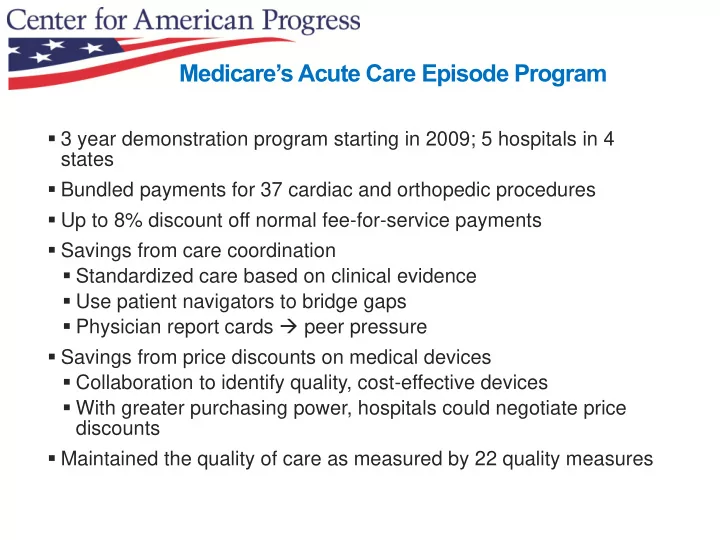
Medicare’s Acute Care Episode Program

  • 3 year demonstration program starting in 2009; 5 hospitals in 4

states

  • Bundled payments for 37 cardiac and orthopedic procedures
  • Up to 8% discount off normal fee-for-service payments
  • Savings from care coordination
  • Standardized care based on clinical evidence
  • Use patient navigators to bridge gaps
  • Physician report cards  peer pressure
  • Savings from price discounts on medical devices
  • Collaboration to identify quality, cost-effective devices
  • With greater purchasing power, hospitals could negotiate price

discounts

  • Maintained the quality of care as measured by 22 quality measures
slide-2
SLIDE 2

Using the ACA’s Key Cost Control Tool

  • Goal: expand a bundled payment nationwide before the President

leaves office

  • Ensure the current health cost slowdown continues
  • Demonstrate the potential of the Affordable Care Act
  • Send a signal to health care providers
  • The ACE Program meets the test for expansion
  • Expansion could be effective for fiscal year 2015
  • Including post-acute care in bundling is important: over 70% of

variation in Medicare costs is from variation in post-acute care

slide-3
SLIDE 3

Bundled Payments vs. ACOs

  • ACOs are voluntary, and thus can’t be expanded nationwide
  • ACOs aren’t appropriate for many (rural) areas of the country
  • Bundled payments are easier to implement, require less upfront

investment

  • ACOs take time to realize returns on investment
  • Bundled payments yield immediate price savings
slide-4
SLIDE 4

Beyond bundling for acute episodes: bundling for cancer

  • Why cancer?
  • High and rising disease burden; high and rising costs of care ($173 billion

by 2020)

  • IOM: current cancer care system is in crisis
  • Widely varying treatment strategies and costs, despite existing care

guidelines

  • Drugs are a significant portion of costs
  • Questions to be answered:
  • Which cancers and stages? Bundle could vary based on specific

diagnoses

  • What to include in the bundle? Diagnostic tests, imaging, drug

administration, management fee, labs, chemotherapy, radiation services, hospitalizations, surgery

  • What length of time should the bundle cover?
  • What measures should define the bundle? Outcomes, process, patient-

reported

  • CAP has organized a consortium of oncologists, patients, payers, and policy

experts to answer these questions

slide-5
SLIDE 5

Bundling need not be foreign

  • In 2004, Germany adopted Diagnosis Related Groups
  • Now Germany bundles all costs for inpatient episodes of care,

including physician services

  • No additional payment for re-admissions related to the bundle
  • In 2008, Germany started bundling outpatient services
  • Single fixed rate for all care in a quarter of the year
  • Insurers offer contracts for “integrated care” – including post-acute

care in the bundle

  • Evidence of success
  • Duplicative services (imaging) have declined
  • Use of pricey technology (imaging) has declined
  • More consensus on treatment pathways, less variation