Medium Sized Commercial Buildings 2014 Building Technologies Office - - PowerPoint PPT Presentation

medium sized commercial buildings
SMART_READER_LITE
LIVE PREVIEW

Medium Sized Commercial Buildings 2014 Building Technologies Office - - PowerPoint PPT Presentation

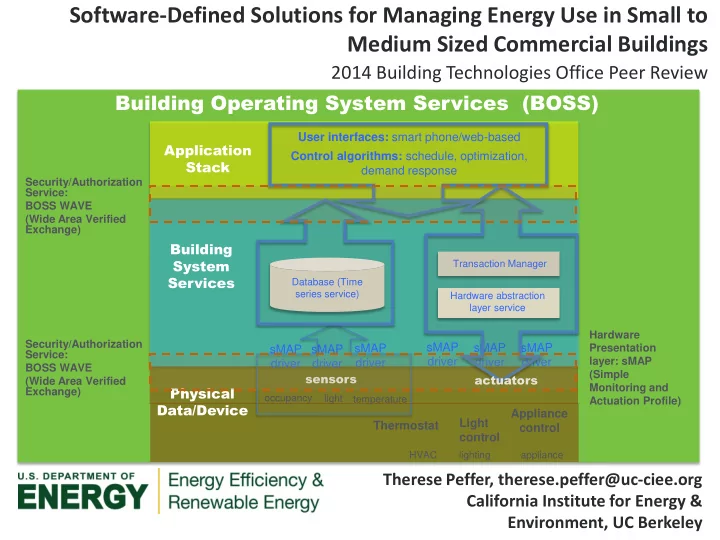
Software-Defined Solutions for Managing Energy Use in Small to Medium Sized Commercial Buildings 2014 Building Technologies Office Peer Review Building Operating System Services (BOSS) User interfaces: smart phone/web-based Application Control


slide-1
SLIDE 1

Software-Defined Solutions for Managing Energy Use in Small to Medium Sized Commercial Buildings

2014 Building Technologies Office Peer Review

Building System Services Application Stack Physical Data/Device

sMAP driver sMAP driver sMAP driver sMAP driver sMAP driver sMAP driver

  • ccupancy

light HVAC lighting appliance

sensors

Database (Time series service) Transaction Manager

Thermostat Light control Appliance control

temperature

actuators

Building Operating System Services (BOSS)

User interfaces: smart phone/web-based Control algorithms: schedule, optimization, demand response

Security/Authorization Service: BOSS WAVE (Wide Area Verified Exchange)

Hardware abstraction layer service

Security/Authorization Service: BOSS WAVE (Wide Area Verified Exchange) Hardware Presentation layer: sMAP (Simple Monitoring and Actuation Profile)

Therese Peffer, therese.peffer@uc-ciee.org California Institute for Energy & Environment, UC Berkeley

slide-2
SLIDE 2

Project Summary

Timeline: Start date: December 09, 2013 (New Project) Planned end date: October 31, 2014 Key Milestones:

  • 1. Successful operation of thermostat, lighting

controller & general load controller, Oct 31, 2014

  • 2. Successful integration of hardware with

BOSS software platform, Oct 31, 2014

  • 3. Software apps display sufficient maturity to

allow full evaluation of BOSS system, Oct 31, 2014

Budget:

Total DOE $ to date: $60,710 Total future DOE $: $440,561

Target Market/Audience:

Small and medium commercial building

  • wners/tenants, manufacturers of equipment

and suppliers of services.

Key Partners:

California Institute for Energy & Environment Software Defined Buildings/EECS/UC Berkeley Western Cooling Efficiency Center/UC Davis Lawrence Berkeley National Laboratory Building Robotics

Project Goal:

Develop a working prototype of an open software-architecture, open source Building Automation System (BAS) for small commercial buildings, based on Building Operating System Services (BOSS). The prototype includes a plug-and-play thermostat, lighting and general controllers, user interface with display, system set-up and auto-mapping.

2

slide-3
SLIDE 3

Purpose and Objectives

Problem Statement: Light commercial buildings (5k-50k sf) account for 42% of the floor area of US commercial buildings, yet do not benefit from Building Automation Systems. These buildings have extremely varied usage and different ΛϟΔ̼Ϊή͸ͻΧͳ ΛΧ̼Ϊ̠θͻΛΔͳ ̠Δ̸ ̭ͻ΍΍ Χ̠ϥΓ̼Δθʹ B!ͼ ΛΧ̼Ϊ̠θΛΪή’ ήΊͻ΍΍ή ̠Ϊ̼ ΍ͻΊ̼΍ϥ ΍ͻΓͻθ̸̼Ͷ Target Market and Audience:

  • 43 billion sf, ~700 billion kWh/year, ~2 billion MMBtu/year fuels
  • Stage 1—Energy Efficiency Application (App) Developers, Thermostat Vendors,

Lighting Controls Vendors, Commercial Equipment Vendors (e.g., copiers)

  • Stage 2—RTU Vendors, Lighting System Vendors
  • Primary Vendors to Small Commercial Buildings (e.g., security/alarm companies)

Impact of Project:

  • 1st R&D Year—Open architecture shows potential for vendor access to market
  • 2nd&3rd R&D Years through 1 year after project—enables app development,

stage 1 energy efficiency apps offered by vendors, service offered by initial primary vendors - 15% energy savings in 1% of market.

  • Years 2-3 Post—Stage 2 apps offered by vendors - 25% savings in 5% of market.
  • Years 3+ Post—Other primary vendors - 25% savings in 25+% of market - $5B/yr.

3

slide-4
SLIDE 4

Approach

Approach: Because the BOSS platform is built on a RESTful web services integration of heterogeneous data, the architecture is inherently scalable to adapt the size of the network (e.g., of sensors or other nodes) to suit smaller

  • r larger buildings or provide greater or fewer data points.

Key Issues: All communication (e.g. commands sent, sensor data published, subscription requests) are secure (BOSS Wide Area Verified Exchange (BOSSwave)). Simple Monitoring and Actuation Profile (sMAP) drivers provide agnostic physical access to sensors, actuators, or data streams—can be WiFi, ZigBEE, Ethernet, BACnet/IP etc. Distinctive Characteristics: The key innovations are a layered open software architecture, and the data aggregator and archiver sMAP. The modular architecture is the disruptive technology to the market as a means for third parties to easily create new applications (control algorithms, diagnostics, visualization) or add new devices (occupancy sensors, actuator/monitor for specific load), while radically reducing cost of implementation.

4

slide-5
SLIDE 5

sMAP – simple Monitoring and Actuation Profile

Uniform Access to Diverse Physical Information

Electrical

Dent Instruments PowerScout 18, ION 6200, Obvius Aquisuite; PSL pQube, Veris Industries, Schneider Electric ION power meters accessed with Modbus/Ethernet, HTTP, OPC-DA

Weather

(NOAA forecast from web scrape, Vaisala WXT520 rooftop weather station with SDI-12, LabJack/Modbus)

Geographical Water Environmental

(Temperature, CO2, light, RH with wireless 6lowPAN mesh)

Structural Actuator

Siemens Apogee BMS, Legrand WattStopper, Johnson Control BMS Accessed by BACnet/IP

Occupancy

PIR with wireless 6lowPAN mesh

sMAP

Modeling Visualization Continuous Commissioning Control Personal Feedback Debugging Storage Location Authentication Actuation

Applications Physical Information

REST API HTTP/TCP ͙ JSON Objects

www.openbms.org

5

slide-6
SLIDE 6

6

6

Building Operating System Services (BOSS)

slide-7
SLIDE 7

Security: BOSS Wide Area Verified Exchange (BOSSwave)

  • Web of trust model
  • Decentralized
  • Push to (multiple) subscribers – not poll
  • Revocation
  • Verify

– Origin, Authorization of Operation, Target

  • Limit

– Processing of unauthorized ops, bandwidth of fanout

  • Tolerate

– Intermittent connection

7

slide-8
SLIDE 8

BOSSwave

App must prove to Broker that it is authorized to publish to light34

1 2 3 4 5 6

8

slide-9
SLIDE 9

Proposed openBAS

Ethernet to device (e.g., thermostat), BACnet if applicable

BOSS server

FITPC with openBAS platform including:

  • sMAP sources (instances of drivers for particular devices)
  • Discovery

Building LAN

WAP

Internet

Periodic updates to Repository TimeSeries Database

Roof Top HVAC Units Overhead lighting

Lighting /gateway •Repository: bridge

  • TimeSeries Archiver/database
  • sMAP drivers
  • Config
  • Discovery registry

9

slide-10
SLIDE 10

Progress and Accomplishments

Lessons Learned: Some commercially available controllers more easily integrated into platform than others (e.g., reliability, open Application Programming Interface (APIs)) Accomplishments: Wrote several device interfaces (sMAP drivers). Implemented Auto-discovery (PlugNPlay) of device (e.g., find device on network, discover type

  • f device, autoload appropriate driver). Developed communication and data

security (BOSSwave). Demonstrated the implementation of two different thermostats, two different lighting control devices, and a general controller. Market Impact:

  • Efforts—Including robust authentication and authorization capability, see

Project Integration (p.11) for collaboration and coordination regarding APIs and accepted standards.

  • Actual impact—On track for end of year 1 architecture to be compelling for

potential equipment vendors to open APIs to monitoring and actuation requests, and energy efficiency vendors to develop applications.

10Awards/Recognition:

slide-11
SLIDE 11

Project Integration and Collaboration

Project Integration:

  • Initiated conversations with key equipment vendors (e.g., lighting controls)

regarding opening API to monitoring and actuation access.

  • Software architecture builds upon accepted standards (E.g., WiFi, MQTT-3)

Partners, Subcontractors, and Collaborators:

California Institute for Energy & Environment, UC Berkeley: Project management and administration, market delivery strategy plan Software Defined Buildings, Electrical Engineering Computer Science, UC Berkeley: System integration, software platform, user interface, apps Western Cooling Efficiency Center, UC Davis: HVAC controller and apps, demos Lawrence Berkeley National Laboratory: Lighting controller and apps, FLEXLAB Building Robotics: Software platform and applications

Communications: E͵͸I’ή Power Delivery & Utilization Program, Software Defined

Buildings Summer and Winter retreats (UC Berkeley/industry), Green Tech Center/ITU/SDU (Denmark), Centre for Sustainable Communications in KTH (Sweden), Saga University (Japan), Daikin Konwakai (ͼθͶ ͢ͻ̮͸̠̼΍’ήͳ ͢D)

11

slide-12
SLIDE 12

Next Steps and Future Plans

Next Steps and Future Plans: Year 1:

  • Implement user interfaces for different types of users (occupant, building

manager, installer/app vendor)

  • Develop market delivery strategy plan
  • Integrate the software with hardware and user interface
  • Test increasingly sophisticated control algorithms
  • Demonstrate BOSS capabilities

Year 2:

  • Test-bed implementation in ͜Bͣ͜’ή FLEXLAB
  • Refine/expand controller capabilities, sensors, and user interface

Year 3:

  • Deployment in three buildings
  • Refine/expand controller capabilities (e.g., DR) and user interface
  • Evaluate, measure, and verify

12

slide-13
SLIDE 13

REFERENCE SLIDES

13

slide-14
SLIDE 14

14

BOSS Software platform = backbone of OpenBAS

14

HVAC RoofTop Unit

Thermostat

Lighting gateway

General control

(bathroom fans, refrigerators, signage, security) sMAP driver

Building System Services Applications Hardware devices

User Interface

System set-up

Auto- mapping Discovery

Status display

Hardware presentation layer

sMAP driver sMAP driver

6lowpan WiFi ZigBEE etc

LED fixture or fluorescent ballasts

Hardware Abstraction Layer Execution Environment

Security: BOSSWAVE (Wide Area Verified Exchange

TimeSeries Service

Publish Command

Control applications

(model building,

  • ptimization, fault

detection/diagnostics, demand response)

Subscribe

Transaction Manager

slide-15
SLIDE 15

Project Budget

Project Budget: $501,271 project budget Variances: More travel than anticipated (participation at BTO review and CMU workshop) Cost to Date: $60,710 spent (12% budget), $0 cost share recorded of $12,500 project budget (0% budget). Additional Funding: None

Budget History

December 9, 2013– FY2013

(past)

FY2014—October 31, 2014

(current)

DOE Cost-share DOE Cost-share $0 $0 $60,710 $0

15

slide-16
SLIDE 16

Project Plan and Schedule

16