
SLIDE 1
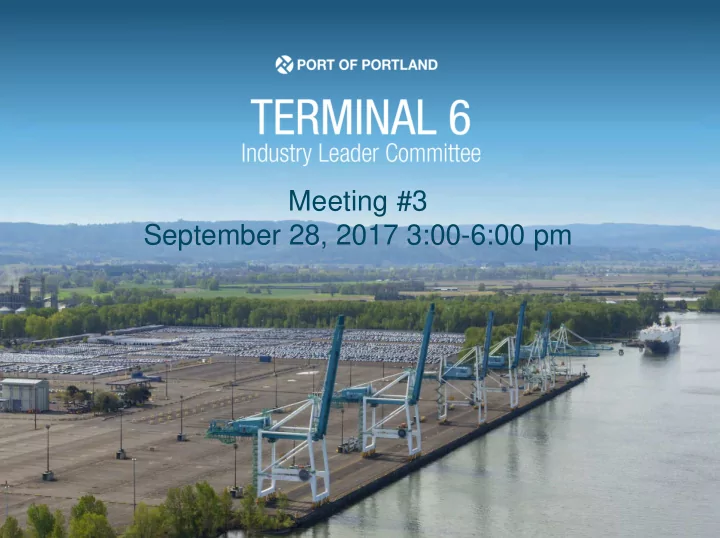
Meeting #3 September 28, 2017 3:00-6:00 pm Jones <Ljones@c - - PowerPoint PPT Presentation
Meeting #3 September 28, 2017 3:00-6:00 pm Jones <Ljones@c Golden Laurn apstone- partners.co m> Welcome Meeting 2 Recap - Meeting Summary Review Follow-Up on Committee Requests Integrated SWOT Summary Information on
–
–
–
–
Laurn Golden Jones <Ljones@c apstone- partners.co m>
2
3
www.advisian.com
Task 2 - Market Analysis
Nolan Gimpel, Project Manager, Advisian September 28, 2017
4
The purpose of the Study is to determine the Port’s future role in container shipping and recommend a sustainable business model for managing and developing the business in the future.
Terminal 6 container facility has been largely idle for the past two years. The Port has the
revitalize the terminal. This task will analyze the container cargo market, focusing on segments that are most likely to be served, potential customers and users of the facility. 5
million tons) or 406,800 TEUs in 2014.
call at Portland. Further analysis must be done in Task 6 to compare this with potential revenues from calling at Portland.
Central Peninsula (Tacoma) and T18 (Seattle). The rest of the terminals must fight to stay above water, mostly due to alliance structure
6
The market study region includes all of Oregon and Idaho as well as some counties in southern Washington
The Port of Portland study region is defined by geographies where the direct transportation costs between the port and the products origin or destination is lower cost compared to other container ports
7
total
the majority is discretionary cargo headed to/from outside the region.
Containers Thousand Tons Total export 130,163 3,228 Total import 95,374 1,092 Total study region 225,537 4,248
Portland Region Container Volume, 2014 Import/Export Split for Regional Containers, 2014
Total export 58% Total import 42% 1 Assumes 20% of the port’s volume is not intermodal
8
Oregon had the most containers in the study region in 2014.
State Containers Thousand Tons Oregon 71,333 1,769 Washington 47,222 1,187 Idaho 11,608 272 Total 130,163 3,228
Exports 2014
State Containers Thousand Tons Oregon 80,003 1,162 Washington 11,821 162 Idaho 3,550 49 Total 95,374 1,373
Imports 2014 State Share of Regional Export Containers 2014 State Share of Regional Import Containers 2014
Oregon 55%
Washington
36% Idaho 9%
Oregon 84%
Washington 12%
Idaho 4%
9
US Port Containers Thousand Tons NWSA 95,907 2,399 Portland 30,905 761 Oakland 3,158 64
Exports 2014
US Port Containers Thousand Tons NWSA 48,269 550 Portland 43,714 420 Oakland 2,837 45
Imports 2014 Export Market Share 2014 Import Market Share 2014
NWSA 74% Portland 24% Oakland 2% NWSA 51% Portland 46% Oakland 3%
10
Top export commodities were primarily hay, vegetables or wood products in 2014.
Commodity (Harm Code 4) Containers Thousand Tons Percent Total Containers Cereal Straw & Husks 31,958 850 25% Wood Sawn or Chipped Length, Sliced Etc 11,879 317 9% Vegetables Nesoi Prepared or Preserve Nesoi, Frozen 9,543 245 7% Kraft Paper & Paperboard, Uncoated Nesoi, Rolls 5,305 145 4% Seeds, Fruit and Spores, For Sowing 4,632 118 4% Apples, Pears and Quinces, Fresh 3,815 93 3% Leguminous Vegetables, Dried Shelled 3,641 89 3% All Others 59,439 1,373 46% Total 130,163 3,228
11
Export Containers 2014
Port of Departure Asia Europe Central and Australia/ South America Oceania NWSA 87,440 2,440 2,417 2,935 Portland 23,133 4,205 3,096 245 Oakland 2,311 210 326 258 All Others 116 1 73 Total 113,000 6,855 5,840 3,511
10,000 20,000 30,000 40,000 50,000 60,000 70,000 80,000 90,000 100,000 NWSA Portland Oakland Asia Europe Central and South America Australia/Oceania
Containers
12
Commodity (Harm Code 4) Containers Thousand Tons % Total Containers Furniture Nesoi and Parts Thereof 7,265 73 8% New Pneumatic Tires, of Rubber 6,603 82 7% Seats (Except Barber, Dental, Etc), and Parts 2,969 18 3% Parts of Balloons, Aircraft, Spacecraft, etc 2,553 12 3% Glass Containers For Packing Etc & Glass Closures 2,502 43 3% Parts & Access For Motor Vehicles 2,342 38 3% Plywood, veneered panels & similar laminated wood 2,309 58 2% Artls & Equip F Genrl Physcl Exerc Etc; Pools; Pts 2,277 29 2% Footwear, Gaiters Etc. and Parts Thereof 2,021 24 2% All Others (incl. consumer goods, electronics) 62,603 981 68% Total 95,374 1,373
Import commodities are destined to western and northern part of Oregon, as well as south Washington
13
Import Containers 2014
Port of Entry Asia Europe Central and South America Australia/ Oceania NWSA 44,450 933 1,468 1,257 Portland 37,483 2,231 3,584 2 Oakland 1,821 501 275 201 All Others 551 4 Total 84,305 3,665 5,331 1,464
Containers 10,000 20,000 30,000 40,000 50,000 60,000 NWSA Portland Oakland Asia Europe Central and South America Australia/Oceania
14
Portland’s Advantages Portland’s Disadvantages Loyal importers using Portland and a growing number of mid-sized importers Having a smaller local population means lower local consumption levels of imported goods. A strong and vibrant export cargo market Being a container port that is 100 miles up a river and requiring dual pilotage isn’t cheap. Carriers who call directly enjoy limited competition Inability to accommodate the larger container vessels that are increasingly being used (see table below). With a lack of direct service options compared to other ports, the sellers pricing power is much greater With a lack of direct service options compared to other ports, the sellers pricing power is much greater Existence of direct rail service to hinterland markets History of poor relations between labor and industry Port Draft depth (Ft) Port of Seattle 50 Port of Tacoma >50 Port of Portland 43 Port of Oakland 50 Port of San Francisco 50 Port of Los Angeles >52 Long Beach >50
Source: Journal of Commerce
15
Market Size Commodities Handled Success Factors Port Hueneme: pop 21,723 (2015). Located 60 miles from Los Angeles MSA, with pop. 18.7M (2015). The port focuses on cargo that needs to be moved quickly, such as fresh produce and automobiles. Bananas account for about 30 percent of the port’s cargo; cars make up 60 percent. The Port handles a limited amount
Partnership with one of world’s largest banana exporters (Ecuador). Three auto processors are located less than 2 miles from the
berths are equipped with shore-side power capacity for vessels to plug in. Large population located within 100 miles. Description Assets Port Hueneme is located just 60 miles northwest of Los Angeles on U.S. 101 and the UP mainline, and serves the Southern California market and lower Central Valley, including its large agricultural and consumer population bases. 3 wharfs for commercial
the Navy. Squid Fishery. 4 Floats for Small Craft 8 acre switchyard that holds 99 box cars or 80 auto racks 256,000 Square Feet On-dock Cold Storage 60,000 Square Feet Off-dock Cold Storage (Private) Mobile harbor cranes available Source: Port of Hueneme, Various News Articles
Case Study: Port of Hueneme benefits from global partnerships, large local pop., specialized cargo handling.
Key Takeaways
fresh/ frozen food products
trade route.
16
Market Size Commodities Handled Success Factors San Diego MSA: 3.3M (2015). Located 100 miles from Los Angeles MSA pop. 18.7M (2015). Also located 20 miles from Mexican border. Importer of perishables and refrigerated commodities, fertilizer, cement, breakbulk commodities. Vehicle import/export facility handling 10% of autos entering US. The Port has a diverse mix
estate assets in prime tourism/business areas of the city. Its specialization in niche breakbulk commodities has allowed it to achieve operational excellence. Description Assets The port oversees 2 maritime cargo terminals, 2 cruise ship terminals, 20 public parks, and 600 tenant businesses. Tenth Avenue Marine Terminal is a 96-acre complex with 8 berths and depth of 42
Terminal is a 135-acre complex with 4 working berths and depth of 35 feet. Operated by Pasha. 10th Ave Marine Terminal: Mobile harbor crane. Cold storage, covered storage and open laydown space. 300,000 sq. ft. warehouse. On-dock shore power and
Marine Terminal: Secure facilities for valuable cargo with 24-hour monitoring. Source: Port of San Diego, Various News Articles
Case Study: San Diego benefits from operational excellence in breakbulk handling and proximity to Mexico & LA.
Key Takeaways
fresh/ frozen food products
trade route.
17
Market Size Commodities Handled Success Factors Philadelphia MSA pop: 6M (2016). State pop: 12.8M (2016). Located within a
200 million people. Containers, steel products, frozen meat, fruit, heavy lift, project, paper. Huge market within one day driving distance; Strong relations and partnerships with private sector. Receives and manages significant federal funding (e.g. Delaware River Main Channel Deepening project). In 2016, Pennsylvania allocated $300 to Port investments. $200 million will go to upgrading Packer Avenue terminal, including buying four 23- wide cranes, expanding by 40 acres, and deepening the berths to 45’ Description Assets PAMT, leased to Astro Holdings Inc. (“Astro”), spans 112 acres and has 3,800 linear ft. of berthing space, including six berths with one being a Roll-On/Roll-Off (RO/RO)
Marine Terminal handled 407,100 TEUs and a total
in 2015. 2 Post-Panamax container cranes and 3 Panamax container cranes. 6 Toploaders: 95,000 lbs., 5 Toploaders: 30,000 lbs., 100 Forklifts: 3,000 lbs. to 35,000 lbs., 20 Yard hustlers Rail connection to CSX and Norfolk Southern Computerized container tracking system; ocean container to domestic truck transloading; distribution Source: Port of Philadelphia, Various News Articles
Key Takeaways
trade route, but it also has some Europe/ ANZAC services.
40’ to 45’ at a cost of $392 million by ’18
constant or increasing over the past few decades
18
interest to a container service, but Portland’s ability to capture that cargo depends upon a number of factors- many of which are outside its control.
absolute terms, but could be offset by offering a niche service.
advantages in terms of size, efficiency, water depth, intermodal, etc.
specialization, partnerships, and government support. However, those niche markets were built around niche BCO’s which do not exist in the Study Region to any great extent.
19
20
21
www.advisian.com
Task 4 – Operating Model Analysis
Nolan Gimpel, Project Manager, Advisian September 28, 2017
22
Operating Port Terminal - the public port authority owns and operates the terminal by
for all management aspects of the terminal.
This was the operating model the Port utilized from 1974-1993
23
Semi-Operating Port Terminal- The port may or may not have a specific container terminal but has a “common” public wharf for vessel operations. Storage and gate
terminal operator. In this model the port
participate in the management of the terminal, but contracts out for the labor for the operational aspects, specifically the vessel operations. The equipment could be
terminal operator. Port ownership of the land and the hiring of a terminal operator is the key for this model.
This was the operating model the Port used from 1993 though 2011
24
Landlord Terminal - The public port authority owns the terminal but leases it out to a terminal operator or ocean carrier for
may or may not own the terminal operating equipment but usually owns the ship to shore cranes. Maintenance of the cranes could be done by the Port or by the lessee depending on local practices, labor agreements or labor contract.
This was the operating model the Port used from 2011 though 2017
25
Concession Terminal - The public port authority offers a long-term concession to a
more than 50 years and usually require the concessionaire to provide the terminal equipment and all improvements to the terminal above ground level (pavement, terminal technology, gates, buildings, etc.). Cranes could be maintained by the Port or the concessionaire depending on work rules, local practices or contractual obligations. All
exposure to maintain any terminal assets.
26
27 27
Control Risk/Reward Landlord Operating Concession Semi-Operating
28
Concession Terminals
Landlord Terminals
Semi-Operating Terminals
Port Operated Terminals
Galveston and Barber Pt (HI) are all <100k teus
29
100,000 150,000 200,000 250,000 300,000 350,000 1975 1980 1985 1990 1995 2000 2005 2010 2015
Terminal 6 Container Volume
TEUs, Fiscal Year Ending Operating Model 1974-1993 Semi-operating Model 1993-2011 Landlord Model 2011-2017
30
OpEx The OpEx (Operating Expenses) are the costs associated with the loading and unloading of the vessels as well as the terminal and gate
OpEx unless some capital expenditure is undertaken. OpEx will have base costs but will have variable costs based upon productivity, volume and model type. CapEx CapEx (Capital Expenses) are the costs associated with the development
equipment such as STS cranes, RTG’s, reachstackers, side picks and
such as electrical, communications buildings and pavement would also be included in this category. Furthermore, any infrastructure for automation (or semi-automation), including existing terminal operating system technologies would be included in this category.
31
32
33
34
35
36
37
38
39