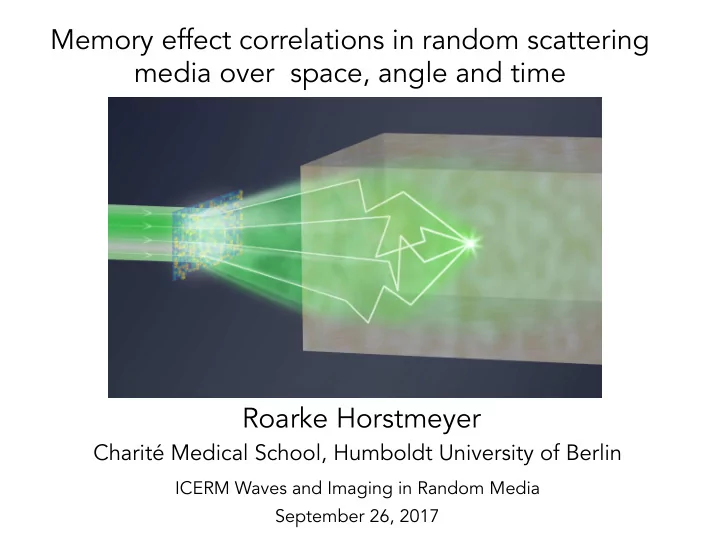
SLIDE 1
Memory effect correlations in random scattering media over space, angle and time Roarke Horstmeyer
ICERM Waves and Imaging in Random Media September 26, 2017
Charité Medical School, Humboldt University of Berlin
SLIDE 2
Challenge: controlling light deep within tissue
SLM Wavefront-shaping: "undo" scattering Light randomly scatters within tissue
SLIDE 3
Challenge: controlling light deep within tissue
SLM Wavefront-shaping: "undo" scattering Light randomly scatters within tissue
SLIDE 4
Camera Spa)al Light Modulator (SLM) Reference beam Camera Spa)al Light Modulator (SLM) Reference beam
DOPC recording Light from "guidestar" Light returns to guidestar location Scattered wavefront Phase conjugate wave DOPC playback
How do we form a focus deep within tissue?
Technique #1: Optical Phase Conjugation
SLIDE 5 Guidestar examples
1 2 3 4
- R. Horstmeyer et al., "Guidestar-assisted
wavefront-shaping methods for focusing light into biological tissue", Nature Photon. (2015)
SLIDE 6
This talk: efficiently scanning focused light deep within tissue
Goal: want to scan focus around Equivalent: maximize FOV of imaging with adaptive optics Scan FOV
SLIDE 7 Talk Outline
- 1. The optical memory effect
- 2. The "shift/shift" memory effect
- 3. The generalized memory effect
- 4. Experimental demo of maximized scanning
- 5. Scanning further with time-gated light
SLIDE 8 The optical memory effect
- Well-known scattering correlation
- Speckle at a distance shifts around but does not change shape
Plane wave Scattered field U Speckle V
SLIDE 9 The optical memory effect
Tilt the wave Scattered field tilts Speckle shifts
Δk
U(k-Δk) Application: Imaging "through" thin scattering layers
- J. Bertolotti et al., "Noninvasive imaging through opaque scattering layers," Nature (2012)
- O. Katz et al., "Noninvasive single shot imaging through opaque scattering layers and around corners,"
Nature Photon. (2014)
- X. Yang et al., "Imaging blood cells through scattering tissue using speckle scanning," Opt. Express (2014)
V(x-Δx)
- Well-known scattering correlation
- Speckle at a distance shifts around but does not change shape
SLIDE 10 The optical memory effect
1 S. Feng, C. Kane, P
. A. Lee, and A. D. Stone, Phys. Rev. Lett. 61, 834 (1988).
- Original approach1 interested in intensity-intensity correlations:
"Memory effect"
Δka
I(k-Δka)
SLIDE 11 The optical memory effect
2 R. Berkovits, M. Kaveh and S. Feng, Phys. Rev. B 40, 737 (1989). 1 S. Feng, C. Kane, P
. A. Lee, and A. D. Stone, Phys. Rev. Lett. 61, 834 (1988).
- Original approach1 interested in intensity-intensity correlations:
"Memory effect"
- We will work with field-field correlations2, the square root of CI
(1):
Our primary interest
SLIDE 12
The optical memory effect
Tilt Tilt
ka kb ka kb T(ka, kb) What does the memory effect look like within the transmission matrix?
SLIDE 13
The optical memory effect
Tilt Tilt
ka kb ka kb T(ka, kb) T(xa, xb) F2D xa xb xa xb
Scattering response to a point source: "Intensity propagator"
dx Banded structure in Tx dx Visualization of the optical memory effect possible in k and x:
SLIDE 14
The optical memory effect: a simple derivation
T(xa, xb) xb xa xb Assume we know the average magnitude of transmission matrix: Assume average intensity response to point source is shift-invariant: <I(xb)> xa
SLIDE 15 The optical memory effect: a simple derivation
T(xa, xb) xb xa xb Recipe to measure the optical memory effect: <I(xb)>
- 1. Put point source on input surface
- 2. Measure average intensity at output surface, <I(xb)>
- 3. Take Fourier transform to get C(Δk)
<I(xb)> F1D C(Δk) Intensity propagator Optical memory effect xa
SLIDE 16
The shift/shift memory effect
ka kb T(ka, kb) T(xa, xb) F2D xa xb
What happens if we switch x's and k's?
SLIDE 17
xa xb T(xa, xb) T(ka, kb) F2D ka kb
The shift/shift memory effect
SLIDE 18
The shift/shift memory effect: the Fourier dual
xa xb F2D ka kb
Shift Shift
xa xb ka kb
Wavevector response to a plane wave: "k-space intensity propagator" <Î(ka,kb)>
T(xa, xb) T(ka, kb) Î(k)
SLIDE 19
- Identical derivation, x's and k's swapped
- Recipe to measure the shift/shift memory effect:
- 1. Shine plane wave on input surface
- 2. Measure average wavevector spread at output
- 3. Take its Fourier transform to get spatial correlation C(Δx)
The shift/shift memory effect: the Fourier dual
T(ka, kb) ka kb ka kb <Î(kb)>
- Focus and scan within anisotropic material (e.g., tissue g ~ 0.92-0.98)
SLIDE 20 Experimental demo of shift/shift memory effect
- B. Judkewitz, R. Horstmeyer et al., "Translation correlations in anisotropically scattering media,"
Nature Physics (2015)
Light from SLM (optical phase conjugation)
SLIDE 21 Experimental demo of shift/shift memory effect
- B. Judkewitz, R. Horstmeyer et al., "Translation correlations in anisotropically scattering media,"
Nature Physics (2015)
Light from SLM (optical phase conjugation)
Green curve: focus intensity Black curve: FT plane wave response
SLIDE 22
How are these two effects connected?
The tilt/tilt and shift/shift memory effects
Tilt/tilt correlation Spatial impulse response k-space impulse response Shift/shift correlation <Î(kb)> <I(xb)> Scanning in k Scanning in x δ(ka) δ(xa)
SLIDE 23 δ(xa,ka)
(xb
+, kb +)
(xb
(xb
0, kb 0)
New input: "single ray"*
The generalized memory effect: combining tilts and shifts
<P <P(xb,kb)>
- G. Osnabrugge, R. Horstmeyer et al, "The generalized optical memory effect," Optica (2017)
*Actually defined via the Wigner distribution, paper has math details:
SLIDE 24 kb xb
δ(xa,ka)
(xb
+, kb +)
(xb
(xb
0, kb 0)
(xb
(xb
0, kb 0)
(xb
+, kb +)
New input: "single ray"* Space-angle response <P(xb,kb)>
The generalized memory effect: combining tilts and shifts
<P <P(xb,kb)>
- G. Osnabrugge, R. Horstmeyer et al, "The generalized optical memory effect," Optica (2017)
*Actually defined via the Wigner distribution, paper has math details:
SLIDE 25 kb xb
δ(xa,ka)
(xb
+, kb +)
(xb
(xb
0, kb 0)
(xb
(xb
0, kb 0)
(xb
+, kb +)
New input: "single ray" Space-angle response <P(xb,kb)>
The generalized memory effect: combining tilts and shifts
<P <P(xb,kb)> 2D Fourier transform of space-angle response gives tilt/shift correlation:
- G. Osnabrugge, R. Horstmeyer et al, "The generalized optical memory effect," Optica (2017)
SLIDE 26 kb xb
δ(xa,ka)
(xb
+, kb +)
(xb
(xb
0, kb 0)
(xb
(xb
0, kb 0)
(xb
+, kb +)
New input: "single ray" Space-angle response <P(xb,kb)>
The generalized memory effect: combining tilts and shifts
<P <P(xb,kb)> 2D Fourier transform of space-angle response gives tilt/shift correlation: 4D Fourier transform used when scattering is not tilt/shift invariant:
- G. Osnabrugge, R. Horstmeyer et al, "The generalized optical memory effect," Optica (2017)
SLIDE 27 The generalized memory effect: is it important?
kb xb Space-angle response <P(xb,kb)> F2D Tilt/shift correlations C(Δk, Δx) Δx Δk
- Tilting and shifting correlations generally not independent
SLIDE 28 The generalized memory effect: is it important?
kb xb Space-angle response <P(xb,kb)> F2D Tilt/shift correlations C(Δk, Δx)
- Tilting and shifting correlations generally not independent
- Optimal tilt and shift combo can achieve larger scan range
Δx Δk
Only shifting Tilting and shifting
SLIDE 29 Experimental setup
- Two experiments:
- 1. Pencil beam response, <P(xb,kb)>
- 2. Shift/tilt correlation function (shift both diffuser & sample)
- Tissue phantom samples (5 µm spheres in agar, g=0.97, 0.3 mm – 1 mm thick)
SLIDE 30
Average space-angle scattering response to pencil beam
0.3 mm thick 0.5 mm thick
SLIDE 31
Directly measured shift/tilt correlations
0.3 mm thick 0.5 mm thick
Direct measurement FT2D of <P(xb,kb)> Simple simulation
SLIDE 32
Directly measured shift/tilt correlations
0.3 mm thick 0.5 mm thick
Direct measurement FT2D of <P(xb,kb)> Simple simulation
Shift-shift
SLIDE 33
Directly measured shift/tilt correlations
0.3 mm thick 0.5 mm thick
Direct measurement FT2D of <P(xb,kb)> Simple simulation
Shift-shift Tilt/tilt[1]
[1] S. Schott et al., "Characterization of the angular memory effect of scattered light in biological tissue," Opt. Express (2015)
SLIDE 34
Directly measured shift/tilt correlations
0.3 mm thick 0.5 mm thick
Direct measurement FT2D of <P(xb,kb)> Simple simulation
Shift-shift Tilt/tilt[1] Optimal shift/tilt
[1] S. Schott et al., "Characterization of the angular memory effect of scattered light in biological tissue," Opt. Express (2015)
SLIDE 35 Scanning distances and the optimal rotation plane
Δxa Δka L/3 L/3 LΔka/k /k0
0 – Δxa
Δxa LΔka/k /k0 L Δxa Δka Optimally tilt and shift = Tilt around plane L/3 deep
SLIDE 36
Why is L/3 optimal? An intuitive picture
Stack of semi-random phase plates
SLIDE 37
Why is L/3 optimal? An intuitive picture
Δka
Correct for top plate Stack of semi-random phase plates distort scanned focus
SLIDE 38
Why is L/3 optimal? An intuitive picture
Δka
Correct for lower plate Stack of semi-random phase plates distort correction pattern
SLIDE 39
Why is L/3 optimal? An intuitive picture
Δka
Stack of semi-random phase plates Distort pattern Distort focus L 2
SLIDE 40
Why is L/3 optimal? An intuitive picture
Δka
Stack of semi-random phase plates Correcting here also corrects for planes after focus and at edges L 2
SLIDE 41
Why is L/3 optimal? An intuitive picture
Δka
Stack of semi-random phase plates
Preferentially weight slightly higher correction plane
L 2
SLIDE 42 Towards a larger memory effect with time gating
t t L
- Goal: select early arriving "snake" photons for scanning
<Îb(kb)> <Î(kb)> Full scattering range More ballistic scatter
SLIDE 43 Towards a larger memory effect with time gating
t t L
- Hypothesis: early arriving snake photons offer larger scan range
<Îb(kb)> <Î(kb)> F1D Cb(Δk) F1D C(Δk)
SLIDE 44 Experimental setup
- Eventually obtained gating measurements in the spectral domain:
- M. Kadobianskyi et al., "Scattering correlations of time-gated light," ArXiv 1707.06896 (2017)
SLIDE 45 Ultrafast speckle evolution over space
Un-normalized Normalized y x
- Time step per frame: 8.5 femtoseconds
- 360 µm thick tissue phantom
5 µm 5 µm
- M. Kadobianskyi et al., "Scattering correlations of time-gated light," ArXiv 1707.06896 (2017)
π
SLIDE 46 Ultrafast speckle evolution over wavevector
k-space, un-normalized k-space, normalized ky kx
- Time step per frame: 8.5 femtoseconds
- 360 µm thick tissue phantom
5 µm 5 µm
- M. Kadobianskyi et al., "Scattering correlations of time-gated light," ArXiv 1707.06896 (2017)
SLIDE 47
- M. Kadobianskyi et al., "Scattering correlations of time-gated light," ArXiv 1707.06896 (2017)
Ultrafast speckle evolution over space and wavevector
SLIDE 48 Time gating extends the shift-shift memory effect 3-4X
- M. Kadobianskyi et al., "Scattering correlations of time-gated light," ArXiv 1707.06896 (2017)
SLIDE 49 To do: Put all of this together
Shift/tilt memory effect Time gating
δ(xa,ka)
<P <P(xb,kb)> t t δ(t) <Q(t)>
?
SLIDE 50 To do: Put all of this together
Shift/tilt memory effect Time gating
δ(xa,ka)
<P <P(xb,kb)> t t δ(t) <Q(t)>
- 1. Combine above:
- 2. Implement
with F-Sharp1
- 1I. N. Papadopoulos et al., "Scattering compensation by focus scanning holographic aberration
probing (F-SHARP)," Nature Photon. 2016
?
SLIDE 51 To do: Put all of this together
Shift/tilt memory effect Time gating
δ(xa,ka)
<P <P(xb,kb)> t t δ(t) <Q(t)>
- 1. Combine above:
- 1I. N. Papadopoulos et al., "Scattering compensation by focus scanning holographic aberration
probing (F-SHARP)," Nature Photon. 2016
?
with F-Sharp1
z
SLIDE 52
Thank you!
Joint work with:
University of University of Twente wente: : Gerwin Osnabrugge Ivo M. Vellekoop Charité Charité Medical School: Medical School: Yiannis Papadopoulos Nick Kadobianskyi Benjamin Judkewitz
2018: starting as an assistant professor in Duke University's Biomedical Engineering Department, contact me if you'd like to chat!
L/3 L/3
SLIDE 53 Fokker-Plank model for correlation in anisotropic scatterer: Find optimal Δkb: take derivative w.r.t. Δkb and set to 0: Use Δka = Δkb and Δrb = Δra +Δkak0/L: x
Tan(θ) ~ θ = (1/k0) * 3k0Δrb/2L = Δrb/2x x = Δrb/2 * 2L/3Δrb = L/3 θ Quick derivation of L/3 depth:
SLIDE 54
Time gating shift/shift correlations with physical shifting
SLIDE 55
Principle of F-Sharp