Memory Errors Bits in memory can be flipped Hard error The chip is - - PowerPoint PPT Presentation

memory errors
SMART_READER_LITE
LIVE PREVIEW

Memory Errors Bits in memory can be flipped Hard error The chip is - - PowerPoint PPT Presentation

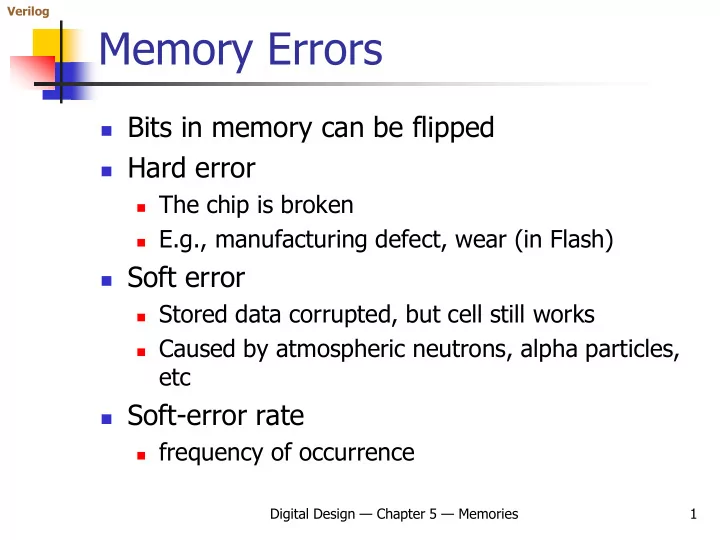
Verilog Memory Errors Bits in memory can be flipped Hard error The chip is broken E.g., manufacturing defect, wear (in Flash) Soft error Stored data corrupted, but cell still works Caused by atmospheric neutrons, alpha


slide-1
SLIDE 1

Verilog

Digital Design — Chapter 5 — Memories 1

Memory Errors

 Bits in memory can be flipped  Hard error

 The chip is broken  E.g., manufacturing defect, wear (in Flash)

 Soft error

 Stored data corrupted, but cell still works  Caused by atmospheric neutrons, alpha particles,

etc

 Soft-error rate

 frequency of occurrence

slide-2
SLIDE 2

Verilog

Digital Design — Chapter 5 — Memories 2

Error Detection using Parity

 Add a parity bit to each location  On write access

 compute data parity and store with data

 On read access

 check parity, take exception on error

 If we could tell which bit flipped

 correct by flipping it back, then write back

to memory location

 Can’t do this with parity

slide-3
SLIDE 3

Verilog

Digital Design — Chapter 5 — Memories 3

Error-Correcting Codes (ECC)

 Allow identification of the flipped bit  Hamming Codes

 E.g., for single-bit-error correction of N-bit word,

need log2N + 1 extra bits

 Example: 8-bit word, d1... d8

 12-bit ECC code, e1...e12  e1, e2, e4, e8 are check bits, the rest data

d1 d2 d3 d4 d5 d6 d7 d8 e1 e2 e3 e4 e5 e6 e7 e8 e9 e10 e11 e12

slide-4
SLIDE 4

Verilog

Digital Design — Chapter 5 — Memories 4

Hamming Code Example

e1 1 e2 1 e4 1 e8 1 e3 1 1 e5 1 1 e6 1 1 e7 1 1 1 e9 1 1 e10 1 1 e11 1 1 1 e12 1 1

e1 = e3 ⊕ e5 ⊕ e7 ⊕ e9 ⊕ e11 e2 = e3 ⊕ e6 ⊕ e7 ⊕ e10 ⊕ e11 e4 = e5 ⊕ e6 ⊕ e7 ⊕ e12 e8 = e9 ⊕ e10 ⊕ e11 ⊕ e12

 Every data bit covered by two

  • r more check bits

 On write: Compute check bits

and store with data

d1 d2 d3 d4 d5 d6 d7 d8 e1 e2 e3 e4 e5 e6 e7 e8 e9 e10 e11 e12

slide-5
SLIDE 5

Verilog

Digital Design — Chapter 5 — Memories 5

Hamming Code Example

e1 1 e2 1 e4 1 e8 1 e3 1 1 e5 1 1 e6 1 1 e7 1 1 1 e9 1 1 e10 1 1 e11 1 1 1 e12 1 1

 On read: Recompute check bits

and XOR with read check bits

 result called the syndrome

 0000 => no error  If data bit flipped

 covering bits of syndrome are 1  = binary code of flipped ECC bit

 If stored check bit flipped

 that bit of syndrome is 1

 On error, unflip bit and rewrite

memory location

slide-6
SLIDE 6

Verilog

Digital Design — Chapter 5 — Memories 6

Multiple-Error Detection

 What if two bits flip

 syndrome identifies wrong bit, or is invalid

 One extra check bit allows

 single-error correction, double-error detection

N Single-bit correction Double-bit detection Check bits Overhead Check bits Overhead 8 4 50% 5 63% 16 5 31% 6 38% 32 6 19% 7 22% 64 7 11% 8 13% 128 8 6.3% 9 7.0% 256 9 3.5% 10 3.9%

slide-7
SLIDE 7

Verilog

Digital Design — Chapter 5 — Memories 7

Summary

 Memory: addressable storage locations  Read and Write operations  Asynchronous RAM  Synchronous RAM (SSRAM)  Dynamic RAM (DRAM)  Read-Only Memory (ROM) and Flash  Multiport RAM and FIFOs  Error Detection and Correction

 Hamming Codes