SLIDE 3 Mental Health Services Act (MHSA) MHSA Component Funding Guidelines and Decision Tree Prepared by RESOURCE DEVELOPMENT ASSOCIATES February 2018 | 3
Prevention & Early Intervention (PEI)6
Purpose MHSA Funding for PEI Populations Served
- Engage persons prior to development of serious mental illness or
emotional disturbance
- Alleviate the need for additional mental health treatment
- Transition those with identifiable need to extended mental health
treatment
At least 51 % of PEI budget must be dedicated to individuals who are between the ages of 0 and 25 (small counties are exempt from this requirement)7 Counties must have a program within each of the funding categories below except for Suicide Prevention, which is optional. Persons prior to onset or development OR at risk of developing serious mental illness or severe emotional disturbance including: Underserved cultural populations Individuals experiencing onset of serious psychiatric illness Children/youth in stressed families Trauma-exposed individuals Children/youth at risk for school failure Children/youth at risk of or experiencing juvenile justice involvement Parents, caregivers, and other family members of the person with early onset of a mental illness
PEI Funding Categories Costs Eligible for PEI Funding Activities NOT Eligible for PEI Funding
- Prevention. Programs to prevent the occurrence, severity, and
consequences of serious mental illness for individuals with identified risk factors or for members of a group with demonstrated greater average vulnerability to mental illness A set of related activities to reduce risk factors for developing a potentially serious mental illness and to build protective factors. The goal of this Program is to bring about mental health including reduction of the applicable negative outcomes as a result of untreated mental illness for individuals and members of groups or populations whose risk
- f developing a serious mental illness is greater than average and, as applicable, their parents, caregivers, and other family members. Services may include relapse prevention
for individuals in recovery from a serious mental illness and universal prevention if there is evidence to suggest that the universal prevention is an effective method for individuals and members of groups or populations whose risk of developing a serious mental illness is greater than average. Prevention programs shall be designed, implemented, and promoted in ways that improve timely access to mental health services for individuals and/or families from underserved populations. Filling gaps in treatment and recovery services for individuals who have been diagnosed with a serious mental illness or severe emotional disturbance Workforce education and training Capital projects or housing Technology projects Broad social marketing campaigns (State-administered projects will support this activity) Development of new training curricula (State-administered projects will support this activity)
- Early Intervention Program services
shall not exceed eighteen months, unless the individual receiving the service is identified as experiencing first onset of a serious mental illness or emotional disturbance with psychotic features, in which case early intervention services shall not exceed four years Early Intervention. Time-limited services for individuals with early
- nset of serious mental illness to promote mental health outcomes
including recovery, wellness, and resilience, and to assist people in quickly regaining productive lives Treatment and other services and interventions, including relapse prevention, to address and promote recovery and related functional outcomes for a mental illness early in its emergence, including the applicable negative outcomes that may result from untreated mental illness.8 Early intervention program services may include services to parents, caregivers, and other family members of the person with early onset of a mental illness, as applicable. Early intervention programs shall be designed, implemented, and promoted in ways that improve timely access to mental health services for individuals and/or families from underserved populations. Outreach for increasing recognition of early signs of mental illness. Conduct outreach to families, employers, primary care health care providers, and others to recognize early signs of potentially severe and disabling mental illness Programs designed for engaging, encouraging, educating, and/or training, and learning from potential responders about ways to recognize and respond effectively to early signs
- f potentially severe and disabling mental illness.9 Outreach for Increasing Recognition of Early Signs of Mental Illness Program may be provided through other Mental Health
Services Act components as long as it meets all of the requirements.10 Stigma and discrimination reduction. Activities to reduce negative feelings, attitudes, beliefs, perceptions, stereotypes and/or discrimination related to being diagnosed with a mental illness, having a mental illness, or to seeking mental health services and to increase acceptance, dignity, inclusion, and equity for individuals with mental illness, and members of their families Direct activities to reduce negative feelings, attitudes, beliefs, perceptions, stereotypes and/or discrimination related to being diagnosed with a mental illness, having a mental illness, or to seeking mental health services and to increase acceptance, dignity, inclusion, and equity for individuals with mental illness, and members of their families. Examples
- f Stigma and Discrimination Reduction Programs include, but are not limited to: social marketing campaigns, speakers’ bureaus and other direct-contact approaches, targeted
education and training, anti-stigma advocacy, web-based campaigns, efforts to combat multiple stigmas that have been shown to discourage individuals from seeking mental health services, and efforts to encourage self-acceptance for individuals with a mental illness. Stigma and Discrimination Reduction Programs shall include approaches that are culturally congruent with the values of the populations for whom changes in attitudes, knowledge, and behavior are intended. Access and linkage to treatment. Create access and linkage to medically necessary care provided by county mental health programs Set of related activities to connect children with serious mental illness and adults and seniors with serious mental illness as early in the onset of these conditions as practicable, to medically necessary care and treatment, including, but not limited to: care provided by county mental health programs. Examples of Access and Linkage to Treatment Programs, include but are not limited to: Programs with a primary focus on screening, assessment, referral, telephone help lines, and mobile response. The County is also required to offer Access and Linkage to Treatment as a Strategy within all PEI programs. Suicide Prevention Organized activities that the County undertakes to prevent suicide as a consequence of mental illness. This category of programs does not focus on or have intended outcomes for specific individuals at risk of or with serious mental illness. Suicide prevention activities that aim to reduce suicidality for specific individuals at risk of or with early onset of a potentially serious mental illness can be a focus of a Prevention or Early Intervention program. Suicide Prevention Programs include, but are not limited to: public and targeted information campaigns, suicide prevention networks, capacity building programs, culturally specific approaches, survivor-informed models, screening programs, suicide prevention hotlines or web-based suicide prevention resources, and training and education. Administration Subcontracts such as professional services for training or program evaluation
6 Adapted from the following sources: Mental Health Services Act as Revised September 2016, Riverside County Mental Health Department MHSA website: http://www.rcdmh.org/MHSA, California Code of Regulations, Title 9, Division 1, Chapter 14, Section 3620: https://www.dhhs.saccounty.net/BHS/Documents/Advisory-Boards-
Committees/Mental-Health-Services-Act-Committee/GI-MHSA-in-California-Code-of-Regulations.pdf; Fresno County MHSA 101: http://www.co.fresno.ca.us/uploadedFiles/Departments/Behavioral_Health/MHSA/Mental%20Health%20Services%20Act%20101%20revised%20-%208-2-13.pdf
7 As of March 2016, California Code of Regulations, Section 3200.260 defines “small county” as a county in California with a total population of less than 200,000:
https://govt.westlaw.com/calregs/Document/I71B47700D45311DEB97CF67CD0B99467?viewType=FullText&originationContext=documenttoc&transitionType=CategoryPageItem&contextData=(sc.Default)
8 Outcomes are listed in Welfare and Institutions Code Title 9, Division 1, Chapter 14, Article 7, Section 5840, subdivision (d) 9 Potential responders are defined in Welfare and Institutions Code Title 9, Division 1, Chapter 14, Article 7, Section 3715, subdivision (c) 10 Requirements listed in Welfare and Institutions Code Title 9, Division 1, Chapter 14, Article 7, Section 3715
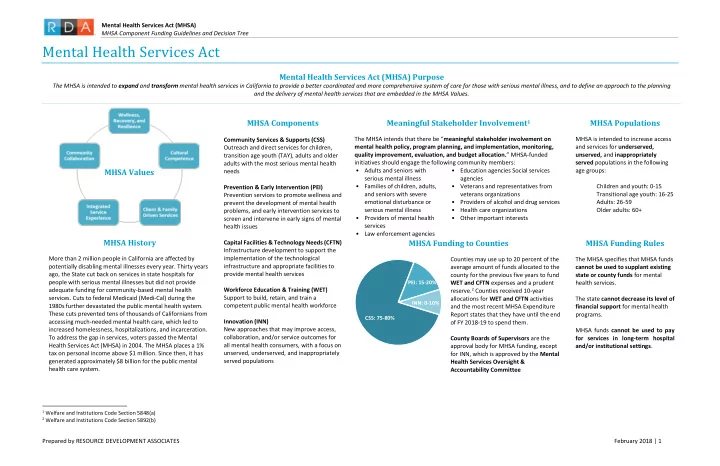
PEI = 10-15%
County MHSA Funding