Mentoring Qualification A brief overview Andre Sternitzke staff - - PowerPoint PPT Presentation

▶
mentoring qualification a brief overview
SMART_READER_LITE
LIVE PREVIEW

Mentoring Qualification A brief overview Andre Sternitzke staff - - PowerPoint PPT Presentation

Mentoring Qualification A brief overview Andre Sternitzke staff member / teacher / teacher trainer andre.sternitzke@hu-berlin.de 18.02.2019 PSE Table of content 1) Practical studies (internship) General aspects


slide-1
SLIDE 1

Andre Sternitzke

staff member / teacher / teacher trainer andre.sternitzke@hu-berlin.de

18.02.2019│ PSE
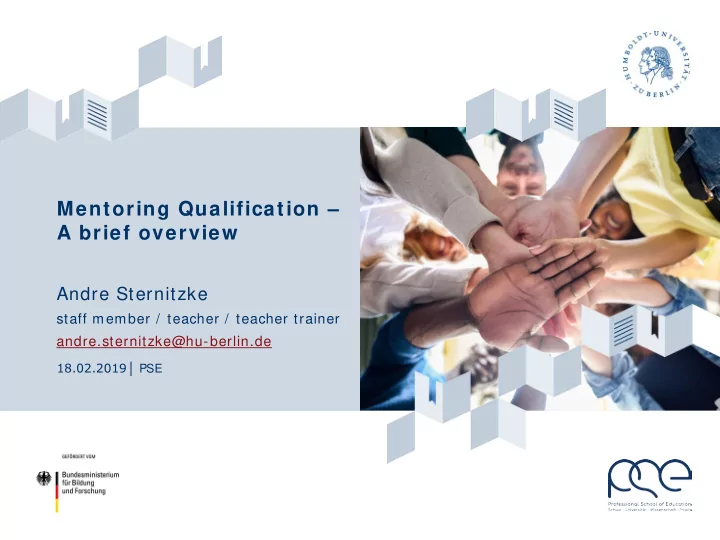
Mentoring Qualification – A brief overview

slide-2
SLIDE 2

Table of content

1) Practical studies (internship)

  • General aspects

− Chronological overview − Practice-orientated activities − Contributors

  • Internships at Stellenbosch University

2) Mentoring qualification

  • Qualification courses for teachers - content
  • General procedure at the Humboldt-University Berlin
  • tasks of a mentor

1 Hier steht z.B. der Titel der Präsentation (über Kopf- u. Fußzeile eintragen)

slide-3
SLIDE 3

Table of content

3) Video example of a co-constructive talk 4) Characteristics of con-constructive talks

  • Coaching moves
  • Effects

5) Q & A

2 Hier steht z.B. der Titel der Präsentation (über Kopf- u. Fußzeile eintragen)

slide-4
SLIDE 4
  • inherent part of the Master of Education studies since 2016
  • usually takes place in the third semester of the master‘s

studies

  • goal:
  • to bridge the gap between university and school and

make the transition easier for future teachers

Practical studies (internship)

3

slide-5
SLIDE 5
  • orientation internship during the bachelor‘s program
  • 6 weeks
  • focus: lesson observaion
  • practical studies ( internship) in Berlin
  • 5 months (01.09. – 31.01.) / 18 weeks (without

holidays)

  • in the 3rd semester of the master‘s studies, during the

winter semester

  • teacher training
  • 18 months

Chronological order

4

slide-6
SLIDE 6

School:

  • lesson observation (sitting in on classes)
  • simple tasks during the class, for example supporting

individual students

  • taking part in and contributing to general school life

(extracurricuclar activities, conferences, staff meetings,… )

  • preparation, execution and evaluation of 32 instructed

lessons University:

  • carrying out a research project
  • attending accompanying seminars

Practice-orientated activities

5

slide-7
SLIDE 7
  • university students
  • university teachers
  • mentors (school teachers)

Contributors within the practical studies

6

slide-8
SLIDE 8
  • Which role do practical studies play at your university?
  • To which extent do your requirements differ from those in

Berlin?

  • What else is of interest to you?

Internships at your faculty

7

slide-9
SLIDE 9

8

  • Professional School of Education (PSE)
  • Dahlem School of Education (DSE)
  • School of Education der TU Berlin (SETUB)
  • Zentrum für künstlerische

Lehrkräftebildung (zfkl)

Mentoring qualification: a Berlin-wide project

slide-10
SLIDE 10
  • general information
  • communication process (active listining, question

techniques, methods and strategies for overcoming problematic situations in conversations)

  • techniques and methods to carry out a co-constructive

discussion before the lesson

  • techniques and methods to carry out co-constructive

evaluation talk after the lesson

Qualification course for teachers - content

9

slide-11
SLIDE 11

Planning, execution and reflection of lessons Focus: Support the execution of lessons The m entors

  • …

provide insight into their own planning process, their teaching and in the process of evaluating lesson (and serve as role models).

  • …

let students take over parts of their lessons to create learning opportunities (team teaching).

  • …

support the students‘ planning, execution and reflection

  • f lessons by conducting co-constructive discussions before

and after the lessons.

Tasks of a mentor

10

slide-12
SLIDE 12

Please watch the video and observe the way the talk is carried

  • ut.
  • What do you notice in terms of the way the conversation is

carried out.

  • What do you find particularly positive about the taped

coaching session?

Example of a co-constructive talk before the lesson

11

slide-13
SLIDE 13
  • mentor guides through the talk
  • student as well as mentor contribute to the discussion (ask

questions, make suggestions)

  • mutual lesson planning and development of new ideas
  • mutual evaluation of the conducted lesson
  • dialogic interaction (long monologues should be avoided)
  • certain coaching moves should be used

Kreis & Staub, 2011; West & Staub, 2003

Co-construcive conversation – characteristics

12

slide-14
SLIDE 14
  • suggestion: every second lesson should be discussed co-

constructivly

  • time for talks before the lesson: maximum 45 minutes
  • time for talks after the lesson : 30 minutes

Co-constructive lesson talks – guidelines

13

slide-15
SLIDE 15

inviting coaching m oves

  • questions, requests, active listening
  • e.g.: „What difficulties could the students have with the task?“

indicating coaching m oves

  • Questions to point out certain aspects
  • e.g.: „What is the difference between the graphic and the table?

It should be clear to us.“

coaching m oves to ensure understanding

  • demands, paraphrasings, summarys, explicit wording of

arrangements

  • e.g.: „Is this what you meant?“

Kreis & Staub, 2013; Staub, 2004; Staub & Kreis, 2013

Coaching moves

14

slide-16
SLIDE 16

Examples of the video

15

slide-17
SLIDE 17

Examples of the video

16

slide-18
SLIDE 18

Examples of the video

17

slide-19
SLIDE 19

−

co-constructive discussions before the lesson is hold evoke twice as many learning achievements as debriefings

−

discussion longer than one hour are no longer effective

Futter & Staub, 2008; Kreis, 2012; Kreis & Staub, 2011; Staub & Kreis, 2013

Effects of co-constructive lesson discussions

18

slide-20
SLIDE 20

Thank you for your attention. Feel free to ask questions!

slide-21
SLIDE 21

contact Andre Sternitzke Team Mentoringqualification Professional School of Education (PSE) Humboldt-Universität Berlin Telefon: + 49 (0)30 2093 70824 E-Mail: andre.sternitzke@hu-berlin.de