
SLIDE 1
The KT Extinction!
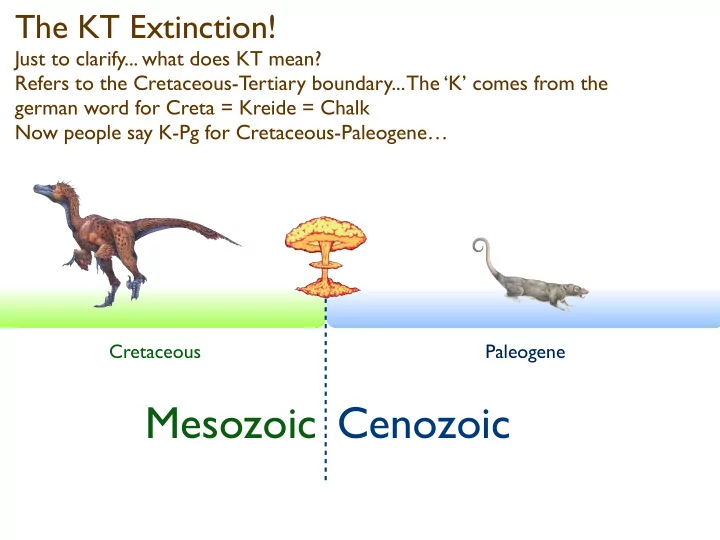
Just to clarify... what does KT mean? Refers to the Cretaceous-Tertiary boundary... The ‘K’ comes from the german word for Creta = Kreide = Chalk Now people say K-Pg for Cretaceous-Paleogene…
Cretaceous Paleogene
Mesozoic Cenozoic Bolides! Asteroid: A rocky or metallic minor - - PowerPoint PPT Presentation
The KT Extinction! Just to clarify... what does KT mean? Refers to the Cretaceous-Tertiary boundary... The K comes from the german word for Creta = Kreide = Chalk Now people say K-Pg for Cretaceous-Paleogene Cretaceous Paleogene
Just to clarify... what does KT mean? Refers to the Cretaceous-Tertiary boundary... The ‘K’ comes from the german word for Creta = Kreide = Chalk Now people say K-Pg for Cretaceous-Paleogene…
Cretaceous Paleogene
Asteroid: A rocky or metallic minor planet, or planetoid Comet: an asteroid that sublimates as the comet warms up Meteorite: A natural object from outer space that survives an impact with Earth
The Asteroid Belt Has been around since the first few million years of solar system formation Much of the original primordial material has been lost (0.1% of original mass left) 12,000 have names; 96,000 have numbers... 700,000 to 1.7 million are larger than 1 Km Harbor a small population of comets with water-ice. May have been the source of Earth’s oceans
Fish & Sharks: Not devastated; the record is not detailed enough to know what happened here. Plesiosaurs/Pliosaurs: Harder to tell... certainly disappeared around the KT Mosasaurs: Extinction occurred abruptly at KT Ichthyosaurs: Disappeared well before the KT event Ammonites: Extinction occurred abruptly at KT Bivalves: 65% went extinct within the last 10 Ma of the Cretaceous, but the record is not fine enough to known exactly when or how
Foraminifera: Abrupt extinction... only a few species crossed over. Calcareous nanofossils: As abrupt as Foraminifera
The world was changing slowly over a period of many years This was the dominant hypothesis regarding the KT event until the early 1980s Main evidence: Non-Dinosaurian terrestrial vertebrates show continuity across the KT boundary Dinosaurs declined for 10 million years prior to the KT boundary Charles Lyell: studied molluscan assemblages that showed very gradual changes through time... Greatly influenced Charles Darwin’s idea of gradual changes in animals through time GRADUALIST Georges Cuvier: studied invertebrate and vertebrate fossils of the Paris Basin and observed abrupt changes between organic remains preserved in sedimentary series CATASTROPHIST
Charles won the day and remained the dominant Father of Geology and Paleontology well into the 20th century. Catastrophism fell by the wayside. Uniformitarianism Prevailed
Until Team Alvarez came around in the late 1970s Grubbio Outcrop, Italy Lower beds contained Cretaceous marine organisms Upper beds contained Exclusively Tertiary marine organisms; no mixing Separated by a thin layer of clay Helen Michel Frank Asaro Walter Alvarez Luis Alvarez ‘Old Dutch’
Team Alvarez analyzed the upper, lower, and clay layers for Trace Elements (Rare elements). The ratios of different elements can give you clues to where the soils came from. They found that the Clay layer contained 104 x the amount of Iridium than you’d expect in the Earths Crust!
Iridium is rare in the Earth’s crust relative to the rest of the Solar System When Earth was periodically heated during it’s formation, molten iron (being heavier than other elements) sank to the Earth’s core, scrubbing
So the Earth has plenty of Iridium... it’s just ‘downstairs’.
Team Alvarez checked the Iridium Anomaly against Iridium results from the same layer in Denmark and New Zealand... the results were consistent!! From this, they conjectured that the Earth was hit by an object from outer space... No one knew anything about the physics of colliding large objects... how much devastation could an impact bring about? They based their analysis on studies of large terrestrial events such as massive volcanic explosions Krakatoa
After a back-of-the-envelope calculation:
Mass of asteroid Surface density
Surface Area of Earth’s Crust Fractional abundance of Ir in asteroids Fraction of material Krakatoa ejected into upper atmosphere
1) Shocked Quartz: Quartz grains with a unique structure: can only form under INTENSE heat, pressure 2) Melt spherules (Microtektites): Impacts eject droplets of molten rock into the atmosphere. Cools in a spheroid shape while in mid-air 3) Graphite: Carbon... evidence of burning and intense heat. Debris is lifted into upper atmosphere and burns upon re-entry
180 Km wide People have known about it since 1981 In 1991, Drill cores revealed shocked quartz Large quantities of microtektites were found in Haiti and the Caribbean in general Sedimentary evidence of tidal waves rushing inland Dated to 65.5 Ma... the nail in the coffin.
It’s now incontrovertible that an impact occurred at the KT boundary. It’s also incontrovertible that this impact was large and devastating. But more evidence is required to ensure that it is the elusive Dinosaur- Killer.
So what exactly happened? To answer that, we have to take a step back... Planetoid Baptistina. 160 million years ago, Baptistina- at 170 Km in diameter struck another asteroid about 60 Km in diameter. => 2 large asteroids ca. 10 Km in diameter One fragment hit the moon ~ Tycho crater (85 Km)
160 MA: the mid-Jurassic
The collision of Baptistina occurred during a period of time when Dinosaurs were reaching the peak of their diversity. Their fate was sealed by the middle of the Jurassic This also explains an accelerated impact rate over the last 100 million years
The remnants of Baptistina can still be observed in the asteroid belt.
Asteroid or comet 10 Km in size struck at about 22 Km/s Blew a hole in the atmosphere 100 Km wide Flung enormous amts of dust, rock, and everything else into the upper atmosphere
As the debris returns to earth, it burns up in the atmosphere, delivering intense IR radiation across the globe (and forming Microtectites) This, with the blast wave caused by the impact, knocked down and burnt trees across 1000s of Kilometers Rock at the site is shock-heated Tidal waves inundate the land for 100s of Km in all directions Stratospheric dust encircles the Earth.
70 x the entire worlds nuclear arsenal
All life near the impact is extinguished Dust blocks out the sun, cooling the Earth for weeks or months The average daytime surface temperature would drop to 10˚C (50˚F) Photosynthesis could be shut down for a year
As the bolide breaks through atmosphere, air is heated and Nitrous Oxides form. When dissolved in water, shells start dissolving... Sulfur oxides were released from the seafloor => Acid Rain Water ejected into the atmosphere would decrease Ozone The News gets better! Impact hit a carbonite shelf... releasing tons of CO2 into the atmosphere After short-term cooling, the world endures a decades-long greenhouse
Terrestrial plants underwent an instantaneous extinction event 79% of Angiosperms went extinct In some places, a fungus spike directly after extinction Global Fern spike soon afterwards
Dinosaurs, of course, are most famous victims 12-28% of fully-terrestrial vertebrates survive BUT 76-90% of aquatically adapted organisms survive Small vertebrates are favored Ectotherms are favored Non-amniotes favored
A) Massive extinction of species B) Successive blooms of opportunistic species C) Radiation of new species
Volcanism: Could explain Ir spike, but not shocked quartz And, you’d only expect a local Ir spike. Deccan Traps: Certainly big and potentially devastating, but they were active before and after the KT without detectable effects on biota. Clearly a bolide hit. Did it cause the mass extinction? Because the most recent evidence does not suggest any decline in diversity or correlation of biotic turnover with climatic effects, it remains the most plausible scenario.
“The new analysis of the dinosaur family tree reveals that dinosaurs were disappearing even before the asteroid hit about 65.5 million years ago. Roughly 24 million years before that impact, dinosaur extinction rates passed speciation rates, meaning that the animals were losing the ability to replace extinct species with new ones, the researchers said.” - LiveScience “It's unclear why the dinosaurs started going extinct so early, but there are clues as to why speciation increased during certain periods, the scientists said. One idea is that rising sea levels cut into the land, fragmenting dinosaur habitats and nudging the beasts to evolve separately into new species in different areas, the researchers said.” -LiveScience
well.
resulting collision is believed to be of very similar magnitude to the KT event.
200 asteroids known to be > 100 km diameter 700,000 to 1.7 million w/ diameter of 1 Km or more