
SLIDE 1
9/4/19 1
Speech
Hynek Hermansky Elecrical and Computer Engineering Hackerman 324Fp Message Message sound
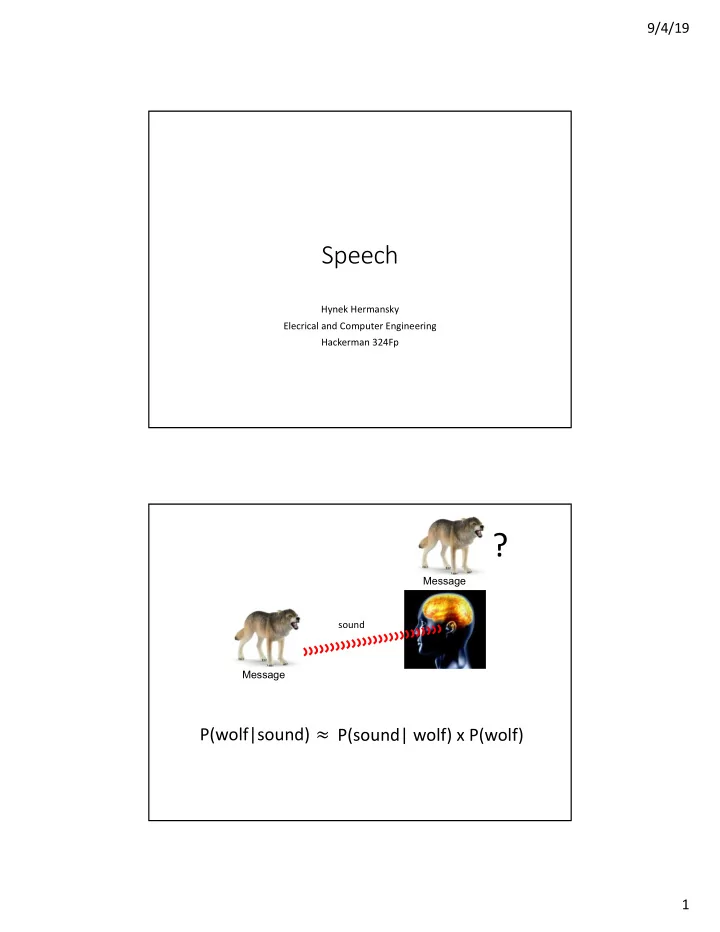
? Message sound Message P(wolf|sound) P(sound| wolf) x P(wolf) 1 - - PDF document
9/4/19 Speech Hynek Hermansky Elecrical and Computer Engineering Hackerman 324Fp ? Message sound Message P(wolf|sound) P(sound| wolf) x P(wolf) 1 9/4/19 P(sound| wolf) no wolf wolf loudness timbre (sound color) More
9/4/19 1
Hynek Hermansky Elecrical and Computer Engineering Hackerman 324Fp Message Message sound
9/4/19 2
P(sound| wolf) no wolf wolf loudness timbre (sound “color”)
More dimensions of the sound – better chance to recognize it
Pristerodon
200 000 000 years
Homo sapiens Evolution of hearing
Environment (survival)
We hear to survive
…. sensory neurons are adapted to the statistical properties of the signals to which they are exposed.
Simoncelli and Olshausen
Human speech evolved to fit properties of human hearing
200 000 years
Evolution of speech
Hearing (communication)
We speak to hear
We speak in order to be heard and need to be heard in order to be understood.
Jakobson and Waugh p.95
9/4/19 3
means for generation many different sounds (many dimensions)
nasal cavity mouth teeth lips tongue lungs velum larynx
breathing eating biting
P(o|x1,x2)= P(x1|o)P(x2|o) P(o) / P(x1)P(x2)
When more than one signal (e.g., audio and visual)
P(wolf|word) ≈ P(word| wolf) x P(wolf) Message Message word
9/4/19 4
9/4/19 5
inner ear basilar membrane tectorial membrane hairs
window round window middle ear stirrup anvil hammer
eardrum to higher processing levels
9/4/19 6
Basilar membrane as a mechanical frequency analyzer
0.05 mm 0.5 mm stiff basal end pliable apical end 500 Hz 100 Hz
basilar membrane movements => bending of hair cells => electrical pulses
inner hair cells ~ 40 hairs/cell ~ 140 hairs/cell
auditory nerve fiber auditory nerve fiber tectorial membrane basilar membrane
tunnel of corti
inner hair cells – firmly connected only to basilar membrane - information
tectorial and the basilar membranes - govern cochlear mechanics (cochlear amplifier - positive feedback)
inner ear middl e ear
ear
9/4/19 7
sensory
~1 ms ~100 ms inter-spike interval ~100,000,000
up to 10, 000,000 active in a given task
~100,000 number of spiking neurons
bottom-up connections top-down connections
Hromadka et al PLOS Biology 2008
9/4/19 8
BASE APEX
processing stages
TONOTOPY different frequencies excite different parts
different frequencies excite different parts
base high frequencies apex low frequencies
9/4/19 9
threshpldth threshold target masker masked threshold
Simultaneous masking
18
9/4/19 10
nasal cavity mouth teeth lips tongue lungs velum larynx
9/4/19 11
motor control critical elements (tongue, lips, velum) shape of the whole vocal tract spectrum of speech signal (redundant contributions of movements of critical elements in different frequency bands) INFORMATION ABOUT TRACT SHAPES DISTRIBUTED IN FREQUENCY
intended speech sounds sluggishness of vocal organs produced speech sounds
movements of vocal organs are rather sluggish
INFORMATION ABOUT TRACT SHAPES DISTRIBUTED IN TIME from Sri Narajanan
9/4/19 12
Linear model of speech production (Chiba and Kajiyama 1942) source filter filtered source signal message in movements of vocal tract modulator voiced or unvoiced carrier to make the tract movements audible message modulated carrier Carrier nature of speech (Dudley 1940)
9/4/19 13
signal vocal tract shape contributions vocal source contributions
vocal source vocal tract speech signal
nasal cavity mouth teeth lips tongue lungs velum larynx
shape shows at all frequencies of speech spectrum
happen very fast
Redundant spread of information
BASE APEX
ear brain
Medial geniculate body Inferior colliculus Superior olive Cochlear nucleus Auditory nerve
9/4/19 14
message coding introduce redundancies in frequency and in time speech signal noise decoding use redundancies for reliable extraction of the message message < 50 bps < 50 bps > 50 kbs PRODUCTION PERCEPTION TRANSMISSION
redundancy in frequency production: tract acoustics distributes the information to all frequencies of the speech spectrum perception: hearing selectivity allows for decoding the information in separate frequency bands redundancy in time production: tract sluggishness (coarticulation) distributes information about each speech sound in time perception: temporal sluggishness of hearing collect the information distributed in time
redundancies in time through sluggishness of a vocal tract redundancies in frequency through effect of tract movements on speech spectrum representation of speech sounds in frequency and in time intended sound sequence speech signal movements of vocal tract vocal tract physiology vocal tract acoustics time time
frequency
perceived sound sequence fusion of multiple streams cortical time- frequency filters corrupted speech signal representations of sound sequences in individual streams formation of spectral streams metacognitive performance monitoring time time time time
frequency frequency frequency frequency
periphery ~100 000 active neurons ~1000 Hz firing rates higher perceptual levels ~10 000 000 active neurons ~10 Hz firing rates
PRODUCTION PERCEPTION