Meta- Meta -Programming with Programming with Modelica Modelica - PDF document
Meta- Meta -Programming with Programming with Modelica Modelica for Meta- for Meta -Modeling and Modeling and Model Transformations Model Transformations Peter Fritzson, Adrian Pop Peter Fritzson, Adrian Pop OpenModelica Course, 2007
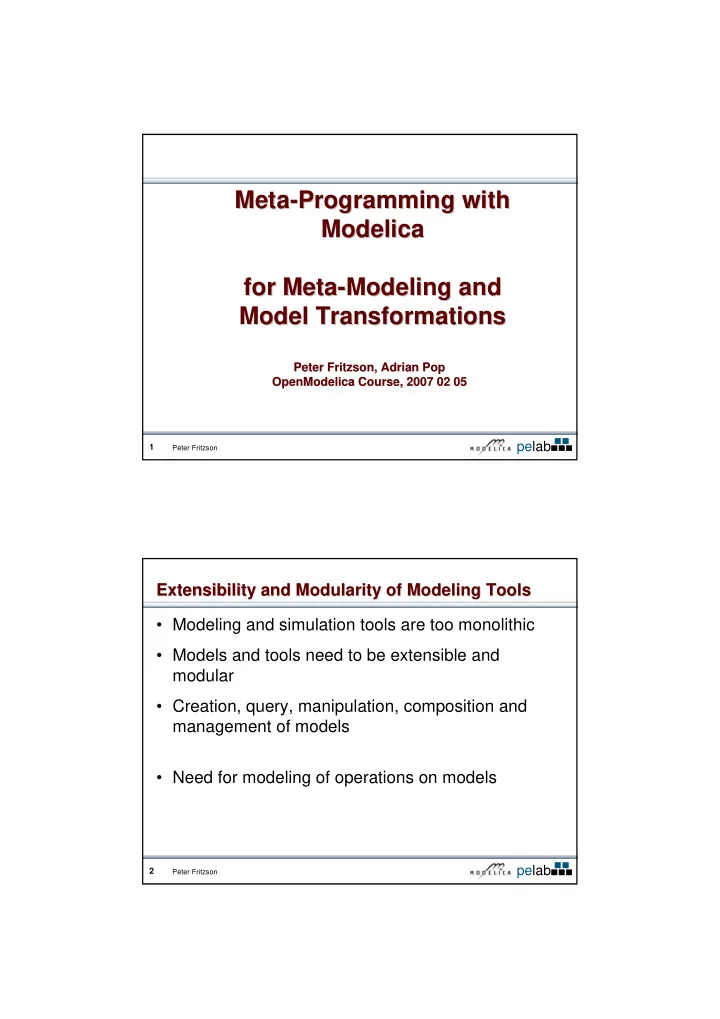
Meta- Meta -Programming with Programming with Modelica Modelica for Meta- for Meta -Modeling and Modeling and Model Transformations Model Transformations Peter Fritzson, Adrian Pop Peter Fritzson, Adrian Pop OpenModelica Course, 2007 02 05 OpenModelica Course, 2007 02 05 pelab 1 Peter Fritzson Extensibility and Modularity of Modeling Tools Extensibility and Modularity of Modeling Tools • Modeling and simulation tools are too monolithic • Models and tools need to be extensible and modular • Creation, query, manipulation, composition and management of models • Need for modeling of operations on models pelab 2 Peter Fritzson
Some Semantics Modeling Approaches Some Semantics Modeling Approaches • Extensibility - allow models to also model language properties • Ontologies to classify application domains • For example, semantic web • Equation-based approaches • Modelica – hybrid differential algebraic equations • Single-assignment equations – functional languages, SOS/Natural semantics • Unification equations: logic programming and functional languages, SOS/Natural semantics • Can usually be efficiently executed • Logic approaches • First-order logic • Often computationally intractable for realistic applications in its general form pelab 3 Peter Fritzson Meta Meta- -Level Operations on Models Level Operations on Models • Model Operations • Creation • Query • Manipulation, • Composition • management • Manipulation of model equations for • Optimization purposes • Parallelization • Model checking • Simulation with different solvers • Modularity • Allow model packages for tool extensions • Example: Automatic PDE discretization schemes pelab 4 Peter Fritzson
Meta Meta- -Level Operations on Models, Cont. Level Operations on Models, Cont. • Model configuration for simulation purposes • Initial state • Initialization via xml data files or databases • Simulation features • Running a simulation and display a result • Running more simulations in parallel • Handle simulation failures and continue the simulation in a different way • Possibility to generate ONLY specific data from a simulation • Possibility to manipulate simulation data for export to another tool pelab 5 Peter Fritzson Meta- Meta -Modelica Compiler (MMC) and Language Modelica Compiler (MMC) and Language • Supports extended subset of Modelica • Used for development of OMC • Some MetaModelica Language properties: • Modelica syntax and base semantics • Pattern matching (named/positional) • Local equations (local within expression) • Recursive tree data structures • Lists and tuples • Garbage collection of heap-allocated data • Arrays (with local update as in standard Modelica) • Polymorphic functions • Function formal parameters to functions • Simple builtin exception (failure) handling mechanism pelab 6 Peter Fritzson
A Simple match A Simple match- -Expression Example Expression Example • Example, returning a number, given a string String s ; Real x ; algorithm x := matchcontinue s case "one" then 1; case "two" then 2; case "three" then 3; else 0; end matchcontinue; pelab 7 Peter Fritzson Tree Types Tree Types – – uniontype Declaration Example uniontype Declaration Example • Union types specifies MetaModelica tree type declaration: a union of one or more record types uniontype Exp • Union types can be record INT Integer x1; end INT; record NEG Exp x1; end NEG; recursive record ADD Exp x1; Exp x2; end ADD; - can reference end Exp; themselves • The Exp type is a ADD union type of three ADD(INT(6),INT(44)) record types INT INT • Record constructors INT, NEG and ADD 6 44 • Common usage is abstract syntax trees. pelab 8 Peter Fritzson
Another uniontype Declaration of Exp Another uniontype Declaration of Exp Expressions Expressions Abstract syntax tree data type declaration of Exp: uniontype Exp record INTconst Integer x1; end INTconst; PLUSop record PLUSop Exp x1; Exp x2; end PLUSop; record SUBop Exp x1; Exp x2; end SUBop; record MULop Exp x1; Exp x2; end MULop; INTconst MULop record DIVop Exp x1; Exp x2; end DIVop; record NEGop Exp x1; end NEGop; 12 end Exp; INTconst INTconst 5 13 12+5*13 PLUSop(INTconst(12), MULop(INTconst(5),INTconst(13))) pelab 9 Peter Fritzson Simple Expression Interpreter – – with equation with equation Simple Expression Interpreter keyword, match, case keyword, match, case function eval "Evaluates integer expression trees" input Exp exp; output Integer intval; algorithm intval := matchcontinue exp Local variables with scope inside case expression local Integer v1,v2; Exp e1,e2; case INTconst(v1) then v1; Pattern binding local pattern case PLUSop(e1,e2) equation variables e1, e2 v1 = eval(e1); v2 = eval(e2); then v1+v2; case SUBop(e1,e2) equation Local equations with local v1 = eval(e1); v2 = eval(e2); then v1-v2; unknowns v1, v2 case MULop(e1,e2) equation v1 = eval(e1); v2 = eval(e2); then v1*v2; A returned value case DIVop(e1,e2) equation v1 = eval(e1); v2 = eval(e2); then v1/v2; case NEGop(e1) equation eval(e1) = v1; then -v1; end matchcontinue ; end eval; pelab 10 Peter Fritzson
Example: Simple Symbolic Differentiator Example: Simple Symbolic Differentiator function difft "Symbolic differentiation // (e1+e2)’ => e1'+e2' of expression with respect to time" case (ADD(e1,e2),tvars) equation input Exp expr; e1prim = difft(e1,tvars); input list<IDENT> timevars; e2prim = difft(e2,tvars); output Exp diffexpr; then ADD(e1prim,e2prim); algorithm // (e1-e2)’ => e1'-e2' diffexpr := case (SUB(e1,e2),tvars) equation matchcontinue (expr, timevars) e1prim = difft(e1,tvars); local Exp e1prim,e2prim,tvars; e2prim = difft(e2,tvars); Exp e1,e2,id; then SUB(e1prim,e2prim); // der of constant // (e1*e2)’ => e1'*e2 + e1*e2' case (RCONST(_), _) then RCONST(0.0); case (MUL(e1,e2),tvars) equation // der of time variable case (IDENT("time"), _) then e1prim = difft(e1,tvars); RCONST(1.0); e2prim = difft(e2,tvars); // der of any variable id then PLUS(MUL(e1prim,e2), case (id as IDENT(_),tvars) then MUL(e1,e2prim)); if listMember(id,tvars) then ... CALL(IDENT("der"),list(id)) else RCONST(0.0); ... pelab 11 Peter Fritzson General Syntactic Structure of match General Syntactic Structure of match- -expressions expressions matchcontinue <expr> <opt-local-decl> case <pat-expr> <opt-local-decl> <opt-equations> then <expr>; case <pat-expr> <opt-local-decl> <opt-equations> then <expr>; ... else <opt-local-decl> <opt-equations> then <expr>; end matchcontinue; pelab 12 Peter Fritzson
Semantics of Local Equations in match- -Expressions Expressions Semantics of Local Equations in match • Only algebraic equations are allowed, no differential equations • Only locally declared variables (local unknowns) declared by local declarations within the case expression are solved for • Equations are solved in the order they are declared. (This restriction may be removed in the future). • If an equation or an expression in a case -branch of a matchcontinue-expression fails, all local variables become unbound, and matching continues with the next branch. pelab 13 Peter Fritzson Semantics of Local Equations cont... Semantics of Local Equations cont... • Certain equations in match-expressions do not solve for any variables – they may be called "constraints" • All variables are already bound in these equations • The equation may either be fulfilled (succeed) or not (fail) • Example: local Real x=5; Integer y = 10; equation true = x>4; // Succeeds! true = y<10; // Fails!! • Thus, there can locally be more equations than unbound variables, if including the constraints pelab 14 Peter Fritzson
Recommend
More recommend
Explore More Topics
Stay informed with curated content and fresh updates.