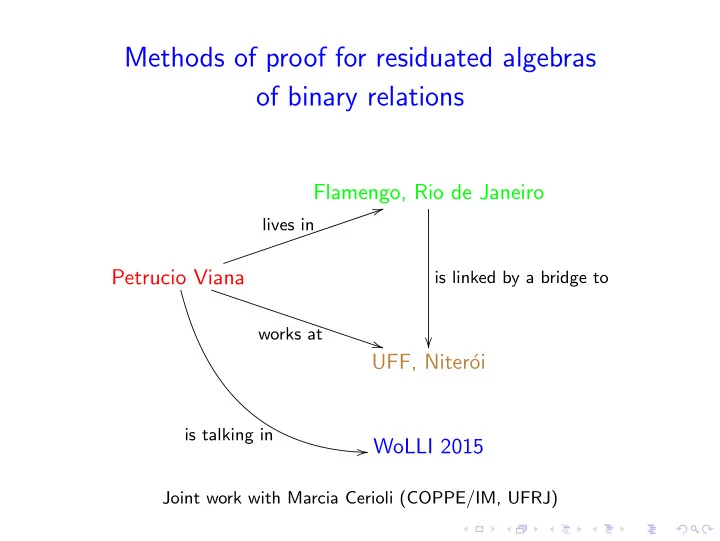
SLIDE 1 Methods of proof for residuated algebras
Flamengo, Rio de Janeiro
is linked by a bridge to
lives in
- works at
- is talking in
- UFF, Niter´
- i
WoLLI 2015
Joint work with Marcia Cerioli (COPPE/IM, UFRJ)
SLIDE 2 Outline
- 1. Binary relations and some of their operations
- 2. Residuated algebras of binary relations
- 3. Algebraic and quasi-algebraic theories of residuated algebras
- f binary relations
- 4. Calculational reasoning
- 5. Diagrammatic reasoning
- 6. Perspectives
SLIDE 3
- 1. Binary relations and some of their operations
SLIDE 4
Binary relations
Let U be a set. Elements of U are usually denoted by u, v, w, . . . A binary relation on U is a subset of U × U. 2RelU is the set of all binary relations on U. Elements of 2RelU are usually denoted by R, S, T, . . .
SLIDE 5
Operations on binary relations
Let R, S ∈ 2RelU. Booleans The union of R and S is: R ∪ S = {(u, v) ∈ U : (u, v) ∈ R or (u, v) ∈ S} The intersection of R and S is: R ∪ S = {(u, v) ∈ U : (u, v) ∈ R and (u, v) ∈ S}
SLIDE 6
Operations on binary relations
Let R, S ∈ 2RelU. Peirceans The composition of R and S is: R ◦ S = {(u, v) ∈ U : ∃w ∈ U[(u, w) ∈ R and (w, v) ∈ S]} The reversion of R is: R−1 = {(u, v) ∈ U : (v, u) ∈ R}
SLIDE 7
Operations on binary relations
Let R, S ∈ 2RelU. Between Booleans and Peirceans The left residuation of R and S is: R\S = {(u, v) ∈ U : ∀w ∈ U[ if (w, u) ∈ R, then (w, v) ∈ S]} The right residuation of R and S is: R/S = {(u, v) ∈ U : ∀w ∈ U[ if (v, w) ∈ S, then (u, w) ∈ R]}
SLIDE 8 Motivations for residuals
– Algebra: M. Ward and R.P. Dilworth. Residuated lattices.
- Trans. Amer. Math. Soc. 45: 335–54 (1939)
– Computer Science: C.A.R Hoare and H. Jifeng. The weakest
- prespecification. Fund. Inform. 9: Part I 51–84, Part II
217–252 (1986) – Linguistics: J. Lambek. The mathematics of sentence
- structure. Amer. Math. Monthly 65: 154–170 (1958)
– Logic: N. Galatos, P. Jipsen, T. Kowalski, and H. Ono . Residuated Lattices. An Algebraic Glimpse at Substructural
SLIDE 9
- 2. Residuated algebras of binary relations
SLIDE 10
Residuated algebras of relations
Let U be a set. Let A ⊆ 2RelU be closed under all the operations ∪, ∩, ◦, −1, \ and /. The residuated algebra of binary relations on U based on A is the algebra: A = A, ∪, ∩, ◦, −1, \, / A2Rel is the class of all residuated algebra of binary relations. Elements of A2Rel are usually denoted by A, B, C, . . .
SLIDE 11 Residuated algebras of relations
Aka lattice-ordered involuted residuated semigroups:
- 1. Lattice: R ∪ S is a supremum and R ∩ S is a infimum.
- 2. Ordered: R ≤ S (iff R ∪ S = S iff R ∩ S = R) is a parcial
- rdering.
- 3. Semigroup: R ◦ S is a not necessarily commutative
multiplication.
- 4. Involuted: (R−1)−1 = R and (R ◦ S)−1 = S−1 ◦ R−1.
- 5. Residuated: \ is the left-inverse of ◦ and / is the right inverse
- f ◦.
SLIDE 12
- 3. Algebraic and quasi-algebraic theories of
residuated algebras of binary relations
SLIDE 13
Terms and inclusions
The terms, typically denoted by R, S, T, . . ., are generated by: R ::= X | R ∪ R | R ∩ S | R ◦ R | R\R | R/R | R−1 where X ∈ Var, a set of variables fixed in advance. A quasi-equality is an expression of the form R ⊆ S where R and S ate terms.
SLIDE 14
Horn quasi-equalities
A Horn quasi-equality is an expression of the form R1 ⊆ S1, . . . , Rn ⊆ Sn ⇒ R ⊆ S where R1, S2, . . . , Rn, Sn, R, S are terms.
SLIDE 15
Valuations and values
Let A ∈ A2Rel. A valuation on A is a function v : Var → A. Let R be a term, A ∈ A2Rel, and v be a valuation on A. The value of R in A according to v, denoted by RA
v is defined by:
X A
v
= vX (R ∪ S)A
v
= RA
v ∪ SA v
(R ∩ S)A
v
= RA
v ∩ SA v
(R ◦ S)A
v
= RA
v ◦ SA v
(R\S)A
v
= RA
v \SA v
(R−1)A
v
= (RA
v )−1
SLIDE 16 Truth and validity
Let R ⊆ S be a quasi-equality, A ∈ A2Rel, and v be a valuation
R ⊆ S is true on A under v if RA
v ⊆ SA v .
R ⊆ S is identically true on A, or A is a model of R ⊆ S, if R ⊆ S is true on A under v, for every valuation v. R ⊆ S is valid if every residuated algebra of relations A is a model
SLIDE 17
Validity and consequence
Let R1 ⊆ S1, . . . , Rn ⊆ Sn ⇒ R ⊆ S (1) be a Horn quasi-equality, A ∈ A2Rels, and v be a valuation on A. (1) is valid, or R ⊆ S is a consequence of R1 ⊆ S1, . . . , Rn ⊆ Sn, if every model of all R1 ⊆ S1, . . . , Rn ⊆ Sn is a model of R ⊆ S.
SLIDE 18
From quasi-equalities to equalities and back
An equality is an expression of the form R = S where R and S ate terms. A Horn equality is an expression of the form R1 = S1, . . . , Rn = Sn ⇒ R = S where R1, S2, . . . , Rn, Sn, R, S are terms.
SLIDE 19
From quasi-equalities to equalities and back
True, identically true, and valid equalities are defined as usual.
SLIDE 20
From quasi-equalities to equalities and back
Since R ⊆ S is valid iff R ∩ S ⊆ S and S ⊆ R ∩ S are both valid, we can consider to build the algebraic and the quasi-algebraic theories of the residuated algebras of relations on the top of the logic of equality. But, taking equational logic as the subjacent logic, we have the following . . .
SLIDE 21
Negative results
The set of all valid equalities (quasi-equalities) is not finitely axiomatizable (Mikul´ as, IGPL, 2010). The set of all valid Horn equalities (Horn quasi-equalities) is not finitely axiomatizable (Andr´ eka and Mikul´ as, JoLLI, 1994).
SLIDE 22
Negative results
One proper question is: are there interesting alternatives for equational reasoning on residuated algebras of binary relations?
SLIDE 23
- 4. Calculational reasoning
SLIDE 24
Quasi-posets
Let P be a set and R be a binary relation on P. P, R is a quasi-poset if R is reflexive and transitive (but not necessarily antisymmetric) on P.
SLIDE 25
Galois connections
Let P1 = P1, ≤1, P2 = P2, ≤2 be quasi-posets, and f : P1 → P2, g : P2 → P1 be functions. P1, P2, f , g is a Galois connection if, for all x ∈ P1 and y ∈ P2: fx ≤2 y ⇐ ⇒ x ≤1 gy
SLIDE 26
Calculational rules
Quasi-poset rules ⊤ x ≤ x
Ref
x ≤ y . . . y ≤ z x ≤ z
Tra
GC rules fx ≤ y x ≤ gy
GC
x ≤ gy fx ≤ y
GC
These rules aloud us to perform both direct and indirect calculational reasoning (without negation).
SLIDE 27 Direct calculational proofs
A direct calculational proof of t1 ≤ t2 is a sequence t1 ≤ t2, t3 ≤ t4, . . . , tn−1 ≤ tn such that, for each i, 3 ≤ i ≤ n, ti ≤ ti+1, at least one oh the following conditions hold:
- 1. ti ≤ ti+1 is an axiom.
- 2. ti ≤ ti+1 is obtained from previou(s) quasi-equation(s) in the
sequence by one application of some calculational rule.
- 3. tn−1 ≤ tn is an axiom.
Start with t1 ≤ t2 and applying axioms and calculational rules arrive in an axiom.
SLIDE 28 Direct calculational proofs from hypothesis
Let Γ be a set of quasi-equations. A direct calculational proof of t1 ≤ t2 from Γ is a sequence t1 ≤ t2, t3 ≤ t4, . . . , tn−1 ≤ tn such that, for each ti ≤ ti+1, where 3 ≤ i ≤ n, at least one of the following conditions hold:
- 1. ti ≤ ti+1 is an axiom
- 2. ti ≤ ti+1 ∈ Γ
- 3. ti ≤ ti+1 is obtained from previou(s) quasi-equation(s) in the
sequence by one application of some Calculational Rule.
- 4. tn−1 ≤ tn is an axiom or belongs to Γ.
Start with t1 ≤ t2 and applying axioms, hyphotesis, and calculational rules arrive in an axiom or hyphotesis.
SLIDE 29
∪ defines a Galois connection
Let A, ⊆ ∈ A2Rel and take A × A, ⊆ × ⊆ ∈ A2Rel. For all X, Y ∈ A, we define f : A × A → A by: f (X, Y ) = X ∪ Y and g : A → A × A by: g(X) = (X, X) With these notations, for all R, S, T ∈ A: R ∪ S ⊆ T ⇐ ⇒ R ⊆ T and S ⊆ T is the same as f (R, S) ⊆ T ⇔ (R, S) ⊆ g(T)
SLIDE 30
\ defines a family of Galois connections
Let A, ⊆ ∈ A2Rel. For every R ∈ A, we define: fR(X) = R ◦ X and gR(X) = R\X With these notations, we have that R ◦ S ⊆ T ⇔ S ⊆ R\T is the same as fR(S) ⊆ T ⇔ S ⊆ gR(T)
SLIDE 31
∩, −1 and / define Galois connections
Sorry, no time to enter in details!
SLIDE 32
Basic arithmetical results
T1) S ⊆ R\(R ◦ S) S ⊆ R\(R ◦ S) GC R ◦ S ⊆ R ◦ S Ref ⊤
SLIDE 33
Basic arithmetical results
T2) R ◦ (R\S) ⊆ S R ◦ (R\S) ⊆ S GC R\S ⊆ R\S Ref ⊤
SLIDE 34
Basic arithmetical results
T3) R\(S ∩ T) ⊆ (R\S) ∩ (R\T) R\(S ∩ T)] ⊆ (R\S) ∩ (R\T) GC R\(S ∩ T)] ⊆ R\S ∧ R\(S ∩ T) ⊆ S\T GC R ◦ [R\(S ∩ T)] ⊆ S ∧ R ◦ [R\(S ∩ T)] ⊆ T GC R ◦ [R\(S ∩ T)] ⊆ S ∩ T GC R\(S ∩ T) ⊆ R ◦ (S ∩ T) Ref ⊤
SLIDE 35
Basic arithmetical results
T4) S ⊆ T = ⇒ R\S ⊆ R\T S ⊆ T T2 R ◦ (R\S) ⊆ T GC R\S ⊆ R\T By T2, R ◦ (R\S) ⊆ S.
SLIDE 36
Basic arithmetical results
T5) T1, T2, T3 = ⇒ GC for \ R ◦ S ⊆ T ⇓ Mon, Ide R ◦ S ⊆ (R ◦ S) ∩ T ⇓ T4 R\(R ◦ S) ⊆ R\[(R ◦ S) ∩ T] ⇓ T1 S ⊆ R\[(R ◦ S) ∩ T] ⇓ T3 S ⊆ R\T By T1, S ⊆ R\(R ◦ S). By T3, R\[(R ◦ S) ∩ T] ⊆ R\T.
SLIDE 37
Basic arithmetical results
T5) T1, T2, T3 = ⇒ GC for \ S ⊆ R\T ⇓ Mon R ◦ S ⊆ R ◦ (R\T) ⇓ T2 R ◦ S ⊆ T By T2, R ◦ (R\S) ⊆ S
SLIDE 38 Indirect calculational proofs
An indirect calculational proof of t1 ≤ tn is a sequence x ≤ t1, t2 ≤ t3, . . . , x ≤ tn such that ti ≤ ti+1 —for each i, 2 ≤ i ≤ n − 1— and x ≤ tn are
- btained from previou(s) quasi-equation(s) in the sequence by one
application of some calculational rule. Suppose x ≤ t1 and prove x ≤ t2 by applying the calculational rules.
SLIDE 39 Indirect calculational proofs from hyphotesis
Let Γ be a set of quasi-equations. A direct calculational proof of t1 ≤ tn from Γ is a sequence x ≤ t1, t2 ≤ t3, . . . , x ≤ tn such that, for each ti ≤ ti+1, where 2 ≤ i ≤ n − 1, at least one of the following conditions hold:
- 1. ti ≤ ti+1 is an axiom
- 2. ti ≤ ti+1 ∈ Γ
- 3. ti ≤ ti+1 is obtained from previou(s) quasi-equation(s) in the
sequence by one application of some calculational rule.
- 4. x ≤ tn is an axiom or belongs to Γ.
Suppose x ≤ t1 and prove x ≤ t2 by applying axioms, hyphotesis, and calculational rules.
SLIDE 40
Basic arithmetical results
T6) (R\S) ∩ (R\T) ⊆ R\(S ∩ T) X ⊆ (R\S) ∩ (R\T) GC X ⊆ R\S ∧ X ⊆ R\T GC R ◦ X ⊆ S ∧ R ◦ X ⊆ T GC R ◦ X ⊆ S ∩ T GC X ⊆ R\(S ∩ T) Hence, (R\S) ∩ (R\T) ⊆ R\(S ∩ T) and R\(S ∩ T) ⊆ (R\S) ∩ (R\T) (this is a bonus!).
SLIDE 41
Some questions
To determine the strengths of: (1) direct calculational proofs, (2) direct calculational proofs from hypothesis, (3) indirect calculational proofs, and (4) indirect calculational proofs from hyphotesis.
SLIDE 42
- 5. Diagrammatic reasoning
SLIDE 43 Digraphs
A directed labelled multi graph is a structure N, A, where:
- 1. N is a set of nodes
- 2. A ⊆ N × Terms × N is a set of arcs labeled by terms
Nodes are usually denoted by u, v, w, . . . Digraphs are usualy denoted by G, H, I, . . .
SLIDE 44
Homomorphisms
Let G1 = N1, A1 and G2 = N2, A2 be digraphs. A homomorphism from G1 to G2 is a mapping h : N1 → N2 such that: (hu, t, hv) ∈ A2 whenever (u, t, v) ∈ A1 A mapping that preserves labels.
SLIDE 45 2-pointed graphs
A 2-pointed digraph is a structure N, A, s, t, where:
- 1. N, A is the subjacent digraph
- 2. s, t ∈ N, where s is the source and t is the target
2-pointed digraphs are usually denoted by G, s, t.
SLIDE 46
2-pointed Homomorphisms
Let G1 = N1, A1, s1, t1 and G2 = N2, A2, s2, t2 be 2-pointed digraphs. A 2-pointed homomorphism from G1 to G2 is a homomorphism h : N1 → N2 such that: hs1 = s2 and ht1 = t2 A homomorphism that preserves source and target.
SLIDE 47 Operations on diagrams
Split digraphs
=
S
Paralelize arcs
=
SLIDE 48 Operations on diagrams
Sequentialize arcs
=
S
Revert arcs
=
SLIDE 49 Operations on diagrams
Close digraphs
R\S
⊆
Add residuals
⊆
SLIDE 50 Operations on diagrams
Hyphotesis rule R ⊆ S ∧
⊆
Hybrid rule S ⊆ T ∧
⊆
SLIDE 51
Basic arithmetical results
Suppose R ◦ S ⊆ T. We shall prove S ⊆ R\T by means of diagrams.
SLIDE 52
Basic arithmetical results
Start with the graph of the left hand side: −
S
+
SLIDE 53 Basic arithmetical results
Apply add residuals: −
S
+
SLIDE 54 Basic arithmetical results
Apply hybrid rule, together with the hyphotesis R ◦ S ⊆ T: −
S
+
SLIDE 55
Basic arithmetical results
Apply homomorphism, erasing superfluous arcs: −
R\T
+
SLIDE 56
Basic arithmetical results
Suppose S ⊆ R\T. We shall prove R ◦ S ⊆ T by means of diagrams.
SLIDE 57
Basic arithmetical results
Start with the graph of the left hand side: −
R◦S
+
SLIDE 58 Basic arithmetical results
Apply sequencialize arcs: −
R
S
+
SLIDE 59 Basic arithmetical results
Apply the hyphotesis R ⊆ R\T: −
R
S
+
SLIDE 60 Basic arithmetical results
Apply close diagram: −
R
+
SLIDE 61
Basic arithmetical results
Apply homomorphism, arasing superfluous arcs: −
T
+
SLIDE 62
Some questions
(1) To determine the strengths of the proofs with graphs. (2) To compare equational reasoning with calculational reasoning with diagrammatic reasoning.