Mid-Atlantic Marine Debris Summit June 17-19, 2019 George Mason - - PowerPoint PPT Presentation

mid atlantic marine debris summit june 17 19 2019 george
SMART_READER_LITE
LIVE PREVIEW

Mid-Atlantic Marine Debris Summit June 17-19, 2019 George Mason - - PowerPoint PPT Presentation

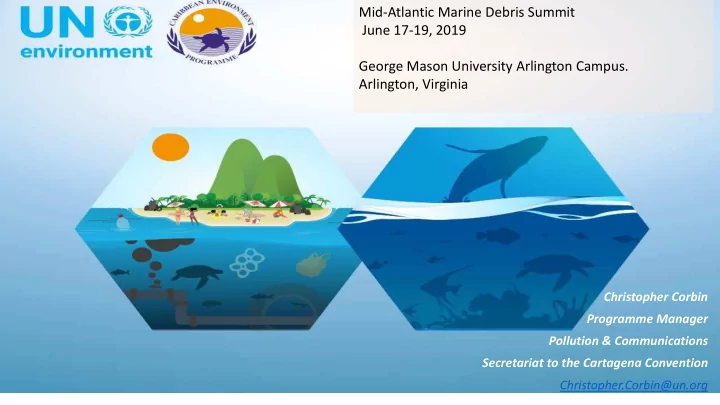
Mid-Atlantic Marine Debris Summit June 17-19, 2019 George Mason University Arlington Campus. Arlington, Virginia Christopher Corbin Programme Manager Pollution & Communications Secretariat to the Cartagena Convention


slide-1
SLIDE 1

Christopher Corbin Programme Manager Pollution & Communications Secretariat to the Cartagena Convention Christopher.Corbin@un.org

Mid-Atlantic Marine Debris Summit June 17-19, 2019 George Mason University Arlington Campus. Arlington, Virginia

slide-2
SLIDE 2

Let’s Take a Journey through the Caribbean Sea

Part 1

slide-3
SLIDE 3

Where do I begin?

slide-4
SLIDE 4

WAS WASTE MO MOVE VES!

slide-5
SLIDE 5
slide-6
SLIDE 6

Global & Regional Solutions

Part 2

slide-7
SLIDE 7

Global Commitments

UN Resolutions & Political Commitments Sustainable Cities, Consumption & Production Waste Management Outlooks & Guidelines Scientific Knowledge on Plastics & Microplastics Green, Blue & Circular Economies (Waste as a Resource & Waste to Value)

slide-8
SLIDE 8
slide-9
SLIDE 9
slide-10
SLIDE 10
slide-11
SLIDE 11
slide-12
SLIDE 12

฀ ฀ ฀ ฀

Clea ean S Sea eas Beat Pl Plastic Pollu lution Ban t n the he Micr crobead Break up up wit ith Pla lastics

Advocacy Behavioral Change Awareness Policy Change

#plasticfreejuly; #pickitup #litteringisnotcool; #zerowaste; #plasticfree; #strawssuck; #refusesingleuse; #wepickupplastic;

slide-13
SLIDE 13

#CleanSeasCampaign

In Latin America & Caribbean 20 countries.

Source: http://www.cleanseas.org/ 60

slide-14
SLIDE 14

STATUS OF THE CARTAGENA CONVENTION & THE LBS PROTOCOL

slide-15
SLIDE 15

About the Caribbean Node

slide-16
SLIDE 16

Regional Frameworks

Legislation, policies and enforcement Institutional frameworks and Stakeholder involvement Monitoring Programmes and Research Education and outreach Solid waste management planning

slide-17
SLIDE 17
slide-18
SLIDE 18

Our Caribbean Reality

Part 3

slide-19
SLIDE 19

19

From here to there

slide-20
SLIDE 20

20

slide-21
SLIDE 21

Waste & Marine Litter Trends

Most Tourism Dependent Region Waste Characterization & Generation Rates

(Increase in Plastics from 5% to 35%)

Climate Change Adaptation & Mitigation Increase of Waste to Energy Proposals Banning of Plastics, Styrofoam etc.

slide-22
SLIDE 22

Sargassum Influx Coastal Development Sedimentation Invasive species Ballast Water Acidification Sea level rise T emperature Coral bleaching Water security Hydrocarbons Agrochemicals Sewage Heavy metals Solid Waste/Plastics/litter POPs Legislation Policies Institutions

OVERFISHING

slide-23
SLIDE 23

23

Systems: Lack of integration of marine litter into solid waste management frameworks Inadequate collection, recycling & recovery Inadequate reception facilities at ports & marinas

slide-24
SLIDE 24

24

Information: Plastic use, sources,

alternatives & impacts Business Models for Waste to Energy/Value Implications of bans, alternatives Barriers to Private Sector Involvement

slide-25
SLIDE 25

25

Enabling Environment: Policy, Legislation & Enforcement Awareness, Attitudes & Behavior Political Priorities

slide-26
SLIDE 26

Trinidad and Tobago High income Turks & Calicos High income US Virgin Islands High income St Kitts & Nevis High income St Maarten High income Anguilla High income Antigua and Barbuda High income Aruba High income The Bahamas High income Barbados High income Bermuda High income British Virgin Islands High income Cayman Islands High income Curacao High income Haiti Low income Belize Upper middle income Cuba Upper middle income Dominica Upper middle income Dominican Republic Upper middle income Grenada Upper middle income Guyana Upper middle income Jamaica Upper middle income Montserrat Upper middle income Saint Lucia Upper middle income S Vi & h G di U iddl i

slide-27
SLIDE 27
slide-28
SLIDE 28
slide-29
SLIDE 29

The Bans in the Region

Pres esents t the k e key a ey aspec ects o

  • f the

e policies and regulatory instrumen ents t that have b been en implemented i in the W Wider C Caribbean Region. Provid ides lessons f for polic icy makers w who s seek t to regu gula late t the u use a and p productio ion o

  • f

disposable le p plastic ics.

The s study dy: ฀

Pres esents t the k e key a ey aspec ects o

  • f the

e policies and regulatory instrumen ents t that have b been en implemented i in the W Wider C Caribbean Region. Provid ides lessons f for polic icy makers w who s seek t to regu gula late t the u use a and p productio ion o

  • f

disposable le p plastic ics.

฀ ฀ ฀

BAN BAN ANNOUNCED BAN IN DISCUSSION – Government Level BAN IN DISCUSSION – Public/NGOs (including Voluntary Ban) NO BAN

slide-30
SLIDE 30
slide-31
SLIDE 31
slide-32
SLIDE 32
slide-33
SLIDE 33

Jamaica

The Bans in the Region

200 170

Jamaica European Union Australia World average

500 140 In Jamaica, as of 2015, each person has been using almost 500 plastic bags annually, an estimated 75 per cent increase from 2011.

#Plastic bags per person per year

Source: http://jamaica-gleaner.com/article/news/20180205/capri-reducing-scandal-bag-use-jamaica-ban-or-fee-denmark-first-country-tax

slide-34
SLIDE 34

Antigua and Barbuda

The Bans in the Region

Source: Antigua and Barbuda Department of the Environment, 2017. “Stages and implementation of Styrofoam ban.”

2 4 6 8 10 12 14 16 18 20 2006 2008 2010 2012 2014 2016

Composition of plastic at landfill (%)

4.4% 19.5%

slide-35
SLIDE 35

Education & Outreach

Part 4

slide-36
SLIDE 36
slide-37
SLIDE 37
slide-38
SLIDE 38
slide-39
SLIDE 39
slide-40
SLIDE 40
slide-41
SLIDE 41
slide-42
SLIDE 42
slide-43
SLIDE 43
slide-44
SLIDE 44

National & Community Actions

Part 5

slide-45
SLIDE 45

Pol

  • licy Sol

cy Soluti tions: s: Sol Solid Was aste

SIDS Specific Solutions Sustainable Financing Regional Plan Awareness – Behaviour Change Climate Change

slide-46
SLIDE 46

Pol

  • licy Sol

cy Soluti tions: s: P Plas asti tics cs

Elimination of problematic or unnecessary plastic packaging and/or products

Promote

Reuse models where relevant, to reduce the need for single-use plastic packaging and/or products

Encourage

Use of reusable, recyclable, or compostable packaging

Incentivize

Collection, sorting, reuse, and recycling rates

Increase

Establishment of the necessary infrastructure and related funding mechanisms/cost recovery

Facilitate

Demand for recycled products including plastics

Stimulate
slide-47
SLIDE 47

Activities of the GPML-Caribe

Link Between Marine Litter and Zika

Relationship between cases of ZikV & marine debris density

Human Health

slide-48
SLIDE 48

Microplastics in Fish

slide-49
SLIDE 49

Microplastic in Commercially Exploited Fish from Grenada, West Indies

slide-50
SLIDE 50

Where do we go from here?

Part 6

slide-51
SLIDE 51

Job Opportunities Community Leaders Targeted Messages Partnerships

Lessons Learned

slide-52
SLIDE 52

www.gpml-caribe.org

slide-53
SLIDE 53

Strategic Planning for Marine Litter Activities in the Caribbean Region Sustainabil ility

slide-54
SLIDE 54

Four Themes

Research and Monitoring Governance Communication Capacity Building & Training

slide-55
SLIDE 55

Sustainable Consumption & Production Solid waste generation is expected to increase; Reduction of the influx of waste os required as well as change in consumption; Appropriate Technologies; Integrated Waste Management The new Rs – Refuse, Repurpose, Re-engineer; Land & Marine-Based Sources; Pollution (LBS) Protocol Marine Litter/Plastics included as priority pollutant - SDG 14.1 Research Impacts of plastic on human & ecological health included associated economic costs.

slide-56
SLIDE 56

T HANK YOU

United Nations Environment Programme Caribbean Environment Programme 14-20 Port Royal Street, Kingston, Jamaica Tel: +876-922-9267; Fax: +876-922-9292 Website: www.unenvironment.org/cep Facebook: UN Environment-Caribbean Environment Programme Twitter: @UNenvironm_CEP