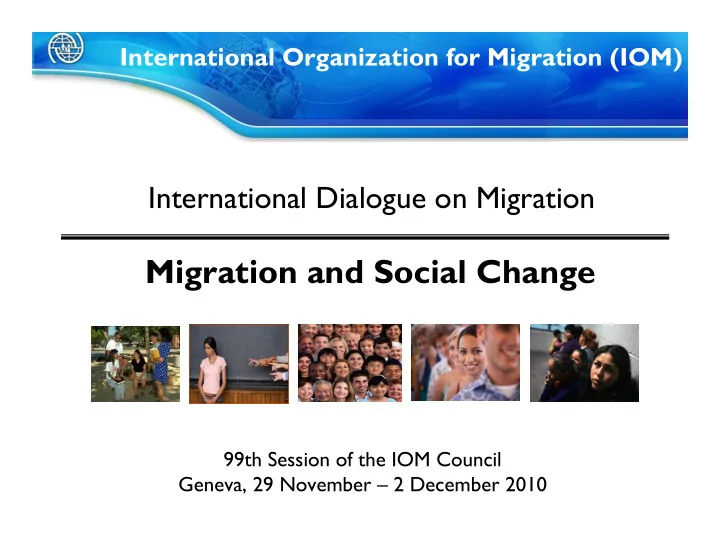
Migration and Social Change 99th Session of the IOM Council Geneva, - - PowerPoint PPT Presentation

migration and social change
SMART_READER_LITE
LIVE PREVIEW

Migration and Social Change 99th Session of the IOM Council Geneva, - - PowerPoint PPT Presentation

International Organization for Migration (IOM) International Dialogue on Migration Migration and Social Change 99th Session of the IOM Council Geneva, 29 November 2 December 2010 International Dialogue on Migration 2010 First workshop


slide-1
SLIDE 1

International Organization for Migration (IOM)

Migration and Social Change

International Dialogue on Migration

99th Session of the IOM Council Geneva, 29 November – 2 December 2010

slide-2
SLIDE 2

International Dialogue

  • n Migration 2010

Second workshop “Societies and Identities: The Multifaceted Impact

  • f Migration”

(19-20 July 2010) First workshop “Migration and Transnationalism: Opportunities and Challenges” (9-10 March 2010)

slide-3
SLIDE 3

Migration and Social Change – A Context

Migration is an evolving social process that connects people, societies and cultures. The dynamism of human mobility creates new spaces for interaction among people of origin and destination countries. Migrants’ transformative role contributes to change in social structures, norms, attitudes and practices.

slide-4
SLIDE 4

Lessons Learned

The challenge is how to manage inevitable changes

  • ccurring due to migration.
  • 1. Migration is one of many

drivers of social change.

  • 2. Transnational dynamics

are a key characteristic of contemporary migration.

slide-5
SLIDE 5

Lessons Learned

  • 3. Migrants are both agents and subjects of

transnationalism.

  • 4. Migration also affects non-migrants in countries
  • f origin and destination.
  • 5. Maintaining cohesive societies in face of greater

mobility / diversity is fundamental.

slide-6
SLIDE 6

Lessons Learned

  • 6. Managing perceptions of migrants and migration is

crucial for social cohesion.

  • 7. The concept of integration needs to be revisited in

light of changing migration dynamics and other parameters.

slide-7
SLIDE 7

Approaches for Policymakers

First, minimize misperceptions of migrants and migration

Sensitize public to negative and false images of migrants and migration Call upon media for objective and accurate reporting Support media by and for migrant or ethnic minority communities

slide-8
SLIDE 8

Approaches for Policymakers

Focus on building local citizenry Support local leadership and community-tailored initiatives Increase interaction between migrants and their communities

  • f origin

Second, mobilize initiatives to increase migrants’ social participation, particularly at the local level

slide-9
SLIDE 9

Approaches for Policymakers

Third, institutionalize mechanisms to enhance political participation of migrants

Countries of destination:

  • Local political rights and participation
  • Innovative youth engagement

Countries of origin:

  • Out-of-country voting
  • Regular consultations with /

representation of the diaspora

slide-10
SLIDE 10

Fourth, adopt policies to support different migrant groups

Countries of origin:

  • Education about rights and

responsibilities

  • Pre-departure orientation

Countries of destination:

  • Key services and institutions accessible in different

languages and to different cultural groups

Approaches for Policymakers

slide-11
SLIDE 11

Fifth, expand cooperation to ensure policy coherence and effectiveness

Approaches for Policymakers

Cooperation at every level Partnerships with non- governmental actors and sharing of best practices

slide-12
SLIDE 12

Countries of origin:

  • Psychosocial assistance for

spouses and children

  • Skills training and access to

economic opportunities Countries of destination:

  • Support to migrant families
  • Attention to 1.5th, 2nd and

3rd generation

Approaches for Policymakers

Sixth, implement measures to minimize the negative impacts of migration on families

slide-13
SLIDE 13

Conclusion

Growing transnational migration will continue to change social fabrics of both origin and destination countries Managing social changes and challenges more effectively and coherently is fundamental for making migration beneficial A way forward:

I. Revisit migration policy (origin and destination countries) taking into account the transnational dimension of human mobility II. Mobilize society to counter anti-migration sentiment, smoothing the integration process

  • III. Support migrants, their families and home and host

communities