
SLIDE 1
Page 1 Steve Brice FNAL Neutrino 2004 June 15
MiniBooNE
Steve Brice Fermilab
Overview MiniBooNE Beam MiniBooNE Detector Neutrino Analyses Summary
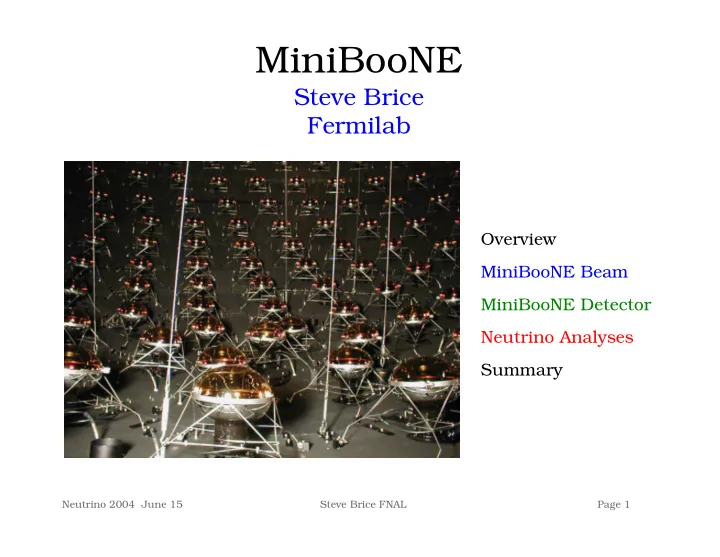
MiniBooNE Steve Brice Fermilab Overview MiniBooNE Beam MiniBooNE - - PowerPoint PPT Presentation
MiniBooNE Steve Brice Fermilab Overview MiniBooNE Beam MiniBooNE Detector Neutrino Analyses Summary Neutrino 2004 June 15 Steve Brice FNAL Page 1 Current Oscillation Signals Unconfirmed m 2 LSND ~ 0.1-10
Page 1 Steve Brice FNAL Neutrino 2004 June 15
Overview MiniBooNE Beam MiniBooNE Detector Neutrino Analyses Summary
Page 2 Steve Brice FNAL Neutrino 2004 June 15
∆m2
LSND~ 0.1-10 eV2
∆m2
atm ~ 2 - 3 x 10⁻³ eV2
✁∆m2
solar ~ 7 x 10⁻⁵ eV2
(Soudan, Kamiokande, MACRO, Super-K) (Homestake, SAGE, GALLEX, Super-K SNO, KamLAND)
Page 3 Steve Brice FNAL Neutrino 2004 June 15
Sensitivity to exclude Null CP signal at 2σ
Black: No MiniBooNE Signal Red: if CPC MiniBooNE signal Blue: if CPV MiniBooNE signal
solar + ∆m2 atm ≠ ∆m2 LSND
✂add extra neutrino flavours, but don't allow them to interact weakly
✂ Page 4 Steve Brice FNAL Neutrino 2004 June 15
✂Excess of νe events in a νµ beam
☎87.9 ± 22.4 ± 6.0 over background
☎~4σ evidence for ν oscillation
Experiment with
✆different systematics
✆higher statistics
✆similar L/E
✂(hep-ex 0104049)
Page 5 Steve Brice FNAL Neutrino 2004 June 15
Fermilab IL, USA
Y.Liu, I.Stancu University of Alabama S.Koutsoliotas Bucknell University E.Hawker, R.A.Johnson, J.L.Raaf University of Cincinnati T.Hart, R.H.Nelson, M.Wilking, E.D.Zimmerman University of Colorado A.A.Aguilar-Arevalo, L.Bugel,
D.Schmitz, M. H. Shaevitz,
Columbia University D.Smith Embry Riddle Aeronautical University L.Bartoszek, C.Bhat, S.J.Brice, B.C.Brown, D.A.Finley, B.T.Fleming, R.Ford, F.G.Garcia, P.Kasper, T.Kobilarcik, I.Kourbanis, A.Malensek, W.Marsh, P.Martin, F.Mills, C.Moore, P.Nienaber, E.Prebys, A.D.Russell, P.Spentzouris, R.Stefanski, T.Williams Fermi National Accelerator Laboratory D.C.Cox, A.Green, T.Katori, H. -O.Meyer, R.Tayloe Indiana University G.T.Garvey, C.Green, W.C.Louis, G.A.McGregor, S.McKenney, G.B.Mills, H.Ray, V.Sandberg, B.Sapp, R.Schirato, R.Van de Water, N.L.Walbridge, D. H. White Los Alamos National Laboratory R.Imlay, W.Metcalf, S.Ouedraogo, M.Sung, M.Wascko Louisiana State University J.Cao, Y.Liu, B.P.Roe, H.J.Yang University of Michigan A.O.Bazarko, P.D.Meyers, R.B.Patterson, F.C.Shoemaker, H.A.Tanaka Princeton University
Page 6 Steve Brice FNAL Neutrino 2004 June 15
L=540 m ~10x LSND
✞E~500 MeV ~10x LSND
✝cover LSND 90% conf region at 4-5σ
✞this needs ~1021 delivered protons
Page 7 Steve Brice FNAL Neutrino 2004 June 15
Primary Beam
✟8 GeV protons from Booster
✠Into MiniBooNE beamline
Secondary Beam
✡Mesons from protons striking Be target
☛Focused by magnetic horn
Tertiary Beam
☞Neutrinos from meson decay in 50m pipe
✌Pass through 500m dirt (and oscillate?) to reach detector
Booster
Beamline Target and Horn LMC Decay Region 500m dirt Detector
Primary Beam (protons) Secondary Beam (mesons) Tertiary Beam (neutrinos)
Page 8 Steve Brice FNAL Neutrino 2004 June 15
In its 30 years the Fermilab Booster has never worked this hard
✎Currently average ...
✏~ 6x10¹⁶ protons/hour
✑Have reached 28% of total protons needed
Page 9 Steve Brice FNAL Neutrino 2004 June 15
Protons impinge on 71cm long, Be target
✓Horn focusing of secondary beam increases ν flux by factor of ~5
✔170 kA pulses, 143µs long at ~5 Hz
✕Has performed flawlessly with ~80 million pulses to date
✖Main νµ flux from π+
✗µ+ νµ
✘Intrinsic νe flux from
✙µ+
✚νµ e+ νe
✛Κ+
✜π0 e+ νe
✢K0
L
✣π- e+ νe
✤Understand fluxes with multiple monitoring systems
Page 10 Steve Brice FNAL Neutrino 2004 June 15
Basis of current MB π production model
✧Measure π & K production from 8 GeV p beam
✩MB target slugs - thin and thick targets
✪Analysis in progress
Page 11 Steve Brice FNAL Neutrino 2004 June 15
✫LMC muon spectrometer
✬Κ decays produce wider angle muons than π decays
✭Scintillating fibre tracker 7 degrees off axis
LMC triggered from beam-on-target signal
Page 12 Steve Brice FNAL Neutrino 2004 June 15
Prompt Čerenkov light
✵Delayed scintillation light
Page 13 Steve Brice FNAL Neutrino 2004 June 15
Identify electrons (and thus candidate νe events) from characteristic hit topology
Michel e from µ decay candidate Beam µ candidate Beam π0 candidate
νµ µ− n p W νe e− n p W νµ n ∆0 Z νµ p π0
Page 14 Steve Brice FNAL Neutrino 2004 June 15
DAQ triggered on beam from Booster
✸Detector read out for 19.2 µs
✹ν pulse through detector lasts 1.6 µs
✺With a few very simple cuts non- neutrino/neutrino rate is ~10-3
✻ν event every 1.5 minutes, ~300k to date
Constant n rate per incident proton
Page 15 Steve Brice FNAL Neutrino 2004 June 15
Measure tube timing response (needed for event reconstruction)
✽4 Flasks distributed about the tank
✾Measure tube charge response (needed for energy measurement)
✿Fully automated calibration system
❀New calibration every 4 days
Page 16 Steve Brice FNAL Neutrino 2004 June 15
Cerenkov – well known
❃Scintillation
❄yield
❅spectrum
❆decay times
❇Fluoresence
❉rate
❊spectrum
❋decay times
Rayleigh (λ4, 1+COS2θ)
■Particulate (Mie)
❏Absorption
❑Cosmics muons, Michel electrons, Laser
▼Scintillation from p beam (IUCF)
❖Scintillation from cosmic µ (Cincinnati)
PGoniometry (Princeton)
◗Fluorescence Spectroscopy (FNAL)
❘Time resolved spectroscopy (JHU)
❙Attenuation (Cincinnati)
Page 17 Steve Brice FNAL Neutrino 2004 June 15
Muon tracker system provides muons of known direction in the tank
❯Key to understanding energy and reconstruction
❱7 Scintillator cubes throughout the tank
❲Provide muons & Michel electrons of known position
Page 18 Steve Brice FNAL Neutrino 2004 June 15
Used to set energy scale
Cosmic Michel data Analytic fit
In Beam Time window
❩Tank hits > 200, Veto hits < 6
❬In fiducial volume
❭Both rings > ~40MeV and well separated
)
2
mass (GeV/c π 0.05 0.1 0.15 0.2 0.25 0.3 0.35 0.4 0.45 0.5 0.55
2
Events/0.005 GeV/c 100 200 300 400 500 600 700
PRELIMINARY
2
0.001 GeV/c ± Mass = 0.1391 /NDF = 150.08/98
2
χ 144 ± ’s = 7208 π No. MC signal + background MC background Data
Page 19 Steve Brice FNAL Neutrino 2004 June 15
Use to understand νe CCQE cross-section
resonant: coherent:
background to νe appearance Use to understand lower vertex Z
p/n p/n
Z
Page 20 Steve Brice FNAL Neutrino 2004 June 15
Cosmic ray cuts
❴Single µ-like ring
❵Topology
❛flux shape
❞cross-section
❡Yellow Region: idea of variation from...
❢scintillation, scattering, ...)
Visible Energy (GeV) 0 0.2 0.4 0.6 0.8 1 1.2 1.4 1.6 1.8 2 0.02 0.04 0.06 0.08 0.1 0.12 0.14 0.16 0.18 0.2 0.22 0.24
Data Shape Errors σ , Φ MC: Shape Errors + σ , Φ MC: Optical Model Variations
)
beam
θ Cosine (
0.5 1 0.02 0.04 0.06 0.08 0.1 0.12 0.14 0.16 0.18 0.2
Data Shape Errors σ , Φ MC: Shape Errors + σ , Φ MC: Optical Model Variations
Page 21 Steve Brice FNAL Neutrino 2004 June 15
CCQE and Q2 from Eµ , θµ
✐(GeV)
QE ν
E 0 0.2 0.4 0.6 0.8 1 1.2 1.4 1.6 1.8 2 0.02 0.04 0.06 0.08 0.1 0.12 0.14 0.16
Data Shape Errors σ , Φ MC: Shape Errors + σ , Φ MC: Optical Model Variations
)
2
(GeV
2
Q 0 0.2 0.4 0.6 0.8 1 1.2 1.4 1.6 1.8 2 0.05 0.1 0.15 0.2 0.25 0.3
Data Shape Errors σ , Φ MC: Shape Errors + σ , Φ MC: Optical Model Variations
Page 22 Steve Brice FNAL Neutrino 2004 June 15
Ntank > 200, Nveto < 6, Fid.Vol.
❦No Michel electron
❧Clear 2-ring fit on all events
♠Each ring: Eγ1, Eγ2 > 40 MeV.
Signal yield extracted from fit with background MC.
)
2
mass (GeV/c π 0.05 0.1 0.15 0.2 0.25 0.3 0.35 0.4 0.45 0.5 0.55
2
Events/0.005 GeV/c 100 200 300 400 500 600 700
PRELIMINARY
2
0.001 GeV/c ± Mass = 0.1391 /NDF = 150.08/98
2
χ 144 ± ’s = 7208 π No. MC signal + background MC background Data
π
θ Cos
0.2 0.4 0.6 0.8 1 Fraction of Signal Events/0.2 0.05 0.1 0.15 0.2 0.25 0.3 Unit area normalization
PRELIMINARY
Data flux shape error σ MC 1 MC flux shape error + representative
variation
Page 23 Steve Brice FNAL Neutrino 2004 June 15
High Momentum tail
♥from ν flux
♦distorted by 2 ring cut No preferred CM γ direction, but distorted by Lab Eγ and 2 ring cuts.
Momentum (GeV/c) π 0.1 0.2 0.3 0.4 0.5 0.6 0.7 0.8 0.9 Fraction of Signal Events/0.1 GeV/c 0.05 0.1 0.15 0.2 0.25 0.3 0.35 0.4 Unit area normalization
PRELIMINARY
Data flux shape error σ MC 1 MC flux shape error + representative
variation
CM
θ Cos 0.1 0.2 0.3 0.4 0.5 0.6 0.7 0.8 0.9 Fraction of Signal Events/0.1 0.02 0.04 0.06 0.08 0.1 0.12 0.14 Unit area normalization
PRELIMINARY
Data flux shape error σ MC 1 MC flux shape error + representative
variation
Page 24 Steve Brice FNAL Neutrino 2004 June 15
p/n
Z
p/n
PRELIMINARY
beam with unrelated background
PRELIMINARY
normalized strobe data
PRELIMINARY
beam after strobe subtraction
Monte Carlo
Page 25 Steve Brice FNAL Neutrino 2004 June 15
Monte Carlo Monte Carlo
Page 26 Steve Brice FNAL Neutrino 2004 June 15
All hardware systems working well
✈We're at 28% of 1021 protons on target
✇Already amassed world's largest ν dataset in ~1GeV range
①Sample of neutrino physics shows that reconstruction and analysis algorithms are working well
②