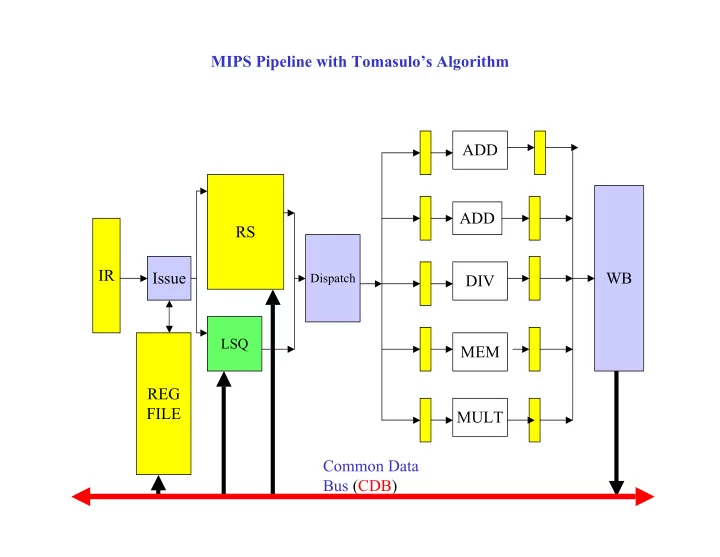
MIPS Pipeline with Tomasulos Algorithm ADD ADD RS IR Issue WB - - PowerPoint PPT Presentation
MIPS Pipeline with Tomasulos Algorithm ADD ADD RS IR Issue WB Dispatch DIV LSQ MEM REG FILE MULT Common Data Bus (CDB) Renaming Source Registers Example A: DIVD F0 , F2, F4 RAW dependency between (A,B) B: ADDD F6, F0 , F8
Renaming Source Registers
Example
A: DIVD F0, F2, F4 RAW dependency between (A,B) B: ADDD F6, F0, F8 WAR dependency between (B,C) C: SUBD F8, F10, F12 RAW dependency between (C,D) D: DIVD F0, F8, F10
- A source register that is not the destination of an in-flight instruction is copied to the
new storage location allocated for the source operand
- A source register that is the destination of an in-flight instruction is tagged with the id
- f the producer
- When the producer instruction does a write the value and its id are broadcast on
the CDB
- The waiting instruction copies the value from the CDB to the storage allocated for
the source operand
2
Example (Issue Unit)
Issue A: DIVD F0, F2, F4
TAG SOURCE1 SOURCE2 OP
- v2, v4: Values read from registers F2, F4 during issue
- Record A as the current writer of F0
RSA DIVD
v2 v4
RSA
Issue B: ADDD F6, F0, F8
ADDD
v8
- v8: Value read from F8
- Other operand will be result of instruction A
RSA RSB
RSA
RSB
RSB
F6 F0
3
Example (Issue Unit)
Issue C: SUBD F8, F10, F12
TAG SOURCE1 SOURCE2 OP
v10, v12: Values read from registers F10, F12 during instruction issue
RSC SUBD
v10 v12 Issue D: DIVD F14, F8, F10
DIVD
v10
- v10: Value read from F10
- Other operand will be result of instruction C
RSC
RSC
RSD
RSD
RSC RSD
F14 F8
4
Dispatch and WB Units
- Dispatch unit selects instructions from RS whose :
- perands are available and functional unit is free
- In the example A, C are ready to execute.
- When execution is complete the Write Unit is notified
Write Unit selects one of the completed instruction in EX/WB register for WB For the selected instruction, say RSI
- Broadcast its result on the CDB
- Broadcast the TAG (RSI) along with the value
- All units that are waiting on the result of the completing instruction (tag
comparison): copy the broadcast value
- Reservation stations copy the value into the RS registers with matching tags
- Register file copies the value into the destination register of the instruction.
5
Snapshot after Issue of A, B, C, D
Issue A: DIVD F0, F2, F4
TAG SOURCE1 SOURCE2 OP RSA DIVD
v2 v4
RSA
Issue B: ADDD F6, F0, F8
ADDD
v8 RSA RSB
RSA
RSB
RSB
F6 F0
6
TAG SOURCE1 SOURCE2 OP RSC SUBD
v10 v12 RSC
Issue D: DIVD F14, F8, F10
DIVD
v10 RSD
RSD
RSC
F14 F8
RSC
Issue C: SUBD F8, F10, F12
RSD
Example (contd ...)
Event: C completes execution Write Unit broadcasts result (RESC) of C together with its tag RSC C releases Reservation Station RSC All registers of the RS and all registers in the Register File monitor CDB for broadcast TAG If the TAG matches copy the broadcast value into the register ID SOURCE1 SOURCE2 OP
F8
RSC SUBD
v10 v12
RESC RSD DIVD RESC
v10
RSD RSD
- F8 updated with result of C even though B has not yet started execution.
- A in execution
- D ready to be dispatched
RSC F14
7
Example (contd ...)
Event: A completes execution Write Unit broadcasts result (RESA) of A along with its tag RSA A releases RSA ID SOURCE1 SOURCE2 OP
F0
RSA DIVD
v2 v4
RESA RSB DIVD RESA
v8
RSB RSB
- D in execution.
- B ready to dispatch
- When D and B complete execution, their results are broadcast and used to update F14 and
F6 respectively. RSA F6
8
WAW Hazards
A: DIVD F0, F2, F4 B: ADDD F6, F0, F8 C: DIVD F0, F10, F12 D: ADDD F8, F0, F14
ID SOURCE1 SOURCE2 OP RSB ADDD
v8
RSB
- Write of F0 by A effectively canceled.
- Intermediate instructions (like B) get operands directly from A bypassing F0.
RSA DIVD
v2 v4
RSA RSC DIVD
v10 v12
RSC RSA
RSA RSB RSC
F6 F0 F0
9
WAW Hazards
A: DIVD F0, F2, F4 B: ADDD F6, F0, F8 C: DIVD F0, F10, F12 D: ADDD F8, F0, F14
ID SOURCE1 SOURCE2 OP RSB ADDD
v8
RSB
- Write of F0 by A effectively canceled.
- Intermediate instructions (like B) get operands directly from A bypassing F0.
RSA DIVD
v2 v4
RSA RSC DIVD
v10 v12
RSC RSA
RSA RSB RSC
F6 F0 F0
10
WAW Hazards
A: DIVD F0, F2, F4 B: ADDD F6, F0, F8 C: DIVD F0, F10, F12 D: ADDD F8, F0, F14
ID SOURCE1 SOURCE2 OP RSB ADDD
v8
RSB
- Write of F0 by A effectively canceled.
- Intermediate instructions (like B) get operands directly from A bypassing F0.
RSA DIVD
v2 v4
RSC DIVD
v10 v12
RSC RSA
RSA RSB RSC
F0 F6 F0
RSD
F8 RSC RSD ADDD
v14
RSB RSD
RSD
11
Load Store Queue (LSQ)
LOAD/STORE BUFFERS FIFO QUEUE
CDB
MEM DISPATCH ISSUE WRITE
- In-flight LOAD or STORE instructions are held in Load/Store Buffers in the LSQ unit
- LOAD dispatched to memory when MEM is free
- STORE dispatched when MEM is free and value to be stored is available in the Load/Store Buffer
- STORE value either copied from REG during issue or copied from CDB while waiting
- We will assume that the effective address is calculated during the ISSUE stage
LSQ
12
Load Store Queue (LSQ)
LSQ: FIFO Queue that holds descriptors of issued LOAD and STORE instructions LOAD and STORE instructions wait in LSQ for memory access. ID MEM ADDR OPERAND OP
LSQA SD ea
LSQA LSQB LSQ Buffers ID: Identifies buffer (which also serves as the identification of the issued instruction) OP: Load or Store (may be implicit if the queues for LOAD and STORE are separate) MEM ADDR: Holds the effective address of the memory location to be accessed OPERAND: (STORE only) Holds value to be stored in memory When a SD instruction is issued the Buffer may either receive the:
- Actual operand value by copying it from the source register or
- Tag of the instruction producing the value if it (producer instruction) is still in flight
ID MEM ADDR OP
LSQB ea LD
13
Load/Store Buffers
Load and Store Buffers: Hold descriptors for Load and Store instructions A: SD 0(R1), F0 I: ADDD F0, F2, F4 B: LD 0(R2), F2 A: SD 0(R1), F0 B: LD 0(R2), F2 ID ADDRESS OPERAND OP
SQA SD
ea v0
LQB LD ea F2 LQB SQA LQB SQA SD
ea RSI
SQA ea ea
14
Example Schedule
LOOP: A LD F0, 0(R1) | temp = x[i] B MUL F4, F0, F2 | temp = temp * a C SD F4, 0(R1) | x[i] = temp D ADDI R1, R1, #8 | i++ E BNE R1, R2, LOOP | branch if R1.ne.R2
- Within an iteration RAW between (A, B) and (C, D) [focusing on FP registers only]
- Across iterations WAR and WAW dependencies become apparent
A1 LD F0, 0(R1) B1 MUL F4, F0, F2 C1 SD F4, 0(R1) D1 ADDI R1, R1, #8 E1 BNE R1, R2, LOOP A2 LD F0, 0(R1) WAR with B1, WAW with A1 B2 MUL F4, F0, F2 WAR with C1, WAW with B1 C2 SD F4, 0(R1) D2 ADDI R1, R1, #8 E2 BNE R1, R2, LOOP
15
Assumptions in Constructing Schedule
- MUL unit is 4 cycles fully pipelined
- There are an unlimited number of buffers in LSQ
- Hence we never stall ISSUE for want of a buffer in the LSQ unit
- Assume that Branches are predicted as Taken
- The Target Address is calculated during the ISSUE stage of the Branch
- Hence there is a 1 cycle stall between the issue of the Branch instruction and the issue of the
instruction at the target address
- When a LD or SD instruction is issued the effective memory address is calculated in the Issue stage
- That is, the base address register Rn is read and the offset added to it
- The effective address is put into the appropriate field of the Buffer in the LSQ
- The integer ALU instructions do not go through the FP or MEM pipeline
- They read the source registers in the ID stage
- Execute at the next cycle in the EX stage
- Write on the following cycle to the integer register
- Forwarding is assumed to be used whenever beneficial to reduce latency of integer instructions
16
Example Schedule
LOOP: | Assume R1 = 1000 initially; Assume F2 = 200 A1 LD F0, 0(R1) | temp = x[i] B1 MUL F4, F0, F2 | temp = temp * a C1 SD F4, 0(R1) | x[i] = temp D1 ADDI R1, R1, #4 | Index next element of the array E1 BNE R1, R2, LOOP | branch if R1.ne.R2 R2 is the address past end of array Cycle 2. Issue A1
F0 LD LQA1
&x[0] = 1000
Cycle 3. Issue B1
F4
RSB1
MUL RSB1 v2= 200
LQA
LQA1
Cycle 4. Issue C1
SD SQC1
RSB1
LQA1
r1 &x[0] = 1000
v2 = 200
17
Schedule
21 20 E2 D2 C2 B2 A2 E1
IF
D1
I IF
C1
D I IF
B1
M D I IF
A1 19 18 17 16 15 14 13 12 11 10 9 8 7 6 5 4 3 2 1 Cycle 4: A1: Memory Read B1: In RS in Dispatch stage C1: In I stage. Will issued to LOAD Buffer at end of cycle
- Effective Address &x[0] = 1000 and tag LQC
18
Example Schedule
Cycle 3 A: in D stage. Ready to be dispatched to MEM B: in I stage. Will issue to RS at end of cycle Cycle 4 A: Memory Read B: Waiting in RS since operand not yet available C: In I stage. Will issued to LOAD Buffer at end of cycle
- Effective Address &x[0] = 1000 and tag LQC
Cycle 5 A: In WRITE stage. WRITE unit broadcasts value read from memory (i.e x[0] value) along with tag LQA B: Finds a match between the broadcast tag LQA and copies broadcast data value into the RS field C: Waiting in LSQ since operand F4 not yet available. Requires MUL to produce the value. D: Integer instruction issued (reads register R1) Cycle 6 B: All operands available; MUL unit free. Dispatched from the RS to the MUL unit C: Still waiting for the MUL value to be broadcast D: ADDI instruction in integer EX stage E: Branch instruction in Issue Stage. Calculates effective address (that of LOOP) and will put the address into PC at the end of the cycle Cycle 7 B: Second cycle of MUL C: Still waiting for the MUL value to be broadcast D: ADDI instruction writes updated R1 (1004) E: Branch instruction in EX Stage. Compares registers and finds its prediction is correct A2: Second iteration begins in IF stage.
19
Schedule
21 20 E2 D2 C2 B2 A2
IF
E1
I IF
D1
D I IF
C1
D D I IF
B1
W M D I IF
A1 19 18 17 16 15 14 13 12 11 10 9 8 7 6 5 4 3 2 1 Cycle 5 A: In WB stage. WB unit broadcasts value read from memory (i.e x[0] value) along with tag LQA1 B: Finds a match between the broadcast tag LQA and copies broadcast data value into the RS field C: Waiting in LSQ since operand F4 not yet available. Requires MUL to produce the value. D: Integer instruction issued (reads register R1)
20
Example Schedule
Cycle 5. WB broadcasts value of x[0] along with TAG LQA1 F0 and RSB1 copy the broadcast value. LOAD buffer held by instruction A1 is released
FO: x[0]
RSB1
MUL RSB1 v2 = 200 SD SQC1 &x[0]
RSB1
x[0] F4 LQA
1
21
E2 D2 C2 B2
IF
A2
I IF
E1
E I IF
D1
D D I IF
C1
* D D I IF
B1
W M D I IF
A1 6 5 4 3 2 1 Cycle 6: B1: All operands available; MUL unit is free. So B is begins execution in the MUL unit D1: ADDI instruction in integer EX stage E1: Branch instruction in Issue Stage. Calculates effective address (that of LOOP) and will put the address into PC at clock edge
22
21 20 E2 D2 C2 B2
IF
A2
E I IF
E1
W E I IF
D1
D D D I IF
C1
* * D D I IF
B1
W M D I IF
A1 19 18 17 16 15 14 13 12 11 10 9 8 7 6 5 4 3 2 1
Cycle 7 B1: Second cycle of MUL C: Still waiting for the MUL value to be broadcast D1: ADDI instruction writes updated R1 (1004) E1: Branch instruction in EX Stage. Compares registers and finds its prediction is correct A2: Second iteration begins in IF stage. 23
Example Schedule
F0 LD LQA2 &x[1]
Cycle 9. Issue B2
F4
RSB2
MUL RSB2 v2 = 200
LQA2
Cycle 10. Issue C2
SD SQC2
RSB2
LQA2
Cycle 8. Issue A2
&x[1] Instructions issued during iteration 2 denoted by A2, B2, C2 etc
24
Schedule
21 20 E2 D2
IF
C2
I IF
B2
D I IF
A2
W E I IF
E1
W E I IF
D1
D D D D D I IF
C1
* * * * D D I IF
B1
W M D I IF
A1 19 18 17 16 15 14 13 12 11 10 9 8 7 6 5 4 3 2 1
25
Snapshot of RS and LSQ Buffers at Cycle 10
LD LQA2 &x[1] = 1004 F4 MUL RSB2 v2 = 200
LQA2
SD SQC2
RSB2
LQA2
&x[1] = 1004 FO: x[0] MUL v2 = 200 SD SQC1 &x[0] = 1000 RSB1 x[0]
LQA
F0: x[0]
RSB1
F4 RSB1
RSB2
F4 was to be written with the result of B. However when C2 was issued this write was CANCELLED. That is B2 became the new writer for F4. Canceling the write of F4 by B is not a problem . Why? C which wants that value will get it directly from the CDB when the WB unit broadcasts the value along with the tag RSB
26
Schedule
/
21 20 E2
IF
D2
I IF
C2
D I IF
B2
D D I IF
A2
W E I IF
E1
W E I IF
D1
D D D D D D I IF
C1
W * * * * D D I IF
B1
W M D I IF
A1 19 18 17 16 15 14 13 12 11 10 9 8 7 6 5 4 3 2 1
27
NOTE: LD of A2 at cycle 10 has stalled for earlier SD (of C1) since we assume LSQ dispatches requests in strict FIFO order.
Schedule
/
21 20
IF
E2
I IF
D2
D I IF
C2
D D I IF
B2
D D D I IF
A2
W E I IF
E1
W E I IF
D1
M D D D D D D I IF
C1
W * * * * D D I IF
B1
W M D I IF
A1 19 18 17 16 15 14 13 12 11 10 9 8 7 6 5 4 3 2 1
27
NOTE: LD of A2 at cycle 11 still stalled for earlier SD (of C1) since we assume LSQ dispatches requests in strict FIFO order.
Schedule
/
21 20
I IF
E2
E I IF
D2
D D I IF
C2
D D D I IF
B2
M D D D I IF
A2
W E I IF
E1
W E I IF
D1
M D D D D D D I IF
C1
W * * * * D D I IF
B1
W M D I IF
A1 19 18 17 16 15 14 13 12 11 10 9 8 7 6 5 4 3 2 1
27
NOTE: LD of A2 at cycle 10 has stalled for earlier SD (of C1) since we assume LSQ dispatches requests in strict FIFO order.
Schedule
/
W
21
M
20
D D D D D I IF
A3
W E I IF
E2
W E I IF
D2
M D D D D D D D D I IF
C2
W * * * * D D D D I IF
B2
W M D D D I IF
A2
W E I IF
E1
W E I IF
D1
M D D D D D D I IF
C1
W * * * * D D I IF
B1
W M D I IF
A1 19 18 17 16 15 14 13 12 11 10 9 8 7 6 5 4 3 2 1
27
NOTE: Completes SD every 8 cycles apart 8(n-1) + 11 = 8n +3 cycles. Additional stalls will arise as RS fills up
Schedule
/
21 20 E2
IF
D2
I IF
C2
D I IF
B2
M D I IF
A2
W E I IF
E1
W E I IF
D1
D D D D D D I IF
C1
W * * * * D D I IF
B1
W M D I IF
A1 19 18 17 16 15 14 13 12 11 10 9 8 7 6 5 4 3 2 1
27
WARNING: In the schedule above M stage (LD) of A2 at cycle 10 has overtaken earlier SD (of C1). Not valid if LSQ dispatches requests in strict FIFO order.
Schedule
21 20
IF
E2
I IF
D2
D I IF
C2
D D I IF
B2
W M D I IF
A2
W E I IF
E1
W E I IF
D1
M D D D D D D I IF
C1
W * * * * D D I IF
B1
W M D I IF
A1 19 18 17 16 15 14 13 12 11 10 9 8 7 6 5 4 3 2 1 T = 6(n-1) + 11 = 6n + 5 cycles for n iterations
28
Schedule
21 20
IF
E2
I IF
D2
D I IF
C2
D D I IF
B2
W M D I IF
A2
W E I IF
E1
W E I IF
D1
M D D D D D D I IF
C1
W * * * * D D I IF
B1
W M D I IF
A1 19 18 17 16 15 14 13 12 11 10 9 8 7 6 5 4 3 2 1 T = 6(n-1) + 11 = 6n + 5 cycles for n iterations
28
Schedule
21 20
I IF
E2
E I IF
D2
D D I IF
C2 *
D D I IF
B2
W M D I IF
A2
W E I IF
E1
W E I IF
D1
M D D D D D D I IF
C1
W * * * * D D I IF
B1
W M D I IF
A1 19 18 17 16 15 14 13 12 11 10 9 8 7 6 5 4 3 2 1 T = 6(n-1) + 11 = 6n + 5 cycles for n iterations
29
Schedule
21 20
W M D I IF W E I IF
E2
W E I IF
D2
M D D D D D D I IF
C2 W * * * *
D D I IF
B2
W M D I IF
A2
W E I IF
E1
W E I IF
D1
M D D D D D D I IF
C1
W * * * * D D I IF
B1
W M D I IF
A1 19 18 17 16 15 14 13 12 11 10 9 8 7 6 5 4 3 2 1 T = 6(n-1) + 11 = 6n + 5 cycles for n iterations
30