Mississippi Valley Divisions Regional Flood Risk Management - - PowerPoint PPT Presentation

mississippi valley divisions regional flood risk
SMART_READER_LITE
LIVE PREVIEW

Mississippi Valley Divisions Regional Flood Risk Management - - PowerPoint PPT Presentation

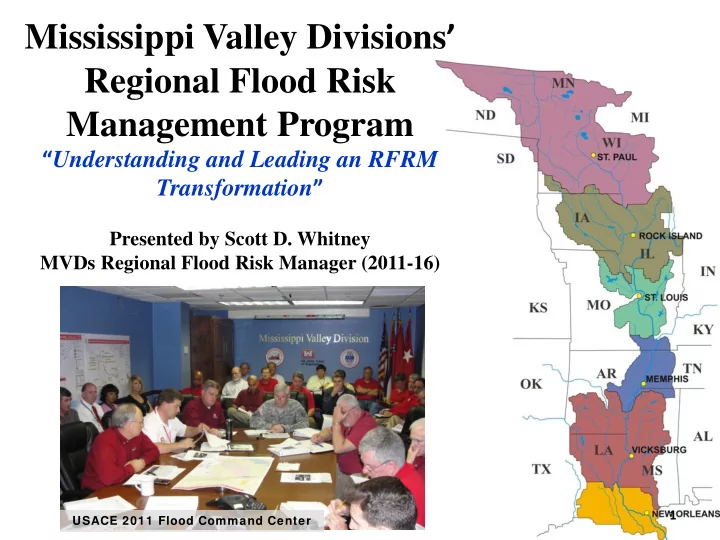
Mississippi Valley Divisions Regional Flood Risk Management Program Understanding and Leading an RFRM Transformation Presented by Scott D. Whitney MVDs Regional Flood Risk Manager (2011-16) 1 USACE 2011 Flood Command Center

slide-1
SLIDE 1

Mississippi Valley Divisions’ Regional Flood Risk Management Program

“Understanding and Leading an RFRM Transformation”

Presented by Scott D. Whitney MVDs Regional Flood Risk Manager (2011-16)

1

USACE 2011 Flood Command Center

slide-2
SLIDE 2

Mississippi River Watershed World’s 3rd Largest

Drainage basin for 41% of the United States

slide-3
SLIDE 3
  • 36 flood control reservoirs:
  • 3 in Arkansas
  • 4 in Mississippi
  • 5 in Illinois
  • 2 in Missouri
  • 3 in Iowa
  • 2 in North Dakota
  • 3 in Louisiana
  • 1 in Wisconsin
  • 13 in Minnesota

MVDs FRM BUSINESS LINE:

Total FY15 $774M Flood Risk Management (FRM) $234M

Ecosystem $41M Env Stewardship $14M Hydropower $11M Recreation $44M FUSRAP $32M

Navigation $398M

  • 59 pumping stations (MR&T)
  • 400 drainage structures
  • ~6,400 mi of levee (3,486 mi MR&T)
  • 700 miles of wing dams
  • 1,144 mi of revetment
  • 326 mi of rock dikes
  • 143 mi of foreshore protection

VALUE TO NATION: Since inception in the early 1930s, MR&T is credited with $1.27T cumulative flood damages prevented. At an investment level of $16B, those savings result in a $80 return on every $1 invested. 3rd LARGEST WATERSHED IN THE WORLD: The 1.25 million-square-mile Mississippi River drainage basin gathers water from 41 percent of the continental United States. This includes all or parts of 31 states and two Canadian provinces via 250+ tributaries.

3

slide-4
SLIDE 4
  • Operation & Maintenance
  • Levee/Dam Safety Program (FY15)
  • MR&T
  • Emergency Operations
  • PL84-99
  • Floodplain Management Services (FPMS)
  • Planning Assistance to States (PAS)
  • Interagency and International Services
  • Silver Jackets
  • National Levee Database
  • CAP FRM Projects
  • Specifically Auth. FRM Projects

District FRM Programs and Personnel

  • Flood Risk Managers
  • Engineers
  • Sr. Management
  • Public Affairs
  • Economists
  • Modelers
  • Biologists
  • Emergency Managers
  • Flood Area Engineers
  • Project Managers
  • Planners
  • PAOs, OC, RE, EM…..etc.

Disciplines Authorities

* Bold items, key elements funded by FRM Business Line

slide-5
SLIDE 5

Making the News…….

5

Flooding in U.S. Midwest more frequent, study finds; Research covered more than 50 years of data in 14 states https://www.sciencedaily.com/releases/2015/02/150209161149.html February 9, 2015, University of Iowa: The U.S. Midwest and surrounding states have endured increasingly more frequent flood episodes over the past half-century, according to a new study.

PEOPLE – PERCEPTIONS - REACTIONS

slide-6
SLIDE 6

Making the News…….

6

PEOPLE – PERCEPTIONS - REACTIONS

slide-7
SLIDE 7

Making the News…….

7

PEOPLE – PERCEPTIONS - REACTIONS

slide-8
SLIDE 8

COMMUNICATION 101

“What’s in this for me?”

B C A A - Awareness B - Understanding C - ACTION

8

= OPPORTUNITY

(Learning, Safety, Resources, Partnerships, Leveraging, Productivity, Performance….etc.)

slide-9
SLIDE 9

File Name 9

Reading the Signs Non Verbal Communication

slide-10
SLIDE 10

QUALITIES OF A SUCCESSFUL TRANSFORMER!

 Fierce Resolve  Integrator  Passion  Authentic  Customer/Partner Focused  Can-DO-Attitude  Innovator  Communicator  Facilitative Leader  Integrity + Credibility + Character = TRUST  Collaborator  Knows Limitations  Develop Star Teams (2 + 2 = 6)

COMMUNICATION!!

CLARITY CONVICTION COMPASSION CONSISTENCY CREDIBILITY

10

slide-11
SLIDE 11

Awareness - Understanding - Certainty Observations

PERCEPTION IS:

“As far as my work as a mediator is concerned, it is about getting people to see things from different perspectives. Thus, I must disagree with you.” “How you focus your attention affects your perceptions. When you have an idea in your mind you tend to look for evidence that supports that idea and not pay attention to evidence that says the idea isn’t accurate. This is called confirmation bias.”

slide-12
SLIDE 12

CRITICAL INTERPERSONAL SKILLS

Results Matter! They matter to your CREDIBILITY.

slide-13
SLIDE 13

VISION: to lead collaborative, comprehensive and sustainable flood risk management services and actions to improve public safety and reduce flood damages to the lives and livelihoods within the Mississippi Valley watershed MISSION: to deliver vital flood risk management service and solutions, in collaboration with our partners, to secure our Nation, energize our economy and reduce risk from disaster. DEFINED: managing both floodwaters to reduce the probability of flooding and floodplains to reduce the consequences of flooding Mississippi Valley Divisions’ Regional Flood Risk Management Program

“Understanding and Leading an RFRM Transformation”

13

slide-14
SLIDE 14

14

Mississippi Valley Divisions’ Regional Flood Risk Management Program

PROBLEM SET:

 Flood events are getting more extreme and frequent  Identity Crisis – What is FRM and SJ and how applied?  Most are poorly informed on their Flood Risk  Need to break cycle of damage-repair-damage-repair  Aging infrastructure, Maintenance and Inspections  Non-strategic FRM approaches prevail  Lack of common vision or unified approach

SOLUTION SET:

 FRM Tenets  Strategic Alignment  Organizational Structure  Best Practices  Challenges  Improvement  Results

slide-15
SLIDE 15

KEY RFRM TENETS

te·net noun \ˈte-nət also ˈtē-nət\ : a principle, belief, or doctrine generally held to be true; especially: one held in common by members of an organization, movement, or profession

#1 FRM LIFE CYCLE #2 SHARED RESPONSIBILITY #3 RISK INFORMED DECISIONMAKING

(1 + 2 = 3)

(Safety + Security = Prosperity)

15

slide-16
SLIDE 16

STRATEGIC ALIGNMENT

“Achieving Meaningful Risk Reduction Actions”

“GOAL LINE”

 Drivers  Allies  Opportunities  Constraints  Antagonists  Obstacles

FAILURE SUCCESS

slide-17
SLIDE 17

17

Identity Crisis

  • Who are you?
  • What is your experience level?
  • What needs to change and why?
  • Why is any of this relevant to me?
  • How can I help?

You must be the change you wish to see in the world.

Helping others realize their true power and potential.

slide-18
SLIDE 18

Challenge Description MVP MVR MVS MVM MVK MVN MVD

Command Level Understanding and Support for FRM/SJ

6 6 7 3 6 9 6.2

Internal/External Collaboration and Communication on FRM/SJ challenges

6 8 6 5 5 7 6.2

Aging FRM Infrastructure with declining O&M funding

7 4 6 7 5 7 6.0

FRM/SJ Education and Awareness (Public and Decision makers)

7 7 6 4 5 6 5.8

FRM Data Management

3 4 5 4 3 4 3.8

Systems or Watershed Perspective and Planning with respect to FRM

7 6 7 5 2 7 5.7

Levee Inspections, Risk Assessments, Accreditation and Certifications

7 8 9 8 3 6 6.8

Flood Damage Repairs

7 5 8 8 2 7 6.2

Flood Mitigation Opportunities

3 2 7 8 2 3 4.2

Flood Preparedness Training

7 9 9 8 7 3 7.2

COMPOSITE (Avg) SCORE

6.0 5.9 7.0 6.0 4.0 5.9 5.8

Classification of Challenge

Develop a“TOP 10” Challenge

LEVEL OF RESOLUTION 1 Unrecognized challenge 2 Increasing Awareness 3 Forming Strategy to address 4 Aligning and Assigning Staff to Address 5 Making progress and notable improvements 6 Starting to observe positive results 7 Functional and fine tuning further improvements 8 Highly Successful resolution 9 Educating others on our success 10 Exemplary resolution, others seek to model

  • - BASELINE --

18

A B C D E F Avg

slide-19
SLIDE 19

After Ralph D. Stacey. Complexity and Creativity in Organizations

SIMPLE

COMPLICATED POLITICAL

CHAOS

COMPLICATED INFORMATIONAL

CERTAINTY AGREEMENT

After Ralph D. Stacey: Complexity and Creativity in Organizations

RESOLVING COMPLEX ISSUES

slide-20
SLIDE 20

20

Traditionalist Mentor Facilitative Leader Trailblazer

Choose Your Team Carefully!

  • Experienced
  • Sharing
  • Inspiring
  • Guiding
  • Building
  • Status Quo
  • Tried and True
  • Just Right
  • Needs met
  • Proven record
  • Strategic View
  • Collaborative
  • Opportunity
  • Earned Trust
  • Tactical Actions
  • Seeking
  • Exploring
  • Testing
  • Innovator
  • Better Ways
  • We are mostly defined by our actions not our words!
  • Some of the most meaningful and catalytic aspects of a transformation process is found in the individual

and group interactions.

  • Interactions serve to highlight past successes, identify common challenges and detail future actions that

will serve to transform and improve.

slide-21
SLIDE 21

BALANCING ACT!

  • Effective RFRM seeks to:

 provide necessary structure and formality to collaboration and communication!  provide awareness, education and action necessary to make informed decisions and policies that serve to reduce risk to deleterious and costly flood damages.

  • RFRM activities cannot be considered in isolation and must
  • ften balance competing needs.
  • An integrated approach to water resource planning considers

RFRM as one of many objectives needed in a watershed.

  • A collaborative approach to water resource planning and
  • mgmt. engages multiple competing stakeholders in the

development of watershed management plans to fulfill these needs.

21

slide-22
SLIDE 22

22

KNOWLEDGE TRANSFER

slide-23
SLIDE 23

USACE Principles of Resilience

23

R

slide-24
SLIDE 24

Qualities of Resilience

24

  • Shifts in thinking related to resilience

– Proactive vs. Reactive approaches – Sustainable vs. Sacrificial features – Adaptive vs. Static infrastructure – Risk-Informed vs. Deterministic design criteria – System-wide vs. Component-based considerations – Diverse vs. ‘robust-yet-fragile’ systems & solutions

  • Resilience Ideals

– Collaborative – Diverse – Holistic

►Inclusive ►Multi-beneficial ►Proactive

slide-25
SLIDE 25

RISK INFORMED DECISIONMAKING

How Likely is it that the Hazard (flood, earthquake) will Occur? How Will the Infrastructure Perform during this Hazard? What are the Consequences for Non-Performance?

25

MUST carefully evaluate and address transference of RISK!

slide-26
SLIDE 26

APR 2012 (50 pgs + Appd) DEC 2012 (36 pgs) AUG 2012 (312 pgs) AUG 2012 (30 pgs) DEC 2012 (350 pgs + Appd)

MR&T 2011 Post-Flood Evaluation PRODUCTS

* *

AUG 2013 (33 pgs) Jan 2012 (45 pgs)

26

slide-27
SLIDE 27

MVD RFRM WEBSITE

http://www.mvd.usace.army.mil

 USACE RFRM Links, Contacts and Resources  Public documents & presentations  Key Messages  Operation Watershed Recovery Components  Public, Partner and Stakeholder Accessibility

slide-28
SLIDE 28

CorpsMap - Flood Damaged Sites

http://www.mvd.usace.army.mil/

 Web based site locator  Pop-up window provides general overview of site specific flood damages.  Provides access to project information papers as well as risk management and construction fact sheets  Describes interim risk management measures

Vicksburg District OPERATION WATERSHED RECOVERY – CRITICAL REPAIR SITES Contacts Kent Parrish, MVD Regional MRL Team Leader
  • Ph. 601-631-5006 fax. 601-631-5151
Kent.D.Parrish@usace.army.mil Scott D. Whitney, MVD Regional Flood Risk Manager
  • Ph. (309) 794-5386 fax (309) 794-5710
scott.d.whitney@usace.army.mil OVERVIEW DISTRICT: Vicksburg District TYPE: Boils and Seepage RM: RM 459.6 (110+00 BEL) FRAGO CLASS: 1 – High Potential for Loss of Life RISK: 3,996 residents, $188.5M infrastructure REPAIR: Berm, 30 Relief Wells, and 12 Horiz. drains
  • EST. REPAIR COST: $2,640,000
Damage Assessment In early 2010, MVK was notified of multiple boils in the project area. In early summer of 2010, the boils were sandbagged as River Levels reached flood stage and the flow of the boils increased. In February, 2011, when conditions in the project area were dry, two of the largest boils were pumped, revealing voids at boil sources as wide as 20 ft and as deep as 10 ft. The voids revealed no obvious “pipes” that continued downward or laterally from the void
  • bottom. As River levels continued to rise and approach
flood stages in March 2011, the boil area voids were backfilled with sand material, covered with a nonwoven filter fabric, and either sandbagged or earthen dams were constructed around them. In May 2011, an emergency berm was constructed over the area which encompassed the worst known boil areas. The top of the berm was constructed to approximate elevation 85.0 ft. Because of the high exit gradients for the predicted flood stages for the known boil areas, and the consequences of failure at this location, it was decided to flood the entire project site by raising water levels in Eagle Lake to approximate elevation 90.0 ft through the use of Muddy Bayou Control Structure. In
  • rder to reduce the risk of failure without raising water
levels in Eagle Lake, remediation is recommended prior to the next high water season. Risk and Consequence If the East Bank Mississippi River Levee System were to fail at the Buck Chute site, the population at risk would be 3,996. The value of the non-residential structures is $31,141,000, and the value of the 1,436 residential structures is $157,396,000. Figure 1. Aerial view of Buck Chute during 2011flood fight. Critical Repairs The reset recommendation for this site includes a 1700 ft reach of earthen berm 200 to 240 ft wide and relief wells from Station 106+50 to 123+50. A 400 ft section of the berm includes a drainage and collection feature, including horizontal drains and a pervious sand layer. The item includes 30 relief wells and 12 horizontal drains. In-place berm volumes will be approximately 13,600 cubic yards of sand for the drainage feature and 150,000 cubic yards for the remaining berm. Special Considerations The site is covered under the 1998 MRL SEIS, as item 458- L, and covers multiple work items. The SEIS does not cover planned relief wells for this site; however, an EA was prepared to cover these wells and a FONSI signed. Coordination under Section 9 of the Endangered Species Act has been completed. The 404 water quality permit for the project has been obtained, and all project impacts have been mitigated for, as this site is part of the existing MRL mitigation program. This segment of EBMRL is not currently certified, but this fix, along with other work MVK currently has planned in the area, will allow certification of the levee system. The Board of Mississippi Levee Commissioners has acquired the necessary ROW for the project. Schedule Bids solicited - 10 Aug 2011 Contract Awarded - 30 Aug 2011 Anticipated contract duration 120 days. Scheduled completion in January 2012. Acquisition Strategy Unrestricted competitive bid awarded 30 Aug 2011 to Phylway Construction, LLC for $3,100,225.00. This site was combined with No. 8 site, Albermarle.

Information Paper

Buck Chute

slide-29
SLIDE 29

TRANSFORMING ACTIONS

29

RFRM TENETS: Embrace and implement three RFRM tenets in a more holistic fashion to ensure future flood risks are reduced by effective mitigation, preparedness, response, recovery, shared responsibility and risk informed decision. STRATEGIC ALIGNMENT: Ensure strategic and complimentary alignment of key RFRM concepts and actions with Campaign Plan, NFRMP, MVD IPLAN, District OPLANS and partner initiatives. ORGANIZATIONAL STRUCTURE: Strengthen linkages and leverage across full spectrum of RFRM organizational structure by creating regular communication forums and clarity on various roles and

  • responsibilities. This is a TEAM endeavor!

BEST PRACTICES: Create regional database of RFRM Best Practices that is accessible and searchable to provide highlights and contacts for tested FRM approaches that have achieved desired results and provide potential examples or reference points for others to employ as means of overcoming similar challenges.

slide-30
SLIDE 30

TRANSFORMING ACTIONS

30

CHALLENGES: Many FRM challenges were revealed and discussed as result of this Annex development. A more concentrated effort should be initiated that seeks to regionally articulate, evaluate, baseline and prioritize RFRM challenges to secure support for collaborative solution pathways. ACTION PLANS: Develop formal regional process to develop, review, prioritize, assign, approve, and report on meaningful RFRM action plans that have well developed and S.M.A.R.T action steps. These action steps should be designed to directly address challenges, transforming actions, and improve FRM service/performance. RESOURCING OPPORTUNITIES: Embracing concepts or recommendations found in the MVD RFRM Annex will create expanded or new opportunities for FRM project resourcing, cost/time savings and enhanced flood risk reduction. These opportunities should be identified and acknowledged as means to increase incentive and support for more challenging transformation actions.

slide-31
SLIDE 31

TRANSFORMING RESULTS

31

 Highly coordinated and effectual Flood Response  Resiliency in Action, Nonstructural Mitigation very successful  Two time USACE National Flood Risk Manager of the Year  Silver Jacket Coordinator and Silver Jacket Team or the Year  Highly effective FRM/SJ working relationships with partners  Annual Regional and National FRM/SJ workshops – Lesson learned  MVD Districts awarded more Silver Jacket Pilot Projects than any

  • ther USACE Division, >$10M and climbing!

 Widely acclaimed and successful FPMS program, >$1M/yr.  FY18 FRM Supplemental Funded Projects, >$900M (e.g. Cedar Rapids $117M.)  FRM Hydraulic Model for Mississippi River Phase I completed FY18  Working with States on outreach, policy, rules and regulations  FRM Strategic Communication Plans Best Practice Model

slide-32
SLIDE 32
slide-33
SLIDE 33

33

QUESTIONS & DISCUSSION

slide-34
SLIDE 34

FRM LIFE CYCLE

RESPONSE RECOVERY MITIGATION PREPARATION

RISK

DISASTER

34

slide-35
SLIDE 35

Federal / State / Local / Individual

Outreach Natural Storage Structural Non – Structural Contingency Plans Building Codes Zoning Insurance Flood Risk Shared Responsibility

Residual Flood Risk

Shared Risk Management

“ Driving Down the Risks with an Informed and Engaged Public “ All Stakeholders relevant roles in contributing risk reduction! “Secure our Nation, energize our economy and reduce risk from disaster.”

35

Both STRUCTURAL and NON-STRUCTURAL solutions that are combinable / interoperable / multi-dimensional to drive down overall risk to an acceptable level of RESIDUAL RISK