ML vs. Racket and datatypes/pattern-matching vs. features - - PowerPoint PPT Presentation

ml vs racket and
SMART_READER_LITE
LIVE PREVIEW

ML vs. Racket and datatypes/pattern-matching vs. features - - PowerPoint PPT Presentation

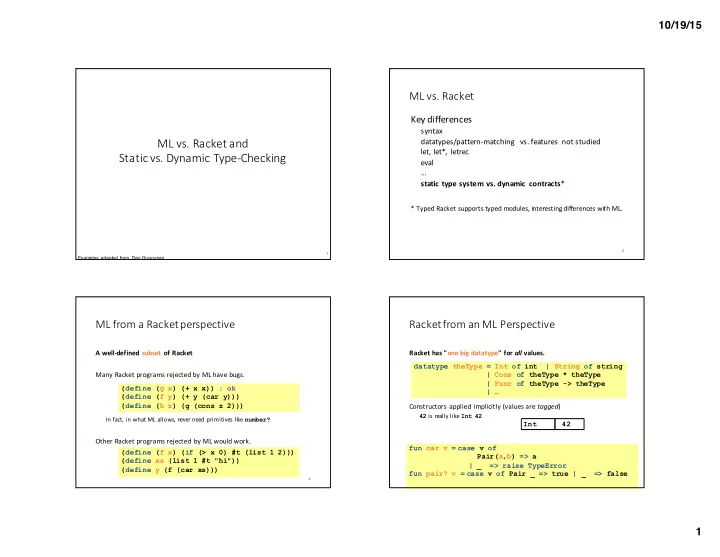
10/19/15 ML vs. Racket Key differences syntax ML vs. Racket and datatypes/pattern-matching vs. features not studied let, let*, letrec Static vs. Dynamic Type-Checking


slide-1
SLIDE 1

10/19/15 1

ML ¡vs. ¡Racket ¡and Static ¡vs. ¡Dynamic ¡Type-­‑Checking

1

Examples ¡adapted ¡from ¡ Dan ¡Grossman

ML ¡vs. ¡Racket

Key ¡differences

syntax datatypes/pattern-­‑matching ¡ vs. ¡features ¡ not ¡studied let, ¡let*, ¡ letrec eval ... static ¡type ¡system ¡vs. ¡dynamic ¡ contracts*

* ¡Typed ¡Racket ¡supports ¡typed ¡modules, ¡interesting ¡differences ¡with ¡ML.

2

ML ¡from ¡a ¡Racket ¡perspective

A ¡well-­‑defined ¡subset of ¡Racket Many ¡Racket ¡programs ¡rejected ¡by ¡ML ¡have ¡bugs.

In ¡fact, ¡in ¡what ¡ML ¡allows, ¡never ¡need ¡primitives ¡like ¡number?

Other ¡Racket ¡programs ¡rejected ¡by ¡ML ¡would ¡work.

4

(define (f x) (if (> x 0) #t (list 1 2))) (define xs (list 1 #t "hi")) (define y (f (car xs))) (define (g x) (+ x x)) ; ok (define (f y) (+ y (car y))) (define (h z) (g (cons z 2)))

Racket ¡from ¡an ¡ML ¡Perspective

Racket ¡has ¡"one ¡big ¡datatype" ¡for ¡all values. Constructors ¡applied ¡implicitly ¡(values ¡are ¡tagged)

42 is ¡really ¡like ¡Int 42

5

fun car v = case v of Pair(a,b) => a | _ => raise TypeError fun pair? v = case v of Pair _ => true | _ => false datatype theType = Int of int | String of string | Cons of theType * theType | Func of theType -> theType | … Int 42

slide-2
SLIDE 2

10/19/15 2

Static ¡checking

May ¡reject ¡a ¡program ¡after parsing, ¡before running. Part ¡of ¡a ¡PL ¡definition: ¡what ¡static ¡checking ¡ is ¡performed? Common ¡ form: ¡static ¡type ¡system

Approach: ¡give ¡each ¡variable, ¡expression, ¡..., ¡a ¡type Purposes: Prevent ¡ misuse ¡of ¡primitives ¡(4/"hi") Enforce ¡abstraction Avoid ¡cost ¡of ¡dynamic ¡(run-­‑time) ¡checks Document ¡intent ...

Dynamically-­‑typed ¡languages ¡= ¡little/no ¡static ¡checking

6

OK ¡for ¡other ¡tools ¡ to ¡do ¡more!

Example: ¡ML ¡type-­‑checking

Catches ¡at ¡compile-­‑time: ¡...

  • Operation ¡used ¡on ¡a ¡value ¡of ¡wrong ¡type
  • Variable ¡not ¡defined ¡in ¡the ¡environment
  • Pattern-­‑match ¡with ¡a ¡redundant ¡pattern

Catches ¡only ¡at ¡run-­‑time: ¡...

  • Array-­‑bounds ¡errors, ¡Division-­‑by-­‑zero, ¡explicit ¡exceptions ¡zip

([1,2],["a"])

  • Logic ¡/ ¡algorithmic ¡errors:
  • Reversing ¡the ¡branches ¡of ¡a ¡conditional
  • Calling ¡f instead ¡of ¡g

(Type-­‑checker ¡ can’t ¡“read ¡minds”)

7

Purpose: ¡prevent ¡certain ¡kinds ¡of ¡bugs. But ¡when ¡/ ¡how ¡well?

“Catch ¡a ¡bug ¡before ¡it ¡matters.” ¡ vs. “Don’t ¡report ¡a ¡(non-­‑)bug ¡that ¡might ¡not ¡matter.” Prevent ¡evaluating ¡ 3 / 0

  • Keystroke ¡time: disallow ¡it ¡in ¡the ¡editor
  • Compile ¡time: ¡disallow ¡it ¡if ¡seen ¡in ¡code
  • Link ¡time: ¡disallow ¡it ¡in ¡code ¡attached ¡to main
  • Run ¡time: ¡disallow ¡it ¡right ¡when ¡we ¡get ¡to ¡the ¡division
  • Later: ¡Instead ¡of ¡doing ¡the ¡division, ¡return +inf.0
  • Just ¡like ¡3.0 / 0.0 does ¡in ¡every ¡(?) ¡PL ¡(it’s ¡ useful!)

10

Correctness

A ¡type ¡system ¡is ¡supposed ¡to ¡prevent ¡X ¡for ¡some ¡X A ¡type ¡system ¡is ¡sound if ¡it ¡never ¡accepts ¡a ¡program ¡that, ¡when ¡run ¡ with ¡some ¡input, ¡does ¡X.

No ¡false ¡negatives ¡/ ¡no ¡missed ¡X ¡bugs

A ¡type ¡system ¡is ¡complete if ¡it ¡never ¡rejects ¡a ¡program ¡that, ¡no ¡matter ¡ what ¡input ¡it ¡is ¡run ¡with, ¡will ¡not ¡do ¡X.

No ¡false ¡positives ¡/ ¡no ¡false ¡X ¡bugs

Usual ¡goal: ¡sound ¡ (can ¡rely ¡on ¡it) ¡but ¡not ¡complete ¡(why ¡not?)

“Fancy ¡features” ¡ like ¡generics ¡aimed ¡at ¡“fewer ¡false ¡positives”

Notice ¡soundness/completeness ¡ is ¡with ¡respect ¡to ¡X.

11

slide-3
SLIDE 3

10/19/15 3

Incompleteness

ML ¡rejects ¡these ¡functions ¡even ¡though ¡they ¡never ¡divide ¡by ¡a ¡string.

12

fun f1 x = 4 div "hi" (* but f1 never called *) fun f2 x = if true then 0 else 4 div "hi" fun f3 x = if x then 0 else 4 div "hi" val y = f3 true fun f4 x = if x <= abs x then 0 else 4 div "hi" fun f5 x = 4 div x val z = f5 (if true then 1 else "hi")

What ¡if ¡it's ¡unsound?

  • Oops: ¡fix ¡the ¡language ¡ definition.
  • Hybrid ¡checking: ¡add ¡dynamic ¡checks ¡to ¡catch ¡X ¡at ¡run ¡time.
  • Weak ¡typing: ¡ "best" ¡effort, ¡but ¡X ¡could ¡still ¡happen.
  • Catch-­‑fire ¡semantics:

allow ¡anything (not ¡just ¡X) ¡to ¡happen ¡if ¡program ¡ could do ¡X.

  • Simplify ¡implementer's ¡job ¡at ¡cost ¡of ¡programmability.
  • Assume ¡correctness, ¡avoid ¡costs ¡of ¡checking, ¡optimize.

14

Weak ¡typing ¡-­‑> ¡weak ¡software

  • An ¡outdated ¡sentiment: ¡"strong ¡types ¡for ¡weak ¡minds"
  • "Humans ¡will ¡always ¡be ¡smarter ¡than ¡a ¡type ¡system ¡(cf. ¡undecidability), ¡so ¡

need ¡to ¡let ¡them ¡say ¡trust ¡me."

  • Closer ¡to ¡reality: ¡"strong ¡types ¡amplify/protect ¡strong ¡minds"?
  • Humans ¡really ¡bad ¡at ¡avoiding ¡bugs, ¡need ¡all ¡the ¡help ¡we ¡can ¡get!
  • Type ¡systems ¡have ¡gotten ¡much ¡more ¡expressive ¡(fewer ¡false ¡positives)
  • 1 ¡bug ¡in ¡30-­‑million ¡ line ¡OS ¡in ¡C ¡makes ¡entire ¡computer ¡vulnerable.
  • Bug ¡like ¡this ¡was ¡announced ¡this ¡week ¡(every ¡week)

15

Racket: ¡dynamic, ¡not ¡weak!

  • Dynamic ¡checking ¡is ¡the ¡definition
  • If ¡implementation proves ¡some ¡checks ¡unneeded,

it ¡may ¡optimize ¡them ¡away .

  • Convenient
  • Cons ¡cells ¡can ¡build ¡anything
  • Anything ¡except ¡#f is ¡true
  • Nothing ¡like ¡the ¡“catch-­‑fire ¡semantics” ¡of ¡weak ¡typing

16

slide-4
SLIDE 4

10/19/15 4

Don't ¡confuse ¡semantic ¡choices ¡and ¡checking.

  • Is ¡this ¡allowed? ¡What ¡does ¡it ¡mean?
  • "foo" + "bar"
  • "foo" + 3
  • array[10] when ¡array has ¡only ¡5 ¡elements
  • Call ¡a ¡function ¡with ¡missing/extra ¡arguments

Not ¡an ¡issue ¡of ¡static ¡vs. ¡dynamic ¡vs. ¡weak ¡checking.

  • But ¡does ¡involve ¡trade ¡off ¡convenience ¡vs. ¡catching ¡bugs ¡early.

Racket ¡generally ¡less ¡lenient ¡than, ¡JavaScript, ¡Ruby, ¡...

17

Which ¡is ¡better? ¡Static? ¡Dynamic? ¡Weak? Discuss.

Most ¡languages ¡do ¡some ¡of ¡each ¡

  • Common: ¡types ¡for ¡primitives ¡checked ¡statically; array ¡bounds ¡are ¡not.

Consider:

  • Flexibility
  • Convenience
  • Catch ¡bugs
  • Speed ¡(run-­‑time, ¡ programming-­‑time, ¡debugging-­‑time, ¡fixing-­‑time)
  • Reuse
  • Documentation ¡value
  • Prototyping
  • Evolution/maintenance
  • Cognitive ¡load ¡(satisfying ¡compiler, ¡ debugging ¡at ¡run-­‑time)
  • ...

18

Convenience: ¡Dynamic ¡is ¡more ¡convenient

Dynamic ¡typing ¡lets ¡you ¡build ¡a ¡heterogeneous ¡list ¡or ¡return ¡a ¡ “number ¡ or ¡a ¡string” ¡without ¡workarounds

19

(define (f y) (if (> y 0) (+ y y) "hi")) (let ([ans (f x)]) (if (number? ans) (number->string ans) ans)) datatype t = Int of int | String of string fun f y = if y > 0 then Int(y+y) else String "hi" case f x of Int i => Int.toString i | String s => s

Convenience: ¡Static ¡is ¡more ¡convenient

Can ¡assume ¡data ¡has ¡the ¡expected ¡type ¡without ¡cluttering ¡code ¡with ¡ dynamic ¡checks ¡or ¡having ¡errors ¡far ¡from ¡the ¡logical ¡mistake

20

(define (cube x) (if (not (number? x)) (error "bad arguments") (* x x x))) (cube 7) fun cube x = x * x * x cube 7

slide-5
SLIDE 5

10/19/15 5

Expressiveness: ¡Static ¡prevents ¡useful ¡programs

Any ¡sound ¡static ¡type ¡system ¡forbids ¡programs ¡that ¡do ¡nothing ¡wrong, ¡ possibly ¡forcing ¡programmers ¡to ¡code ¡around ¡limitations.

21

fun f g = (g 7, g true) (* might not type-check *) val pair_of_pairs = f (fn x => (x,x)) (define (f g) (cons (g 7) (g #t))) (define pair_of_pairs (f (lambda (x) (cons x x))))

Expressiveness: ¡Static ¡lets ¡you ¡tag ¡as ¡needed

Pay ¡costs ¡of ¡tagging ¡(time, ¡space, ¡late ¡errors) ¡only ¡where ¡needed, ¡ rather ¡than ¡on ¡everything, ¡everywhere, ¡all ¡the ¡time. Common: ¡ a ¡few ¡cases ¡needed ¡in ¡a ¡few ¡spots. Extreme: ¡"TheOneRacketType" ¡in ¡ML, ¡everything ¡everywhere.

22

datatype tort = Int of int | String of string | Cons of tort * tort | Fun of tort -> tort | … if e1 then Fun (fn x => case x of Int i => Int (i*i*i)) else Cons (Int 7, String "hi")

Bugs: ¡Static ¡catches ¡bugs ¡earlier

Lean ¡on ¡type-­‑checker ¡for ¡compile-­‑time ¡ bug-­‑catching, ¡do ¡less ¡testing.

23

(define (pow x) ; curried (lambda (y) (if (= y 0) 1 (* x (pow x (- y 1)))))) ; oops fun pow x y = (* does not type-check *) if y = 0 then 1 else x * pow (x,y-1)

Bugs: ¡Static ¡catches ¡only ¡easy ¡bugs

But ¡static ¡often ¡catches ¡only ¡“easy” ¡bugs, ¡so ¡you ¡still ¡have ¡to ¡test ¡your ¡ functions, ¡ which ¡should ¡ find ¡the ¡“easy” ¡bugs ¡too.

24

(define (pow x) ; curried (lambda (y) (if (= y 0) 1 (+ x ((pow x) (- y 1)))))) ; oops fun pow x y = (* curried *) if y = 0 then 1 else x + pow x (y-1) (* oops *)

slide-6
SLIDE 6

10/19/15 6

Efficiency: ¡Static ¡typing ¡is ¡faster

Language ¡ implementation:

  • Need ¡not ¡store ¡tags ¡(space, ¡time)
  • Need ¡not ¡check ¡tags ¡(time)

Y

  • ur ¡code:
  • Need ¡not ¡check ¡argument ¡and ¡result ¡types.

(Convenience, ¡Expressiveness, ¡Bugs)

Y

  • ur ¡effort:
  • Need ¡not ¡spend ¡time ¡writing ¡checks ¡or ¡debugging ¡type ¡issues ¡later. ¡

(Bugs)

25

Efficiency: ¡Dynamic ¡typing ¡is ¡faster ¡

Language ¡ implementation:

  • May ¡optimize ¡to ¡remove ¡some ¡unnecessary ¡tags ¡and ¡tests
  • Example: ¡(let ([x (+ y y)]) (* x 4))
  • Hard ¡(impossible) ¡in ¡general
  • Often ¡easier ¡for ¡performance-­‑critical ¡parts ¡of ¡program
  • Can ¡be ¡surprisingly ¡effective

Y

  • ur ¡code:
  • Need ¡not ¡“code ¡around” ¡type-­‑system ¡limits ¡with ¡extra ¡tags, ¡functions ¡

(Convenience, ¡Expressiveness)

Y

  • ur ¡effort:
  • Need ¡not ¡spend ¡time ¡satisfying ¡type ¡checker ¡now.

(Convenience, ¡Expressiveness)

26

Reuse: ¡Code ¡reuse ¡easier ¡with ¡dynamic

Reuse ¡code ¡on ¡different ¡data ¡flexibly ¡without ¡restrictive ¡type ¡system.

  • If ¡you ¡use ¡cons ¡cells ¡for ¡everything, ¡libraries ¡that ¡work ¡on ¡cons ¡cells ¡

are ¡useful

  • Collections ¡libraries ¡are ¡amazingly ¡useful, ¡may ¡have ¡complicated ¡

static ¡types

  • Use ¡code ¡based ¡on ¡what ¡it ¡actually ¡does, ¡not ¡just ¡what ¡it ¡says ¡it ¡can ¡

do, ¡for ¡flexibile code ¡reuse.

27

Reuse: ¡Code ¡reuse ¡easier ¡with ¡static

  • Modern ¡type ¡systems ¡support ¡reasonable ¡code ¡reuse ¡with ¡features ¡

like ¡generics ¡and ¡subtyping

  • If ¡you ¡use ¡cons ¡cells ¡for ¡everything, ¡you ¡will ¡confuse ¡what ¡represents ¡

what ¡and ¡get ¡hard-­‑to-­‑debug ¡errors

  • Use ¡separate ¡ static ¡types ¡to ¡keep ¡ideas ¡separate
  • Static ¡types ¡help ¡avoid ¡library ¡misuse
  • Enforce ¡clean ¡abstractions ¡and ¡invariants ¡for ¡safe/reliable ¡code ¡reuse.
  • Also ¡possible ¡with ¡dynamic ¡types, ¡less ¡common, ¡often ¡involves ¡at ¡least ¡a ¡

small ¡static ¡component.

28

slide-7
SLIDE 7

10/19/15 7

But ¡software ¡evolves.

Considered ¡5 ¡things ¡important ¡when ¡writing ¡code: 1. Convenience 2. Not ¡preventing ¡useful ¡programs 3. Catching ¡bugs ¡early 4. Performance 5. Code ¡reuse

What ¡about:

  • Prototyping before a ¡spec ¡is ¡stable
  • Maintenance ¡/ ¡evolution after initial ¡release

29

Prototyping: ¡Dynamic ¡better ¡for ¡prototyping

Early ¡on, ¡may ¡not ¡know ¡what ¡cases ¡needed ¡in ¡datatypes and ¡functions

  • Static ¡typing ¡disallows ¡code ¡without ¡having ¡all ¡cases
  • Dynamic ¡lets ¡incomplete ¡programs ¡run
  • Static ¡forces ¡premature ¡ commitments ¡to ¡data ¡structures
  • Waste ¡time ¡appeasing ¡the ¡type-­‑checker ¡ when ¡you ¡will ¡just ¡change ¡it/throw ¡it ¡

away ¡soon ¡anyway

30

Prototyping: ¡Static ¡better ¡for ¡prototyping

What ¡better ¡way ¡to ¡document ¡your ¡evolving ¡decisions ¡on ¡data ¡ structures ¡and ¡code-­‑cases ¡ than ¡with ¡the ¡type ¡system? New, ¡evolving ¡code ¡most ¡likely ¡to ¡make ¡inconsistent ¡assumptions Temporary ¡stubs ¡as ¡necessary, ¡such ¡as

| _ => raise Unimplemented but ¡don't ¡forget ¡them!

31

Evolution: ¡Dynamic ¡better ¡for ¡evolution

Can ¡change ¡code ¡to ¡be ¡more ¡permissive ¡without ¡affecting ¡old ¡callers

  • Example: ¡T

ake ¡ an ¡int or ¡a ¡string instead ¡of ¡an ¡int

  • All ML ¡callers ¡must ¡now ¡use ¡constructor ¡on ¡arguments, ¡pattern-­‑match ¡results.
  • Existing ¡Racket ¡callers ¡can ¡be ¡oblivious

Counter-­‑argument: ¡Quick ¡patches ¡and ¡hacks ¡leave ¡bloated, ¡confusing ¡code. ¡ ¡ Easy ¡to ¡make ¡deeper ¡change ¡that ¡accidentally ¡breaks ¡callers.

32

(define (f x) (* 2 x)) (define (f x) (if (number? x) (* 2 x) (string-append x x))) fun f x = 2 * x fun f x = case f x of Int i => Int (2 * i) | String s => String(s ^ s)

slide-8
SLIDE 8

10/19/15 8

Evolution: ¡Static ¡better ¡for ¡evolution

When ¡changing ¡types ¡of ¡data ¡or ¡code, ¡type-­‑checker ¡errors ¡provide ¡a ¡ to-­‑do ¡list ¡of ¡necessary ¡changes.

  • Avoids ¡introducing ¡bugs
  • The ¡more ¡of ¡your ¡spec ¡that ¡is ¡in ¡your ¡types, ¡the ¡more ¡the ¡type-­‑checker ¡lists ¡

what ¡to ¡change ¡when ¡your ¡spec ¡changes

Examples:

  • Change ¡the ¡return ¡ type ¡of ¡a ¡function
  • Add ¡a ¡new ¡constructor ¡to ¡a ¡datatype

Counter-­‑argument:

  • The ¡to-­‑do ¡list ¡is ¡mandatory, ¡so ¡evolution ¡in ¡pieces ¡is ¡a ¡pain.
  • Cannot ¡test ¡part-­‑way ¡through.

33

Resolved?

Static ¡vs. ¡dynamic ¡typing ¡is ¡too ¡coarse ¡a ¡question.

  • Better: ¡ ¡What should ¡we ¡enforce ¡statically? ¡Dynamically?
  • My ¡research ¡area: ¡Concurrency/parallelism ¡need ¡more ¡of ¡both!

Legitimate ¡ trade-­‑offs, ¡not ¡all-­‑or-­‑nothing.

Beyond...

  • Gradual ¡typing
  • Long-­‑running, ¡active ¡research ¡field
  • Just ¡starting ¡to ¡appear ¡in ¡practice
  • (e.g., ¡Facebook's ¡Flow ¡static ¡type ¡checker ¡for ¡JavaScript, ¡many ¡others)
  • Still ¡some ¡kinks ¡to ¡work ¡out
  • Would ¡programmers ¡use ¡such ¡flexibility ¡well? ¡ ¡Who ¡decides?

34

[optional, but intriguing]

Beyond...

More ¡expressive ¡static ¡type ¡systems ¡that ¡allow ¡ more ¡safe ¡ behaviors ¡(without ¡more ¡unsafe ¡behaviors).

  • Dependent ¡typing (long-­‑running, ¡active ¡research ¡field)
  • Starting ¡to ¡see ¡wider ¡adoption
  • Concurrency, ¡network ¡activity, ¡security, ¡data ¡privacy
  • Strong, ¡fine-­‑grain ¡guarantees

35

fun nth 0 (x::xs) = x | nth n (x::xs) = nth (n-1) xs SML ¡type ¡checker: ¡pattern-­‑matching ¡inexhaustive. nth : int -> 'a list

  • > 'a

Dependent ¡types ¡would ¡allow:

nth : (n:int, n>=0) -> (xs:'a list, length xs >= n) -> 'a Or ¡maybe ¡even: -> (r:'a, exists ys,zs,

xs = (ys @ (r::zs)), length ys = n)

[optional, but intriguing]

Beyond...

Types ¡are ¡much more. Curry-­‑Howard ¡correspondence: ¡ Proofs ¡are ¡Programs!

36

Logic Programming ¡ Languages Propositions Types Proposition ¡P ¡→ Q ¡ Type ¡P -­‑> Q Proposition ¡P ¡∧ Q Type P ¡* ¡Q Proof ¡of ¡proposition ¡P Expression ¡e : ¡P Proposition ¡P ¡is ¡provable ∃expression e : P [optional, but intriguing]

What ¡then ¡is ¡'a ¡in ¡logic?

Ta Table ¡ ¡adapted ¡ ¡from ¡ ¡Pierce, ¡ ¡Ty Types ¡ ¡and ¡ ¡Programming ¡ ¡Languages, ¡ , ¡an ¡ ¡excellent ¡ ¡read ¡ ¡if ¡ ¡this ¡ ¡direction ¡ ¡ins pires ¡ ¡you.