MO MODARIA I II: W WORKING NG G GROUP 6 6 BIOSPH PHERE M ERE - - PowerPoint PPT Presentation

mo modaria i ii w working ng g group 6 6
SMART_READER_LITE
LIVE PREVIEW

MO MODARIA I II: W WORKING NG G GROUP 6 6 BIOSPH PHERE M ERE - - PowerPoint PPT Presentation

MO MODARIA I II: W WORKING NG G GROUP 6 6 BIOSPH PHERE M ERE MODELLING F FOR L R LONG NG-TERM S RM SAFETY ASSE SSESSM SSMENTS O OF RADI DIOACT CTIVE VE W WASTE DI DISP SPOSAL L FACI CILI LITIES IAEA r revie eview a and


slide-1
SLIDE 1

MO MODARIA I II: W WORKING NG G GROUP 6 6

BIOSPH PHERE M ERE MODELLING F FOR L R LONG NG-TERM S RM SAFETY ASSE SSESSM SSMENTS O OF RADI DIOACT CTIVE VE W WASTE DI DISP SPOSAL L FACI CILI LITIES

IAEA r revie eview a and en enhancement o

  • f Bi

Biomass m methodolo logy

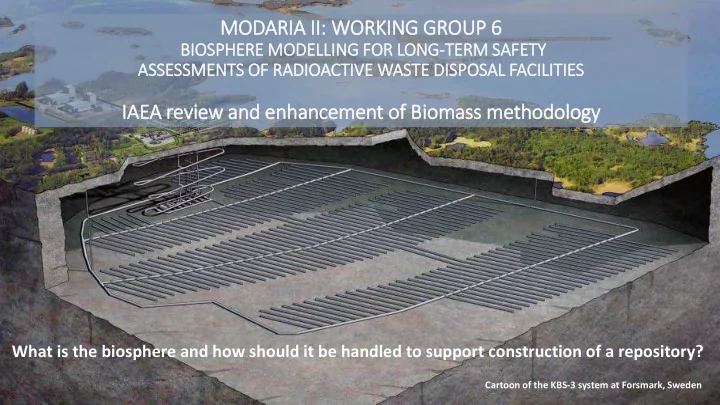
What is the biosphere and how should it be handled to support construction of a repository?

Cartoon of the KBS-3 system at Forsmark, Sweden

slide-2
SLIDE 2

IAEA Biosphere Modelling Methodological Documents

  • BIOMASS-6. Reference Biospheres for Solid Radioactive Waste Disposal,

Report of BIOMASS Theme 1 of the BIOsphere Modelling and ASSessment Programme (2003)

  • TECDOC 1799. Environmental Change in Post-Closure Safety Assessment
  • f Solid Radioactive Waste Repositories. Report of WG3 EMRAS II (2016)
  • Common Framework for Addressing Climate Change and Landscape

Development in Post-Closure Radiological Assessment of Solid Waste

  • Disposal. Report of WG6 of MODARIA, submitted to IAEA

WORKING GROUP 6

slide-3
SLIDE 3

BIOMASS Methodology enhancements

Assessment Context Biosphere system identification and justification Biosphere system descriptions Human actions, wildlife Potentially exposed group definition human/wildlife Biosphere and supporting model definition Conceptual model, mathematical model & data FEP list and screening Site under- standing Data and model selection principles

Climate development & downscaling Geosphere (discharge area) Near Surface investigation methods landscape development Principles for critical group selection Protection of the environment Confidence building

Calculation & communication

WORKING GROUP 6

slide-4
SLIDE 4

WORKING GROUP 6

Developments i in biosphere m modelling s since ce B BIOMASS-6

  • Experience from examples of practical application of BIOMASS-6 since 2001
  • Experience of site characterisation at real sites
  • Finland, Sweden, France, Spain, USA, UK, Canada … others…
  • Science developments,
  • Understanding of climate change and landscape evolution
  • Ecosystem understanding and representation
  • Methods in toxicology and multiple stressors
  • Mathematical representation of processes
  • Coherent link to the remainder of the safety assessment
  • e.g. via transport of elements and site development
  • Special models for special radionuclides, C-14, Cl-36 and Se-79
  • Wider range of assessment endpoints:
  • complementary indicators and
  • those relevant to non-human biota
  • Regulatory development and experience of assessment review
slide-5
SLIDE 5

WORKING GROUP 6

Progress to date shows us that the task is to evaluate, update, clarify and as appropriate, extend the BIOMASS-6 methodology, and deliver a report that:

  • Describes the biosphere assessment strategy and how it links to the overall

safety assessment so as to support transparent evaluation against protection

  • bjectives
  • Builds on the biosphere concept and describes the lessons learned since 2001,

including from the BIOPROTA program

  • Describes supporting information/system description models needed for dose

modelling

  • Extends consideration to a wider range of geographical environments
  • Links landscape environmental change (MODARIA l) to dose modelling
  • Assesses latest science that supports all the above, and
  • Describes how site understanding functions as basis for model development
slide-6
SLIDE 6

WORKING GROUP 6

  • Evaluates discharge areas, and how

to define areas/volumes of interest corresponding to the protection

  • bjectives
  • Shows how to analyse and address

uncertainties and correlations

  • Examines methods for presenting

and communicating results so as to enhance stakeholder confidence

  • Provide real examples of the

application of the enhanced methodology General task… cont.

Hypothetical radionuclide flow path (Lindborg et al. 2010)

slide-7
SLIDE 7

BIOMASS methodology outline

  • Assessment context
  • Guidance on critical and other exposure groups
  • Guidance on application of data
  • Biosphere system identification and justification
  • Biosphere system principal components
  • Biosphere system classification
  • Application to specific examples
  • Biosphere system description
  • Procedure for biosphere system description
  • Biosphere model development

Periglacial environment, West Greenland

WG6 Format

WORKING GROUP 6

Sub-activities

  • Analogue environments
  • Confidence and uncertainties
  • Specific real sites as examples
  • Potential Exposure Groups
  • Environmentalchange and effects
  • Climate and landscape development
  • Safety assessment lessons learnt

Meetings and field studies

  • Annual meeting Vienna
  • Interim meetings
  • BIOPROTA meetings
  • Analogue environment studies

Report writing

  • Defined writers and editors
  • Input from participants
  • Review of scientific findings and results
slide-8
SLIDE 8

WORKING GROUP 6

Scope of activities includes:

  • Deep geological disposal
  • Near surface disposal
  • All types of (solid) radioactive waste
  • Wide range of geographical environments
  • Taking account of on-going work in the

parallel BIOPROTA project on review and enhancement of the BIOMASS-6 methodology

  • Legacy sites involving mixtures of

contaminated land, old disposal facilities and in-situ disposal

  • Greater focus on the first few thousand

years

Landscape development data flow chart (Lindborg et al. 2010)

slide-9
SLIDE 9

WG6 interim meeting 2017

Held at the Headquarters of Swiss Federal Nuclear Safety Inspectorate (ENSI), Brugg, Switzerland 10 – 12 May

  • 28 participants from 10 IAEA Member States
  • Presentations on ideas to enhance the BIOMASS methodology
  • Defining report structure
  • Identifying tasks to be done
slide-10
SLIDE 10

This week:

  • Presentations on international experiences

and scientific/technical developments.

  • Presentations and discussions on tasks

identified within the WG.

  • Interim report presentation and discussions
  • Inputs from and integration of

BIOPROTA-programme

  • Update work-plan with task allocation
slide-11
SLIDE 11

Join

The biosphere, an integral part of the entire system

Join WG6!