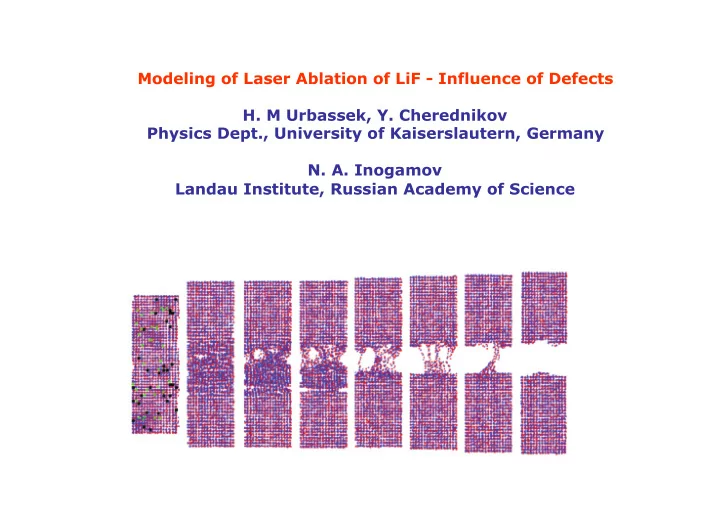
SLIDE 1 Modeling of Laser Ablation of LiF - Influence of Defects
- H. M Urbassek, Y. Cherednikov
Physics Dept., University of Kaiserslautern, Germany
Landau Institute, Russian Academy of Science
SLIDE 2 Theoretical tools
Solve Newton‘s equations. Advantages:
- Input: only interatomic forces,
nowadays available for many materials
- as realistic as possible
- for many-body simulations
- for thermal nonequilibrium situations
- easy visualization / animation:
appeals to imagination Disadvantages:
- computationally slow
- cannot handle time scales & 1 ns
- cannot handle space scales & 100 nm
[1 µm]
Isaac Newton (1643 – 1727) 1687: Philosophiae Naturalis Principia Mathematica
SLIDE 3 Outline
- Two-temperature model / MD for metals
- Two-temperature model / MD for LiF
- Melting and spallation of thin LiF films
- defects
- swift-ion tracks in LiF
SLIDE 4
Two-temperature model + MD for metals: assumes electronic and atomic system to be internally thermalized with temperatures T_e, T_a heat conduction equation for electrons Newton‘s equations for atoms electron-ion coupling terms
Schäfer, Urbassek, Zhigilei 2002
SLIDE 5
typical results for thin metal films: here: Al with increasing energy input E0 = absorbed energy / atom melting ...
SLIDE 6
metal (Al) target melting spallation multi-fragmentation
SLIDE 7 Outline
- Two-temperature model / MD for metals
- Two-temperature model / MD for LiF
- Melting and spallation of thin LiF films
- defects
- swift-ion tracks in LiF
SLIDE 8
System: LiF thin Film (10 nm) (100) surface lateral size X-ray pulse: 7 ps photon energy 90 eV
SLIDE 9
V ijðrÞ ¼ qiqj 4πϵ0r þ Aij expð−r=λijÞ − Cij r6 ;
MD: Buckingham potential + dispersion forces describes well: elastic constants yield strength melting temperature (Tm = 1118 K) ...
SLIDE 10
cold curve (T=0)
SLIDE 11
LiF electron kinetics
Inogamov et al 2009
ne: electron density in conduction band Q(t): laser source νimp: impact ionization κrec: recombination Egap: gap energy Result: Electron concentration < 3 %
SLIDE 12
LiF electron kinetics
Inogamov et al 2009
ne: electron density in conduction band Q(t): laser source νimp: impact ionization κrec: recombination Egap: gap energy A: energy transfer in electron-atom collisions A = 1 / ps Ee: electron energy in conduction band Te: electron temperature
Ee = neEgap +Ee,kin = neEgap + 3 2nekTe
SLIDE 13
electron kinetics
SLIDE 14
Electron and atom temperatures after F= 30 mJ/cm2
SLIDE 15
LiF coupling of electron kinetics and molecular dynamics
SLIDE 16 Outline
- Two-temperature model / MD for metals
- Two-temperature model / MD for LiF
- Melting and spallation of thin LiF films
- defects
- swift-ion tracks in LiF
Cherednikov et al., J. Opt. Soc. Am. B 28, 1817 (2011)
SLIDE 17
LiF snapshots after 50 ps 10 20 30 40 50 80 mJ/cm2
SLIDE 18
Synopsis:threshold energies for various material classes Absorbed energy / atom is scaled to melting temperature: E0/kTm
SLIDE 19 Outline
- Two-temperature model / MD for metals
- Two-temperature model / MD for LiF
- Melting and spallation of thin LiF films
- defects
- swift-ion tracks in LiF
Cherednikov et al., Phys Rev B 88, 134109 (2013)
SLIDE 20
Defects : neutral Li and F atoms F- -> F0 + e- Li+ + e- -> Li0 Defects are introduced ad hoc
SLIDE 21
Potentials taken from quantum chemical calculations:
Wang et al, Phys Rev B 68 (2003) 115409
Note: Li0 is small -> may easily diffuse high polarizability -> attractive binding
SLIDE 22 Thermal ablation (no defects) defect-supported ablation (0.45% defects) F= 38 mJ / cm2 F = 10 mJ / cm2 Result: defects lower ablation threshold
- bond weakening
- tensile pressure due to smaller atom radii
agrees with experiment
SLIDE 23
Green: Li cluster (metallic colloid) destabilizes lattice
SLIDE 24
Top view of defects: black: F0, green: Li0 Formation of Li cluster by fast Li0 diffusion Condensation heat -> ablation Experimentally observed under swift-particle irradiation of LiF
SLIDE 25 „Cold ablation“ Extreme case: assume that laser irradiation
- produces no free electrons (no target heating)
- only produces defects (potential energy)
Here defect concentration 0.57%
SLIDE 26 Outline
- Two-temperature model / MD for metals
- Two-temperature model / MD for LiF
- Melting and spallation of thin LiF films
- defects
- swift-ion tracks in LiF
Cherednikov et al., Phys Rev B 87, 245424 (2013)
SLIDE 27
Swift ions deposit their energy in the form of electronic excitation in the target „Similar physics“ as in laser irradiation How to treat system in MD: After ion passage: F- -> F+ + 2e- in track cylinder
Schiwietz et al 2004
SLIDE 28 Here: couple MD with a particle-in-cell (PIC) code for electron dynamics Equations for electrons:
ρ = e(Zini − ne) (
∇2φ = − ρ ε0 ,
ne = n0 exp e(φ − φ0) kBTe
electric potential: number density:
SLIDE 29
Electric potential: at passage of ion 10 fs later
SLIDE 30
number of electrons remaining in track shielding of F+ ions
SLIDE 31
Evolution of ionization track: sputtering
SLIDE 32 Conclusions
Two-temperature model for LiF: need for plasma equations for electron density and energy
- Ablation mechanism similar as in metals: spallation in molten
state
- Role of longlived defects
- Defects de-stabilize lattice -> lower ablation threshold
- even „cold“ ablation is possible
- role of metallic clusters:
- form due to high Li0 diffusion rate
- destablilize lattice due to condensation heat
- efficient: potential energy introduced by defects small compared
to laser energy (or thermal energy of electrons) Cherednikov et al., J. Opt. Soc. Am. B 28, 1817 (2011) Cherednikov et al., Phys Rev B 88, 134109 (2013) Cherednikov et al., Phys Rev B 87, 245424 (2013)
SLIDE 33