Models for pain care delivery 11 articles (10 studies) included - - PowerPoint PPT Presentation

models for pain care delivery
SMART_READER_LITE
LIVE PREVIEW

Models for pain care delivery 11 articles (10 studies) included - - PowerPoint PPT Presentation

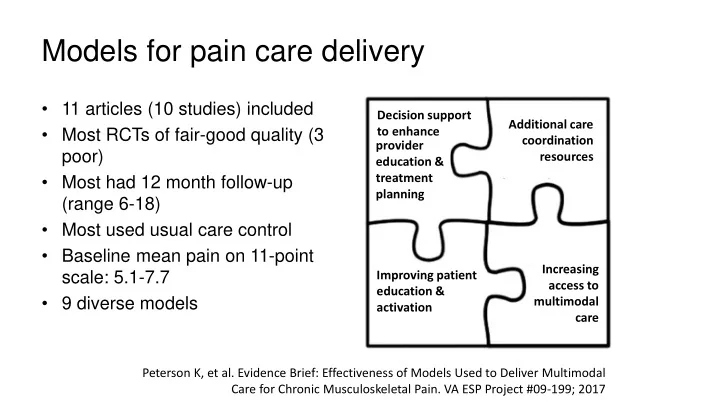
Models for pain care delivery 11 articles (10 studies) included Decision support Additional care Most RCTs of fair-good quality (3 to enhance coordination provider poor) resources education & Most had 12 month follow-up


slide-1
SLIDE 1

Models for pain care delivery

  • 11 articles (10 studies) included
  • Most RCTs of fair-good quality (3

poor)

  • Most had 12 month follow-up

(range 6-18)

  • Most used usual care control
  • Baseline mean pain on 11-point

scale: 5.1-7.7

  • 9 diverse models

Peterson K, et al. Evidence Brief: Effectiveness of Models Used to Deliver Multimodal Care for Chronic Musculoskeletal Pain. VA ESP Project #09-199; 2017 Decision support to enhance provider education & treatment planning Additional care coordination resources Improving patient education & activation Increasing access to multimodal care

slide-2
SLIDE 2

A Few Definitions

  • Integrated Care
  • Multidisciplinary approach
  • Interfaces with and supports primary care
  • Not Integrative care (or CAM) though may incorporate
  • Collaborative Care
  • Team-based
  • Population-based
  • Measurement-based
  • Key components
  • Self-management support
  • Delivery system redesign (addition of care management)
  • Decision support
  • Clinical information system facilitation
slide-3
SLIDE 3

Patient-Centered Team Care / Collaborative

  • Team focused on

patient’s goals

Population-Based Care

  • No patients “falling

through the cracks”

  • Specialists support

care

Measurement- Based Treatment to Target

  • Outcomes

measured + stepped up care

Evidence-Based Care

  • Psychosocial and

pharmacological treatments

Accountable

  • Reaching treatment

targets

Principles of Effective Collaborative Care

slide-4
SLIDE 4
slide-5
SLIDE 5

System Redesign through COHE

  • Four quality indicators, representing occupational best practices,

linked to physician payment incentives

– Each time a physician performed a best practice he/she received added payment

  • Community-based COHEs

– Quality improvement (QI) activities:

  • Care coordination
  • Mentoring and CME for community MDs
  • Disseminate treatment guidelines and best practices information
  • Medical leadership

5

Wickizer et al. Milbank Quarterly 2001 & 2004.

slide-6
SLIDE 6

Collaborative Care

Primary Care Practice

  • Primary Care Physician
  • Patient

+

  • Mental Health Care Manager
  • Psychiatric Consultant

Outcome Measures Treatment Protocols Population Registry Psychiatric Consultation

slide-7
SLIDE 7

Building Capacity. “Let Doctors be Doctors”

  • Who needs to be on the Primary Care Team?
  • Pharmacy Support
  • Integrated Behavioral Health
  • RN Case Management
  • Centralized Resource
  • Embedded Nurse Navigator
  • Empowered, engaged support staff
  • Available to the team?
  • Chemical Dependency
  • Social work
  • Community resources/ church/ other
  • Standard Work!
  • Local Practice teams creating work flow that supports best practice.
  • This drives specific job expectations, skills training and skill task alignment.
  • Accountable leadership, willing to invest in resource and training.
  • Support metrics and reliable dashboards that encourage performance.