Models of Human Parsing Experimental Data 2 Informatics 2A: - - PowerPoint PPT Presentation

models of human parsing
SMART_READER_LITE
LIVE PREVIEW

Models of Human Parsing Experimental Data 2 Informatics 2A: - - PowerPoint PPT Presentation

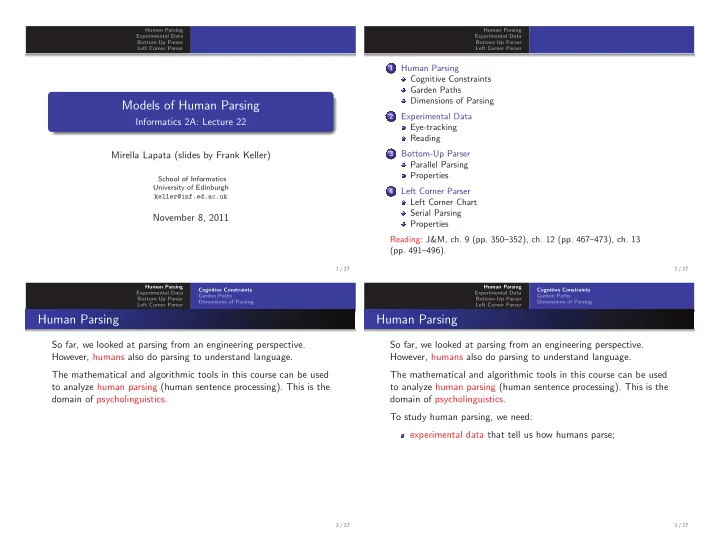
Human Parsing Human Parsing Experimental Data Experimental Data Bottom-Up Parser Bottom-Up Parser Left Corner Parser Left Corner Parser Human Parsing 1 Cognitive Constraints Garden Paths Dimensions of Parsing Models of Human Parsing


slide-1
SLIDE 1

Human Parsing Experimental Data Bottom-Up Parser Left Corner Parser

Models of Human Parsing

Informatics 2A: Lecture 22 Mirella Lapata (slides by Frank Keller)

School of Informatics University of Edinburgh keller@inf.ed.ac.uk

November 8, 2011

1 / 27 Human Parsing Experimental Data Bottom-Up Parser Left Corner Parser

1

Human Parsing Cognitive Constraints Garden Paths Dimensions of Parsing

2

Experimental Data Eye-tracking Reading

3

Bottom-Up Parser Parallel Parsing Properties

4

Left Corner Parser Left Corner Chart Serial Parsing Properties Reading: J&M, ch. 9 (pp. 350–352), ch. 12 (pp. 467–473), ch. 13 (pp. 491–496).

2 / 27 Human Parsing Experimental Data Bottom-Up Parser Left Corner Parser Cognitive Constraints Garden Paths Dimensions of Parsing

Human Parsing

So far, we looked at parsing from an engineering perspective. However, humans also do parsing to understand language. The mathematical and algorithmic tools in this course can be used to analyze human parsing (human sentence processing). This is the domain of psycholinguistics.

3 / 27 Human Parsing Experimental Data Bottom-Up Parser Left Corner Parser Cognitive Constraints Garden Paths Dimensions of Parsing

Human Parsing

So far, we looked at parsing from an engineering perspective. However, humans also do parsing to understand language. The mathematical and algorithmic tools in this course can be used to analyze human parsing (human sentence processing). This is the domain of psycholinguistics. To study human parsing, we need: experimental data that tell us how humans parse;

3 / 27

slide-2
SLIDE 2

Human Parsing Experimental Data Bottom-Up Parser Left Corner Parser Cognitive Constraints Garden Paths Dimensions of Parsing

Human Parsing

So far, we looked at parsing from an engineering perspective. However, humans also do parsing to understand language. The mathematical and algorithmic tools in this course can be used to analyze human parsing (human sentence processing). This is the domain of psycholinguistics. To study human parsing, we need: experimental data that tell us how humans parse; cognitive constraints derived from these data (e.g., incrementality, garden paths, memory limitations);

3 / 27 Human Parsing Experimental Data Bottom-Up Parser Left Corner Parser Cognitive Constraints Garden Paths Dimensions of Parsing

Human Parsing

So far, we looked at parsing from an engineering perspective. However, humans also do parsing to understand language. The mathematical and algorithmic tools in this course can be used to analyze human parsing (human sentence processing). This is the domain of psycholinguistics. To study human parsing, we need: experimental data that tell us how humans parse; cognitive constraints derived from these data (e.g., incrementality, garden paths, memory limitations); parsing models (and algorithms that implement them) that respect these constraints;

3 / 27 Human Parsing Experimental Data Bottom-Up Parser Left Corner Parser Cognitive Constraints Garden Paths Dimensions of Parsing

Human Parsing

So far, we looked at parsing from an engineering perspective. However, humans also do parsing to understand language. The mathematical and algorithmic tools in this course can be used to analyze human parsing (human sentence processing). This is the domain of psycholinguistics. To study human parsing, we need: experimental data that tell us how humans parse; cognitive constraints derived from these data (e.g., incrementality, garden paths, memory limitations); parsing models (and algorithms that implement them) that respect these constraints; an evaluation of the models against the data.

3 / 27 Human Parsing Experimental Data Bottom-Up Parser Left Corner Parser Cognitive Constraints Garden Paths Dimensions of Parsing

Incrementality

Parsing: extracting syntactic structure from a string; prerequisite for assigning a meaning to the string. The human parser builds structures incrementally (word by word) as the input comes in. This can lead to local ambiguity. Example: (1) The athlete realized his potential . . . a. . . . at the competition. b. . . . would make him a world-class sprinter.

4 / 27

slide-3
SLIDE 3

Human Parsing Experimental Data Bottom-Up Parser Left Corner Parser Cognitive Constraints Garden Paths Dimensions of Parsing

Incrementality

Structure 1 (NP reading):

S NP Det The N athlete VP VP V realized NP Det his N potential PP . . .

5 / 27 Human Parsing Experimental Data Bottom-Up Parser Left Corner Parser Cognitive Constraints Garden Paths Dimensions of Parsing

Incrementality

Structure 2 (S reading):

S NP Det The N athlete VP V realized S NP Det his N potential VP . . .

6 / 27 Human Parsing Experimental Data Bottom-Up Parser Left Corner Parser Cognitive Constraints Garden Paths Dimensions of Parsing

Garden Paths

Early commitment: when it reaches potential, the processor has to decide which structure to build. If the parser makes the wrong choice (e.g., NP reading for sentence (1-b)) it needs to backtrack and revise the structure. A garden path occurs, which typically results in longer reading times (and reverse eye-movements). Some garden paths are so strong that they parser fails to recover from them.

7 / 27 Human Parsing Experimental Data Bottom-Up Parser Left Corner Parser Cognitive Constraints Garden Paths Dimensions of Parsing

Garden Paths

More examples of garden paths: (2) a. The horse raced past the barn fell. b. I convinced her children are noisy. c. Until the police arrest the drug dealers control the street. d. The old man the boat. e. We painted the wall with cracks. f. Fat people eat accumulates. g. The cotton clothing is usually made of grows in Mississippi. h. The prime number few.

8 / 27

slide-4
SLIDE 4

Human Parsing Experimental Data Bottom-Up Parser Left Corner Parser Cognitive Constraints Garden Paths Dimensions of Parsing

Dimensions of Parsing

In addition to incrementality, a number of properties are important when designing a model of the human parser: Directionality: the parser can process sentence bottom-up (from the words up) or top-down (from the non-terminals down). Evidence that the human parser combines both strategies. Parallelism: a serial parser maintains only one structure at a time; a parallel parser pursues all possible structures. Controversial issue; evidence for both serialism and limited parallelism. Interactivity: the parser can be encapsulated (only access to syntactic information) or interactive (access to semantic information, context). Evidence for limited interactivity.

9 / 27 Human Parsing Experimental Data Bottom-Up Parser Left Corner Parser Eye-tracking Reading

Eye-tracking

An eye-tracker makes it possible to record the eye-movements of subjects while their are performing a cognitive task: looking at a scene; driving a vehicle; using a computer; reading a text. Mind’s Eye Hypothesis: where subjects are looking indicates what they are processing. How long they are looking at it indicates how much processing effort is needed.

10 / 27 Human Parsing Experimental Data Bottom-Up Parser Left Corner Parser Eye-tracking Reading

Eye-tracking

A head-mounted, video-based eye-tracker.

11 / 27 Human Parsing Experimental Data Bottom-Up Parser Left Corner Parser Eye-tracking Reading

Eye-movements and Reading

Let’s look at eye-tracking data for reading in detail: eye-movements are recorded while subjects read texts; very high spatial (0.15◦ visual angle) and temporal (1 ms) accuracy; eye movements in reading are saccadic: a series of relatively stationary periods (fixations) between very fast movements (saccades); average fixation time is about 250 ms; can be longer or shorter, depending on ease or difficulty of processing; typically test a number of subjects, with a number of test sentences, and statistical analysis done on results.

12 / 27

slide-5
SLIDE 5

Human Parsing Experimental Data Bottom-Up Parser Left Corner Parser Eye-tracking Reading

Eye-movements and Reading

13 / 27 Human Parsing Experimental Data Bottom-Up Parser Left Corner Parser Eye-tracking Reading

Eye-movements and Reading

14 / 27 Human Parsing Experimental Data Bottom-Up Parser Left Corner Parser Eye-tracking Reading

Eye-movements and Reading

15 / 27 Human Parsing Experimental Data Bottom-Up Parser Left Corner Parser Eye-tracking Reading

Eye-movements and Reading

We can use the data generated by eye-tracking experiments to investigate how the human parser works. For example: evidence for garden paths comes from increased reading times, and more reverse saccades, when reading certain words; evidence for incrementality comes from studies where participants view visual scenes while listening to sentences; evidence for interactivity comes from the fact that semantic properties of words influence reading times in the same way as syntactic ones. We will look at how to model these properties by building a parser that mimics human parsing behavior.

16 / 27

slide-6
SLIDE 6

Human Parsing Experimental Data Bottom-Up Parser Left Corner Parser Eye-tracking Reading

Clicker Questions

Which of the following sentences in not a garden path?

1 The man returned to his house was happy. 2 The complex houses married and single soldiers and their

families.

3 The tomcat that curled up on the cushion seemed friendly. 4 The sour drink from the ocean. 17 / 27 Human Parsing Experimental Data Bottom-Up Parser Left Corner Parser Eye-tracking Reading

Clicker Questions

Which of the following sentences in not a garden path?

1 The man returned to his house was happy. 2 The complex houses married and single soldiers and their

families.

3 The tomcat that curled up on the cushion seemed friendly. 4 The sour drink from the ocean.

What does it mean if we skip words during reading?

1 We have dyslexia 2 We are non-native speakers 3 These are usually unknown words. 4 These are usually non-content bearing words. 17 / 27 Human Parsing Experimental Data Bottom-Up Parser Left Corner Parser Parallel Parsing Properties

A Small Grammar of English

We need a grammar of English to study our parsing models. Phrasal categories: S: sentence, NP: noun phrase, VP: verb phrase Syntactic categories (aka parts of speech): Det: determiner, CN: common noun, TV: transitive verb Phrase structure rules: S → NP VP NP → Det CN VP → TV NP Det → the CN → kittens TV → bite CN → dog

18 / 27 Human Parsing Experimental Data Bottom-Up Parser Left Corner Parser Parallel Parsing Properties

Syntax Tree

The syntax tree for the sentence the kittens bite the dog: S NP Det The CN kittens VP TV bite NP Det the CN dog Let’s assume that this tree is constructed a CYK parser as discussed in lecture 16.

19 / 27

slide-7
SLIDE 7

Human Parsing Experimental Data Bottom-Up Parser Left Corner Parser Parallel Parsing Properties

A Bottom-Up Parallel Parser

Example of a CYK chart (in graph notation):

The dog kittens bite the cn det tv det cn np np vp s

20 / 27 Human Parsing Experimental Data Bottom-Up Parser Left Corner Parser Parallel Parsing Properties

Properties of the Model

This offers a simple model of the human parser with the following properties: bottom-up: parsing is driven by the addition of words to the chart; chart is expended upwards from lexical to phrasal categories; limited incrementality: when a new word appears, all possible edges are added to the chart; then the system waits for the next word; parallelism: all chart edges are added at the same time; multiple analyses are pursued.

21 / 27 Human Parsing Experimental Data Bottom-Up Parser Left Corner Parser Parallel Parsing Properties

Properties of the Model

This offers a simple model of the human parser with the following properties: bottom-up: parsing is driven by the addition of words to the chart; chart is expended upwards from lexical to phrasal categories; limited incrementality: when a new word appears, all possible edges are added to the chart; then the system waits for the next word; parallelism: all chart edges are added at the same time; multiple analyses are pursued. This model is therefore not cognitively plausible. Let’s look at an alternative that is more promising.

21 / 27 Human Parsing Experimental Data Bottom-Up Parser Left Corner Parser Left Corner Chart Serial Parsing Properties

Left Corner Parsing

Cognitively plausible incrementality: each word is integrated into the structure as it appears (no unconnected words). This can be achieved using left corner parsing. The chart of a left-corner parser contains edges that represent incomplete constituents. This is similar to the Earley parsing, but uses a different Predictor: Predictor((A → α . , [i, k])) 1 for each (B → A β) in Grammar Rules For(B, grammar) 2 do Enqueue((B → A . β, [i, k]), chart[i]) The Completer and Scanner as the same as in Earley.

22 / 27

slide-8
SLIDE 8

Human Parsing Experimental Data Bottom-Up Parser Left Corner Parser Left Corner Chart Serial Parsing Properties

Example of a Left Corner Chart

The kittens bite cn det tv det cn dog the np −> det . cn s −> np . vp vp −> tv . np np −> det . cn np np vp s

23 / 27 Human Parsing Experimental Data Bottom-Up Parser Left Corner Parser Left Corner Chart Serial Parsing Properties

Serial Parsing

If parsing was fully parallel, all analyses of a sentence would be equally available; there would be no garden paths. In the literature, two types of models have been assumed: ranked parallel: multiple structures are pursued in parallel; they are ranked in order of preference; garden paths occur if a low-ranked structure turns out to be correct; serial: only one structure is pursued; if it turns out to be incorrect, then a garden path occurs. Let’s assume a serial left-corner parser with backtracking.

24 / 27 Human Parsing Experimental Data Bottom-Up Parser Left Corner Parser Left Corner Chart Serial Parsing Properties

Serial Parsing

Serial left-corner parser with backtracking: At each point of ambiguity, the parser has to chose one structure, instead of adding all possible structures to the chart; if this structure turns out to be incorrect; the parser has to backtrack; at the last point of ambiguity, the incorrect structure is removed from the chart, and an alternative one is added to the chart instead; this requires additional data structures to keep track of the choice points and the choices made.

25 / 27 Human Parsing Experimental Data Bottom-Up Parser Left Corner Parser Left Corner Chart Serial Parsing Properties

Properties of the Model

Properties of the left corner model: this model will parse garden path sentences such as the horse raced past the barn fell; extensive backtracking will occur for such sentences; only possible if the stack size of the choice point stack is sufficient; Potential problems: backtracking requires that parse failure is detected; requires that the parser knows where the sentence boundaries are; processing order is fixed; context or experience is not taken into accounts; no attempt to minimize backtracking; still not fully incremental; would need to add Composition

  • peration to the algorithm.

26 / 27

slide-9
SLIDE 9

Human Parsing Experimental Data Bottom-Up Parser Left Corner Parser Left Corner Chart Serial Parsing Properties

Summary

The human parser builds syntactic structure in response to strings of words; parsing models have to capture the incrementality of human parsing and account for ambiguity resolution (garden paths); parsing models can be implemented using a chart (representing partial syntactic structure); a simple bottom-up parser assumes limited incrementality, full parallelism: not cognitively plausible; left-corner parsing models achieves a higher degree of incrementality; to model garden paths, we can assume serial parsing with backtracking.

27 / 27