Modification of O-mode reflectometer system to detect LH waves S. - - PowerPoint PPT Presentation

modification of o mode reflectometer system to detect lh
SMART_READER_LITE
LIVE PREVIEW

Modification of O-mode reflectometer system to detect LH waves S. - - PowerPoint PPT Presentation

Modification of O-mode reflectometer system to detect LH waves S. Baek, R. Parker, S. Shiraiwa, A. Dominguez, G. Wallace,G. Kramer LHCD density limit observed below accessibility limit: SOL effect Indirect measurements (ECE, hard X-ray)


slide-1
SLIDE 1

Modification of O-mode reflectometer system to detect LH waves

  • S. Baek, R. Parker, S. Shiraiwa, A. Dominguez, G. Wallace,G. Kramer
  • LHCD density limit observed below accessibility limit: SOL effect
  • Indirect measurements (ECE, hard X-ray) indicates negligible penetration of

LH waves into the plasma in relatively high density plasma

  • Direct measurement of local LH wave field
  • Material probe cannot be deeply inserted due to high temperature
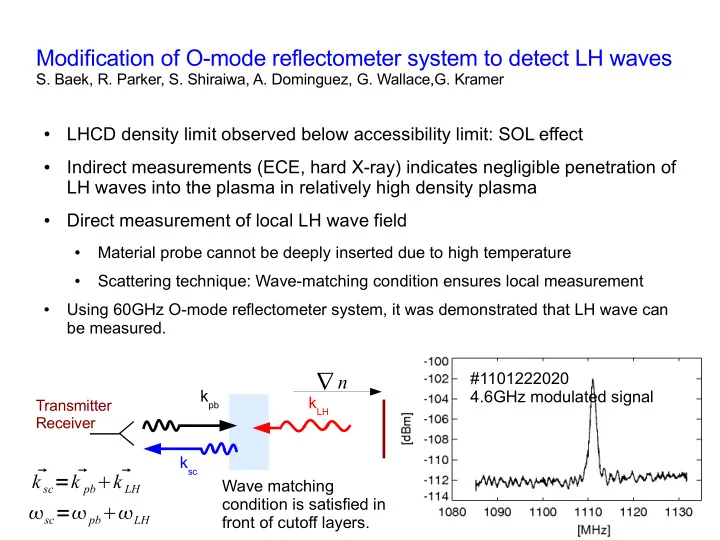
  • Scattering technique: Wave-matching condition ensures local measurement
  • Using 60GHz O-mode reflectometer system, it was demonstrated that LH wave can

be measured.

∇ n

Transmitter Receiver

ksc kpb kLH #1101222020 4.6GHz modulated signal

 k sc=  k pb  k LH sc= pbLH

Wave matching condition is satisfied in front of cutoff layers.

slide-2
SLIDE 2

Preliminary results from 60GHz system shows the variation of power amplitude

  • f scattered signals depending on the plasma density.
  • L-mode : As plasma density increases, the power amplitude decreases,

suggesting the presence of weaker LH electric fields in the interaction region.

  • H-mode: stronger power amplitude is seen even higher density when

compared to L-mode.

  • The biggest concern is whether the power of scattered signal is in the range
  • f detector sensitivity.
slide-3
SLIDE 3

Expanding frequency channels to study the penetration of LH waves

  • Preparing similar setup in the higher frequency channels (75,88 GHz) to the

60GHz system will allow the study of LH wave propagation.

  • Hardware modification is necessary.
  • Need to change the intermediate frequency (IF)

– Currently, IF is tuned to the baseband fluctuation measurement

  • Gunn oscillators, mixers, filters, amplifiers
  • Improve the sensitivity of the spectrum recorder

Density profile 1101222020

60GHz:

Currently available channel Density profile 1110106020

slide-4
SLIDE 4

Hardware upgrade is necessary.

  • Spectrum recorder can be improved to increase the sensitivity, in general.
  • 100 kHz low pass filter is currently used to select frequency.
  • The combination of electronic chips and the narrow low pass filter near

zero frequency might suppress the signal heavily as I have pushed the lower limit of operating frequency region.

  • Using higher frequency with narrow bandpass filter will also lower 1/f

noise.

  • 75GHz: major hardware modification is done with 60GHz system.
  • Need to assess waveguide losses
  • Still, it remains the question whether the input beam is strong enough
  • 88/112GHz: major modification is necessary
  • Gunn diode oscillators, mixers, filters, amplifier,....
  • The final goal is to demonstrate how far LH waves propagates

inside plasma using multiple frequency channels.