w.f.gard@tudelft.nl COST E53, Bled, Slovenia, 2009
Moisture content control by shrinkage behaviour of the wood first - - PowerPoint PPT Presentation
Moisture content control by shrinkage behaviour of the wood first experimental results Wolfgang F. Gard & Michel Riepen Delft University of Technology, Faculty of Civil Engineering and Geosciences Timber Structures and Wood
w.f.gard@tudelft.nl
2
COST E53, Bled, Slovenia, 2009
Content
- Introduction
- Drying trials: material and method
- Results
- Conclusion
w.f.gard@tudelft.nl
4
COST E53, Bled, Slovenia, 2009
I ntroduction
Why would you like to control a drying process ?
- To obtain the final moisture content
- To avoid cracks, distortions and discoloration
w.f.gard@tudelft.nl
5
COST E53, Bled, Slovenia, 2009
I ntroduction
How do you control a drying process ?
- Moisture content measurements
- Moisture evaporation rate (drying rate)
- Strain measurements
Along the cross-section of the timber !!!!!!!!!
w.f.gard@tudelft.nl
6
COST E53, Bled, Slovenia, 2009
I ntroduction
Common inline measurement systems for moisture content in a kiln ?
- Electrical resistance probes
- Exceptionally: weighing the stack
- ?????????
Prediction of water evaporation and moisture content by drying models !!!!!!
w.f.gard@tudelft.nl
7
COST E53, Bled, Slovenia, 2009
I ntroduction
Limitations of electrical resistance measurements ?
- Moisture content above fibre saturation
- Temperature above 80°C
w.f.gard@tudelft.nl
8
COST E53, Bled, Slovenia, 2009
I ntroduction
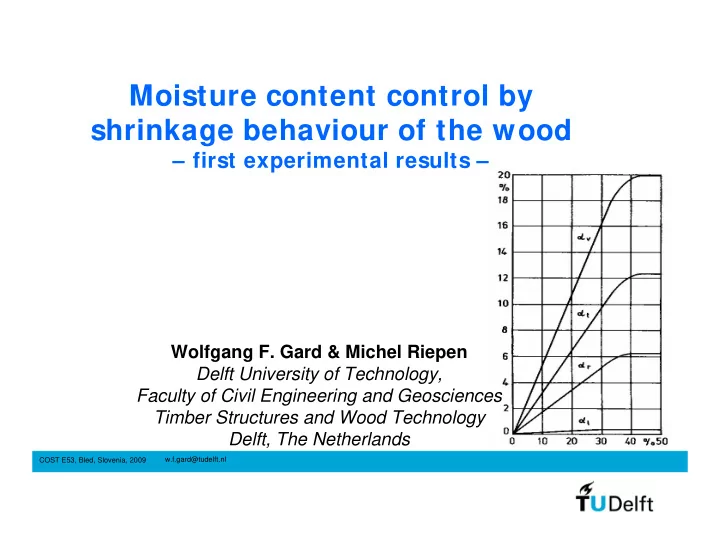
What about shrinkage ? There is also a relationship between shrinkage and moisture content.
w.f.gard@tudelft.nl
10
COST E53, Bled, Slovenia, 2009
Drying trial
Material
- Sitka Spruce from Scotland/UK
- 2500mm x 100mm x 50mm
- Initial moisture content 40% - 170%
(50% of all boards higher 90%)
- Final moisture content required 15%±1
- 63 boards per trial
w.f.gard@tudelft.nl
11
COST E53, Bled, Slovenia, 2009
Drying trial
Sensors 6 moisture probes in the timber 2 temperature sensors in the timber 2 relative humidity sensors in the kiln 2 temperature sensors in the kiln 2 shrinkage sensors at the timber stack 2 load cells for weighing the stack
w.f.gard@tudelft.nl
12
COST E53, Bled, Slovenia, 2009
Drying trial
- Top load 500 kg/m2, to avoid
deformation during drying
- Measuring online the decrease
- f thickness with a displacement
sensor (LVDT)
- Measuring the decrease of the
mass with a load cell
Timber stack
w.f.gard@tudelft.nl
14
COST E53, Bled, Slovenia, 2009
Drying trial
Drying schedule
20 40 60 80 100 120 time T wet T dry r.H.
warming up cooling steam drying pre-drying conditioning
w.f.gard@tudelft.nl
16
COST E53, Bled, Slovenia, 2009
Results
0.0 20.0 40.0 60.0 80.0 100.0 120.0 140.0 24 48 72 96 120 144 168 Time [h] T [°C], RH [%], MC [%]
Tair RH T wet T wood MC MC above FSP
w.f.gard@tudelft.nl
17
COST E53, Bled, Slovenia, 2009
Results
- 25.00
- 22.50
- 20.00
- 17.50
- 15.00
- 12.50
- 10.00
- 7.50
- 5.00
- 2.50
0.00 24 48 72 96 120 144 168
time [h] displacement [mm]
290 310 330 350 370 390 410 430 450 470 490
mass [kg] Thickness decrease [mm] mass [kg]
In this period timber is above FSP, but shows linear thickness decrease proportional with mass decrease, due to evaporation.
w.f.gard@tudelft.nl
18
COST E53, Bled, Slovenia, 2009
Results
Shrinkage parameters
- total thickness of the boards 350mm in the
beginning of the drying
- total thickness decrease 17.7mm total
shrinkage 5.0%
- final moisture content 14.5% (oven dry)
- assumed fibre saturation point 30%
- derived shrinkage coefficient 0.50% per % MC
change
w.f.gard@tudelft.nl
20
COST E53, Bled, Slovenia, 2009
Results
20 40 60 80 100 120 24 48 72 96 Time [h] T [°C], RH and MC [%]
- 18
- 15
- 12
- 9
- 6
- 3
Thickness decrease [mm] Tair T wet T wood MC wood MC shrink Thickness decrease
Sitka spruce on industrial scale
w.f.gard@tudelft.nl
22
COST E53, Bled, Slovenia, 2009
Conclusion of the first results
- With a displacement sensor we get information on the
drying rate, which is especially in the early drying stages
- f Sitka very important for the drying quality.
- Displacement measurements are reliable at high
temperatures (> 100°C).
- There is a direct linear relation between thickness
decrease and mass decrease due to drying.
w.f.gard@tudelft.nl COST E53, Bled, Slovenia, 2009