
MOL2NET, 2017, 3, doi:10.3390/mol2net-03-xxxx 1
MDPI
MOL2NET, International Conference Series on Multidisciplinary Sciences http://sciforum.net/conference/mol2net-03
Evaluation of the Interference of Solvents Used in the Evaluation of Antimicrobial Activity of Liposoluble Natural Compounds
Gildoberg Nunes da Silva (E-mail: bergnunes22@gmail.com)a, Raquel Carlos de Brito (E-mail: quelbrito1987@gmail.com)a, Ticiane Costa Farias (E-mail: ticiane_92@hotmail.com)a, Sávio Benvindo Ferreira (E-mail: saviobenvindo@gmail.com)b.
a Graduate student of the Federal University of Campina Grande, Campus Cajazeiras - PB. b Substitute Professor of Federal University of Campina Grande, Cajazeiras campus - PB.
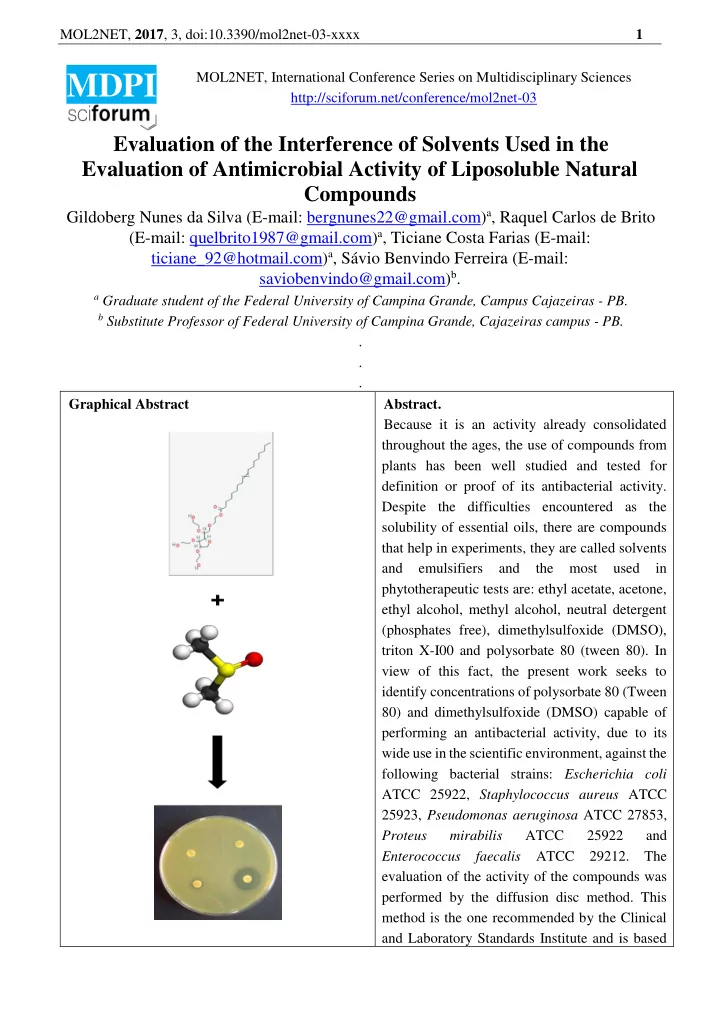
. . . Graphical Abstract Abstract. Because it is an activity already consolidated throughout the ages, the use of compounds from plants has been well studied and tested for definition or proof of its antibacterial activity. Despite the difficulties encountered as the solubility of essential oils, there are compounds that help in experiments, they are called solvents and emulsifiers and the most used in phytotherapeutic tests are: ethyl acetate, acetone, ethyl alcohol, methyl alcohol, neutral detergent (phosphates free), dimethylsulfoxide (DMSO), triton X-I00 and polysorbate 80 (tween 80). In view of this fact, the present work seeks to identify concentrations of polysorbate 80 (Tween 80) and dimethylsulfoxide (DMSO) capable of performing an antibacterial activity, due to its wide use in the scientific environment, against the following bacterial strains: Escherichia coli ATCC 25922, Staphylococcus aureus ATCC 25923, Pseudomonas aeruginosa ATCC 27853, Proteus mirabilis ATCC 25922 and Enterococcus faecalis ATCC 29212. The evaluation of the activity of the compounds was performed by the diffusion disc method. This method is the one recommended by the Clinical and Laboratory Standards Institute and is based