Molecular Psychiatry An atypical antidepressant drug regulates - - PDF document

molecular psychiatry
SMART_READER_LITE
LIVE PREVIEW

Molecular Psychiatry An atypical antidepressant drug regulates - - PDF document

4/9/2014 Molecular Psychiatry An atypical antidepressant drug regulates synaptic plasticity Nature Publishing Group Impact Factor: 14.897 (2012) 1/135 Psychiatry 7/251 Neuroscience 5/290 Biochemistry & Zhang, H.,


slide-1
SLIDE 1

4/9/2014 1 An atypical antidepressant drug regulates synaptic plasticity

Ed Shi April 7, 2014

Zhang, H., Etherington, L. A., Hafner, A. S., Belelli, D., Coussen, F., Delagrange, P., ... & Groc, L. (2013). Regulation of AMPA receptor surface trafficking and synaptic plasticity by a cognitive enhancer and antidepressant molecule. Molecular psychiatry, 18(4), 471- 484.

Molecular Psychiatry

  • Nature Publishing

Group

  • Impact Factor: 14.897

(2012)

– 1/135 Psychiatry – 7/251 Neuroscience – 5/290 Biochemistry & Molecular Biology

“Molecular Psychiatry” (2014). Retreived April 5, 2014. http://www.nature.com/mp/index.html

Laurent Groc

  • Research Director at

French National Center for Research (CNRS)

  • Study of molecular

mechanisms of neural connection formation

  • Principal Investigator at

Bordeaux Segalin Unversity

  • Neuroscience PhD from

Wayne State University, Michigan

Development and Adaptation of Neural Circuits. Retreived April 5, 2014. http://www.iins.u- bordeaux2.fr/research-teams/groc-team

Daniel Choquet

  • Research Director at French

National Center for Research CNRS

  • Director of the Institute of

Interdisciplinary Neuroscience – Bordeaux Segalin University

  • Director of Bordeaux Imaging

Center

  • Study of receptor trafficking via

high resolution imaging techniques

  • PhD in neuroscience from

Pasteur Institute, France

“Daniel Choquet Group” Retreived April 5, 2014. http://www.iins.u-bordeaux2.fr/research-teams/daniel- choquet-team

Others

  • Honyu Zhang –

Postdoc

  • Anne-Sophie Hafner

– Postdoc

  • Francois Coussen –

Researcher (now married to D. Choquet)

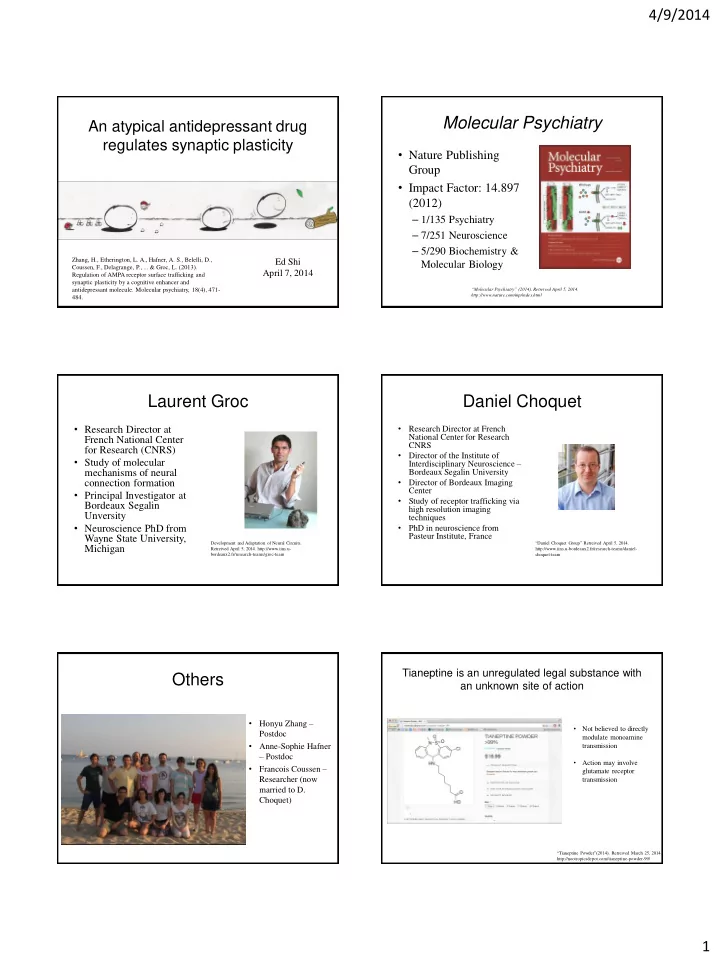
Tianeptine is an unregulated legal substance with an unknown site of action

“Tianeptine Powder”(2014). Retreived March 25, 2014. http://nootropicsdepot.com/tianeptine-powder-99/

  • Not believed to directly

modulate monoamine transmission

  • Action may involve

glutamate receptor transmission

slide-2
SLIDE 2

4/9/2014 2 Ionotropic Glutamate Receptors (iGluRs)

  • AMPA Receptor (AMPAR)
  • Four subunits
  • GluA1-3 subunits
  • Excitatory
  • NMDA Receptor

(NMDAR)

  • V
  • ltage

dependent Mg2+ block

  • Kainate Receptor

AMPA receptor

  • Ligand gated (glutamate) ion

channels responsible for excitatory synaptic transmission

Mechanism of long term potentiation (LTP) synaptic plasticity at a glutamate synapse

  • 1. Depolarization of postsynaptic membrane
  • 2. Relief of NMDAR Mg2+ block
  • 3. Ca2+ influx through NMDAR
  • 4. Activation of Ca2+ Dependent Kinase
  • 5. Phosphorylation of AMPAR facilitating

surface delivery

  • 6. More excitatory AMPAR, more excitable

synapse

Kauer & Malenka 2007

Compromised synaptic plasticity may underlie mood disorder

  • Alterations in plasticity seen in stress-induced animal models of

depression

  • Synaptic plasticity mechanisms intimately related to denritic

branching and brain region volume

  • Regions affected include hippocampus, pre-frontal cortex, amygdala
  • All important in cognitive and affective function
  • Tianeptine may exert its antidepressant effect by reversing

compromised plasticity

Tianeptine reverses stress induced decreases in LTP

  • LTP dependent on high

frequency activation

  • 4 pulse of high freq. stim

results in subsequent higher fEPSP – Indicative of LTP

  • Graph plot of fEPSP after LTP-

inducing stimulation, as % of control

  • Stress decreases magnitude of

LTP

  • Effect reversed by

tianeptine

Tianeptine decrease stimulation threshold for LTP

  • 3 pulse stimulation

produces change in fEPSP in control (black trace)

  • Tianeptine

administration results in significantly greater potentiation with 3 pulse stimulation (red trace)

Tianeptine reduces stress induced decrease in field EPSP

  • Field EPSP

– Extracellular recording of a population of neurons – A measurement of basal synaptic transmission strength

slide-3
SLIDE 3

4/9/2014 3 Tianeptine molecular mechanism involves AMPA receptor lateral diffusion GluA1 AMPA receptor subunit is important in LTP

  • Regulatory phosphorylation sites

– Serine-831: receptor trafficking – Serine-845: modulate how often receptor can open

  • AMPA receptors containing only GluA1 are

trafficked to synapse in early LTP

– Open “wider” – Permeability to Ca2+ may play later role in LTP

Tianeptine reduces stress induced decrease of surface GluA1 AMPA receptor subunit

  • Fluorescent imaging of GluR1 :: superEcliptic pHluorin

(SEP) intensity

  • pH sensitive fluorescent protein
  • Strong emission indicative of extracellular environment

(~neutral pH)

  • Low emission in acidified intracellular vesicles

Tianeptine increases GluA1 at the synapse

  • Quantification of GluA1 at

synapse by fluorescent intensity

  • Postsynaptic protein

homer1c is tagged with red fluorescent protein

  • Co-localization with

tagged homer1c defines “synaptic”

Tianeptine decreases GluA1 AMPAR surface diffusion

  • GluA1 :: SEP used

to visualize

  • Light pulse is used

to bleach SEP

  • Unbleached tagged

GluA1 diffuse laterally and florescence is recovered

  • In (a) & (b)

qualitative and quantitative fluorescence recovery is faster with tianeptine

  • Indicates

greater lateral mobility

GluA2 AMPA receptor subunit quantum dot (QD) tracking

  • Antibody specific for N-

terminal domain of GluA2

  • QD secondary antibody
  • Visualization using mercury

lamp and regular CCD video camera

  • High signal/noise ratio vs.

fluorescent protein

slide-4
SLIDE 4

4/9/2014 4

Tianeptine decreases GluA2-AMPAR surface diffusion

  • Yellow traces show

path of a single GluA2 containing AMPA receptor

  • Quantification of

diffusion revealed significant differences

Tianeptine reduces glucocorticoid incubation induced AMPAR movement

  • Glucocorticoid (GC) is a stress

hormone

  • Activation of glucocorticoid

receptors in brain implicated in effects of stress

  • Figure shows trajectory of QD

tagged GluA2

  • GC induced mobility

increase is reduced by tianeptine

The molecular mechanism of tianeptine action is dependent on a CaMKII – Stargazin – PSD-95 interaction

  • Dependent on CaMKII

phosphorylation of Stargazin protein that associates with AMPARs

  • Phosphorylated Stargazin must

bind PSD-95 (a synaptic strutural protein)

  • Inhibition of either of these

steps by drug or mutation prevented the effects of tianeptine

  • Energy emitted by GFP on

PSD95 is absorbed by red fluorophore on Stargazin if two are close together

  • GFP will become dimmer
  • Measurement of GFP “lifetime”

quantifies stargazin-PSD95 binding

  • GFP lifetime is significantly

shorter in tianeptine administration

Further evidence for affect on Stargazin – PSD95 interaction

Summary

  • Tianeptine reduces stress induced LTP changes

– Perhaps through reduction of LTP-inducing stimulation threshold

  • Tianeptine reduces lateral diffusion of AMPA

receptors out of the synapse

– No effect on endocytosis or exocytosis seen

  • A CaMKII – Stargazin – PSD-95 interaction is

necessary for the effects of tianeptine