Montana State Auditor The Office of Montana State Auditor, - - PowerPoint PPT Presentation

montana state auditor
SMART_READER_LITE
LIVE PREVIEW

Montana State Auditor The Office of Montana State Auditor, - - PowerPoint PPT Presentation

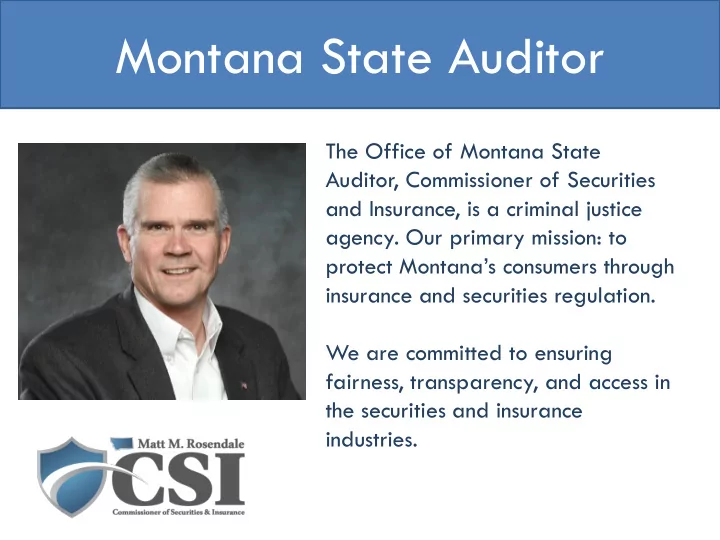
Montana State Auditor The Office of Montana State Auditor, Commissioner of Securities and Insurance, is a criminal justice agency. Our primary mission: to protect Montanas consumers through insurance and securities regulation. We are


slide-1
SLIDE 1

Montana State Auditor

The Office of Montana State Auditor, Commissioner of Securities and Insurance, is a criminal justice

  • agency. Our primary mission: to

protect Montana’s consumers through insurance and securities regulation. We are committed to ensuring fairness, transparency, and access in the securities and insurance industries.

slide-2
SLIDE 2

Securities Regulation

The Securities Act of Montana charges Commissioner Rosendale and the CSI staff with the following three tasks in regards to securities regulation: 1) Protect the investor, persons engaged in securities transactions, and the public interest 2) Promote uniformity among the states; and 3) Encourage, promote, and facilitate capital investment in Montana

slide-3
SLIDE 3

What is a Investment Contract?

SEC v. W. J. Howey Company

In 1946 the Supreme Court of the United States outlined a method of determining if an investment is covered by the Securities Act of 1933. It is known as the Howey test. 1) An investment due to 2) an expectation of profits arising from 3) a common enterprise 4) which depends on the efforts of a promoter or third party.

slide-4
SLIDE 4

Types of Securities

Debt securities - raise money by obtaining loans from investors (bonds, notes, promissory notes, certificates of deposit, debentures, etc.) Equity securities – raise money by selling ownership interest in your company (stocks, mutual funds, beneficial interests, limited partnerships, joint ventures, LLC units,

  • ptions, warrants, investment contracts, variable

annuities, mineral/oil rights, etc.)

slide-5
SLIDE 5

Basic General Rule

MCA 30-10-202. Registration of securities. It is unlawful for any person to

  • ffer or sell any security in this state, except securities exempt under 30-10-

104 or when sold in transactions exempt under 30-10-105, unless: (1) the security is registered by notification, coordination, or qualification under parts 1 through 3 of this chapter; or (2) for a federal covered security, the security has been filed with the commissioner pursuant to 30-10-211 and the fee prescribed in 30-10-209 has been paid.

slide-6
SLIDE 6

Securities Registration

Issuers can register their securities with the Securities and Exchange Commission and with state securities regulators. Once a security is registered, it is considered a public

  • ffering.

MCA §§ 30-10-204 and 205 set forth the requirements for securities registration.

slide-7
SLIDE 7

Registered or Exempt

▪ With few exceptions, every offer or sale of a security must, before it is offered or sold in this state, be registered

  • r exempt from registration under the Montana Securities

Act. ▪ Some securities sales that are exempt are self-executing and require no securities filings in this state. ▪ Other exemptions are available depending on the manner in which the securities are sold, and include various factors.

slide-8
SLIDE 8

Exempt Securities

MCA § 30-10-104: Provides for the exemption of certain types

  • f securities such as:
  • securities issued by governments (federal, state, county, city)
  • securities issued non-profit issuers such as churches, hospitals,

schools, fraternal organizations

  • employee stock purchase plans
  • securities listed on the New York Stock Exchange, the American

Stock Exchange, the NASDAQ NMS

  • securities issued by insurance companies
slide-9
SLIDE 9

Exempt Transactions

MCA § 30-10-105: Exempt transactions provides exemptions for both the security and the offer and sale of the security. Following are some examples:

  • MCA § 30-10-105(8)(a ): Exempt offering to not more than 10 investors
  • MCA § 30-10-105(8)(b ): Exempt offering to not more than 25 investors
  • MCA § 30-10-105(8)(c ): Exempt offering to not more than 35 investors (Montana

businesses only)

  • MCA § 30-10-105(22): Exempt securities crowdfunding exemption
  • MCA § 30-10-105(21): Exempt securities cooperative exemption
slide-10
SLIDE 10

Requirements for all Securities Offerings

Don’t discount disclosure. Whether a securities offering is registered or exempt from registration, the issuer is always required to make full disclosure to prospective investors. Federal and state securities laws require the issuer to disclose all material facts and risks to investors. If you do not comply with disclosure requirements, you and your business may have committed securities fraud and could be subject to private lawsuits as well as administrative or criminal enforcement actions. Full disclosure is the best way for a business to protect itself.

slide-11
SLIDE 11

Concept of “Full Disclosure

▪ Investors entitled to complete, accurate, and detailed information about the investment being offered to them. ▪ Salespersons and issuers have an affirmative obligation to provide complete disclosure. ▪ Failure to provide full and complete disclosure of a material fact to a prospective investor is a violation of the Montana Securities Act and could result in civil, administrative, or criminal penalties.

slide-12
SLIDE 12

What is “Full Disclosure?”

  • What type of securities are being offered
  • What type of business does the issuer conduct
  • What are the risks associated with the issuer and the investment
  • Who are the business’ officers and directors and what are their salaries
  • How is the business capitalized
  • How much money is being raised from investors
  • How will the investment proceeds be spent
  • And more…anything material…full disclosure protects everyone and is

required by Montana law Disclosure is usually made through a prospectus or private placement memorandum

slide-13
SLIDE 13

What is Crowdfunding?

Crowdfunding is an money-raising strategy that began as a way for the public to donate small amounts of money, often through social networking websites, to help artists, musicians, filmmakers and other creative people finance their projects. The concept recently has been promoted as a way of assisting small businesses and start-ups looking for investment capital to help get their business ventures off the ground.

slide-14
SLIDE 14

Crowdfunding that is NOT Subject to Securities Law.

Gifts: Wedding guests pay for a couples’ honeymoon. Charities & non profits: Money is given to promote the

  • rganization with no expectation of returns.

Sales and donation based models: Startups pre-sell items they hope to produce or people donate to help a product

  • r creative project become reality., IndiGogo, GoFundMe,

Kickstarter etc.

slide-15
SLIDE 15

Crowdfunding in Montana

There is a 5 page application form on the CSI web site which must be completed and submitted with a $50 filing fee 10 days prior to any solicitation for money OR 15 days after the first unsolicited sale of the security. The CSI website has a disclosure template that issuers can complete and fill out. It covers the key topics issuers need to provide information about to prospective investors.

slide-16
SLIDE 16

Requirements of the Crowdfunding Law § 30-10-105(22):

  • The issuer (seller) can raise $1 million from Montana investors in any 12

month period.

  • Investors can invest up to $10,000 in the offering.
  • Accredited investors can invest an unlimited amount in the offering.
  • The issuer must be a Montana business.
  • The issuer must comply with all state laws, including proper registration for its

company with the Montana Secretary of State www.sos.mt.gov

slide-17
SLIDE 17

Qualified Opportunity Zones Funds (QOFs)

QOFs are defined as “any investment vehicle which is organized as a corporation or a partnership for the purpose of investing in qualified

  • pportunity zone property.

Under state and federal law, interest in a QOF offered and sold to investors will typically constitute securities within the state and federal definition. As a result, these securities will need to be registered or qualify for an exemption both at the state and federal level.

slide-18
SLIDE 18

Regulation D, Rule 506

Rule 506 is the most commonly used exemption from registration under state and federal securities laws. Issuers can raise an unlimited amount of money from investors and sell securities to an unlimited number of accredited investors. Bad Boy provisions Rule 506(b) and Rule 506(c) have differences

slide-19
SLIDE 19

What is an Accredited Investor?

Net worth exceeds $1,000,000 (excluding the value of the primary residence) OR Annual income exceeds $200,000 (or $300,000 jointly with a spouse) OR An entity such as a bank, insurance company, corporation or trust with assets in excess of $5,000,000

slide-20
SLIDE 20

Tips for Small Businesses & Entrepreneurs

Don’t go it alone. Businesses seeking to raise capital by registering their securities or through the use of an exemption still need legal guidance as to how to comply with the Montana law. Issuers should consult with an attorney to help with the

  • ffering and should contact the CSI for assistance prior to

conducting an offering.

slide-21
SLIDE 21

Cooperatives

A cooperative organized under Title 35, chapter 15 or 17 can seek an exemption and raise an unlimited amount

  • f money from an unlimited number of investors in

Montana Cooperatives must make full and complete disclosure to prospective investors as described previously in my presentation

slide-22
SLIDE 22

Tips for Small Businesses & Entrepreneurs

Avoid Distractions. Having hundreds of “owners” may distract a business’ management from devoting the time and energy that is necessary to run a successful business. Venture capital companies or private equity funds may be less inclined to invest in a company that already has a large number

  • f small investors.
slide-23
SLIDE 23

In Summary

Funding or growing a business with investor capital can eliminate the need for debt service, can include a community, and can create pride in local ownership. Capital formation can be a positive experience for both businesses and

  • investors. Sometimes, however, things go terribly wrong.

The CSI has the resources and expertise to assist a business in every step of the way with its capital formation efforts. It also has the resources to prevent and detect securities fraud. For any questions…call

800-332-6148

  • r 406-444-2040