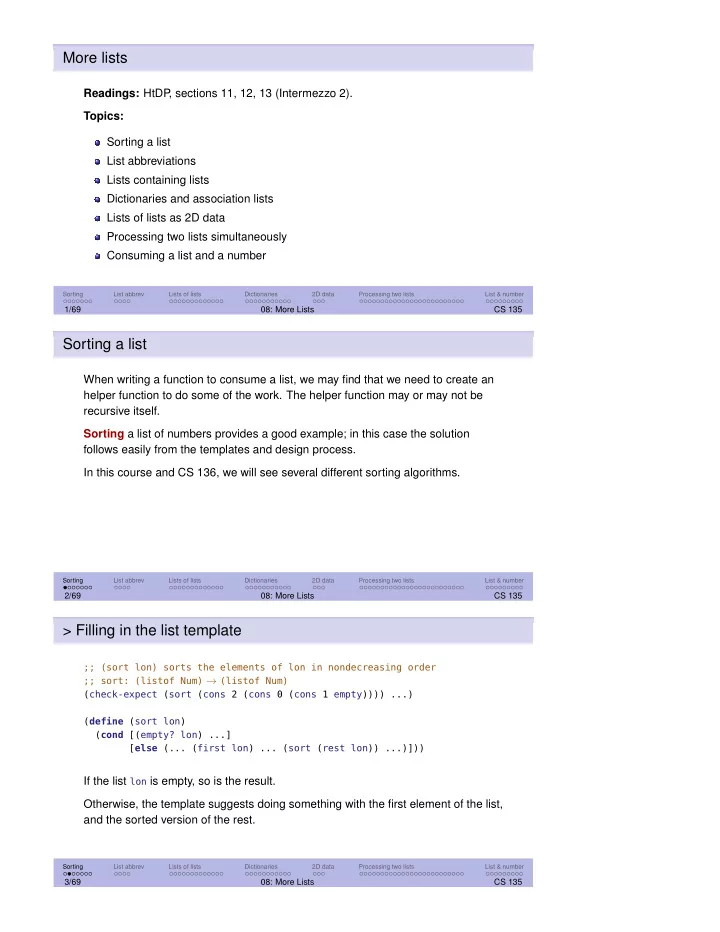
More lists Readings: HtDP , sections 11, 12, 13 (Intermezzo 2). - - PDF document

more lists
SMART_READER_LITE
LIVE PREVIEW

More lists Readings: HtDP , sections 11, 12, 13 (Intermezzo 2). - - PDF document

More lists Readings: HtDP , sections 11, 12, 13 (Intermezzo 2). Topics: Sorting a list List abbreviations Lists containing lists Dictionaries and association lists Lists of lists as 2D data Processing two lists simultaneously Consuming a


slide-1
SLIDE 1

More lists

Readings: HtDP , sections 11, 12, 13 (Intermezzo 2). Topics: Sorting a list List abbreviations Lists containing lists Dictionaries and association lists Lists of lists as 2D data Processing two lists simultaneously Consuming a list and a number

Sorting List abbrev Lists of lists Dictionaries 2D data Processing two lists List & number

1/69 08: More Lists CS 135

Sorting a list

When writing a function to consume a list, we may find that we need to create an helper function to do some of the work. The helper function may or may not be recursive itself. Sorting a list of numbers provides a good example; in this case the solution follows easily from the templates and design process. In this course and CS 136, we will see several different sorting algorithms.

Sorting List abbrev Lists of lists Dictionaries 2D data Processing two lists List & number

2/69 08: More Lists CS 135

> Filling in the list template

;; (sort lon) sorts the elements of lon in nondecreasing order ;; sort: (listof Num) → (listof Num) (check-expect (sort (cons 2 (cons 0 (cons 1 empty)))) ...) (define (sort lon) (cond [(empty? lon) ...] [else (... (first lon) ... (sort (rest lon)) ...)]))

If the list lon is empty, so is the result. Otherwise, the template suggests doing something with the first element of the list, and the sorted version of the rest.

Sorting List abbrev Lists of lists Dictionaries 2D data Processing two lists List & number

3/69 08: More Lists CS 135

slide-2
SLIDE 2

;; (sort lon) sorts the elements of lon in nondecreasing order ;; sort: (listof Num) → (listof Num) (check-expect (sort (cons 2 (cons 0 (cons 1 empty)))) ...) (define (sort lon) (cond [(empty? lon) empty] [else (insert (first lon) (sort (rest lon)))])) insert is a recursive helper function that consumes a number and a sorted list,

and inserts the number to the sorted list.

Sorting List abbrev Lists of lists Dictionaries 2D data Processing two lists List & number

4/69 08: More Lists CS 135

> A condensed trace of sort and insert

(sort (cons 2 (cons 4 (cons 3 empty))))

⇒ (insert 2 (sort (cons 4 (cons 3 empty)))) ⇒ (insert 2 (insert 4 (sort (cons 3 empty)))) ⇒ (insert 2 (insert 4 (insert 3 (sort empty)))) ⇒ (insert 2 (insert 4 (insert 3 empty))) ⇒ (insert 2 (insert 4 (cons 3 empty))) ⇒ (insert 2 (cons 3 (cons 4 empty))) ⇒ (cons 2 (cons 3 (cons 4 empty)))

Sorting List abbrev Lists of lists Dictionaries 2D data Processing two lists List & number

5/69 08: More Lists CS 135

> The helper function insert

We again use the list template for insert.

;; (insert n slon) inserts the number n into the sorted list slon ;; so that the resulting list is also sorted. ;; insert: Num (listof Num) → (listof Num) ;; requires: slon is sorted in nondecreasing order (define (insert n slon) (cond [(empty? slon) ...] [else (... (first slon) ... (insert n (rest slon)) ...)]))

Sorting List abbrev Lists of lists Dictionaries 2D data Processing two lists List & number

6/69 08: More Lists CS 135

slide-3
SLIDE 3

If slon is empty, the result is the list containing just n. If slon is not empty, another conditional expression is needed.

n is the first number in the result if it is less than or equal to the first number in slon.

Otherwise, the first number in the result is the first number in slon, and the rest of the result is what we get when we insert n into (rest slon).

Sorting List abbrev Lists of lists Dictionaries 2D data Processing two lists List & number

7/69 08: More Lists CS 135

> Insert

(define (insert n slon) (cond [(empty? slon) (cons n empty)] [(<= n (first slon)) (cons n slon)] [else (cons (first slon) (insert n (rest slon)))])) (insert 4 (cons 1 (cons 2 (cons 5 empty))))

⇒ (cons 1 (insert 4 (cons 2 (cons 5 empty)))) ⇒ (cons 1 (cons 2 (insert 4 (cons 5 empty)))) ⇒ (cons 1 (cons 2 (cons 4 (cons 5 empty))))|

Our sort with helper function insert are together known as insertion sort.

Sorting List abbrev Lists of lists Dictionaries 2D data Processing two lists List & number

8/69 08: More Lists CS 135

List abbreviations

Now that we understand lists, we can abbreviate them. In DrRacket, “Beginning Student With List Abbreviations” provides new syntax for list abbreviations, and a number of additional convenience functions. Remember to follow the instructions in Module 01 when changing language levels.

Sorting List abbrev Lists of lists Dictionaries 2D data Processing two lists List & number

9/69 08: More Lists CS 135

slide-4
SLIDE 4

The expression

(cons exp1 (cons exp2 (... (cons expn empty)...)))

can be abbreviated as

(list exp1 exp2 ... expn)

The result of the trace we did on the last slide can be expressed as

(list 1 2 4 5).

Sorting List abbrev Lists of lists Dictionaries 2D data Processing two lists List & number

10/69 08: More Lists CS 135

(second my-list) is an abbreviation for (first (rest my-list)). third, fourth, and so on up to eighth are also defined.

Use these sparingly to improve readability. The templates we have developed remain very useful.

Sorting List abbrev Lists of lists Dictionaries 2D data Processing two lists List & number

11/69 08: More Lists CS 135

> cons vs. list

Note that cons and list have different results and different purposes. We use list to construct a list of fixed size (whose length is known when we write the program). We use cons to construct a list from one new element (the first) and a list of arbitrary size (whose length is known only when the second argument to cons is evaluated during the running of the program).

Sorting List abbrev Lists of lists Dictionaries 2D data Processing two lists List & number

12/69 08: More Lists CS 135

slide-5
SLIDE 5

Lists containing lists

Here are two different two-element lists.

1

1 2 4 1 3

We now know two different ways to construct these lists:

(cons 1 (cons 2 empty)) (cons 3 (cons 4 empty))

OR

(list 1 2) (list 3 4)

Lists can contain anything, including other lists, at which point these abbreviations can improve readability.

Sorting List abbrev Lists of lists Dictionaries 2D data Processing two lists List & number

13/69 08: More Lists CS 135

Here is a one-element list whose single element is one of the two-element lists we saw above.

4 1 3

As before, we now know two different ways we could construct this.

(cons (cons 3 (cons 4 empty)) empty)

OR

(list (list 3 4))

When the thing a list contains is complicated, we may draw an arrow to it, as shown on the right. This visualization represents the same list as the

  • ne above.

4 1 3

Sorting List abbrev Lists of lists Dictionaries 2D data Processing two lists List & number

14/69 08: More Lists CS 135

We can create a two-element list, each of whose elements is itself a two-element

  • list. These are two different visualizations of the same list.

4 1 3 2 1

OR

4 1 3 2 1

Such a list can be created in code two different ways:

(cons (cons 1 (cons 2 empty)) (cons (cons 3 (cons 4 empty)) empty))

OR

(list (list 1 2) (list 3 4))

Clearly, the abbreviations are more expressive.

Sorting List abbrev Lists of lists Dictionaries 2D data Processing two lists List & number

15/69 08: More Lists CS 135

slide-6
SLIDE 6

> Example: processing a payroll

A company needs to process their payroll – a list of employee names and their salaries. It produces a list of each employee name and the tax owed. The tax owed is computed with tax-payable from Module 04. Payroll:

(list (list "Asha" 50000) (list "Joseph" 100000) (list "Sami" 7000))

TaxOwed:

(list (list "Asha" 7750) (list "Joseph" 18250) (list "Sami" 1050))

Asha 50000

Joseph 100000

Sami 10000

Asha 7750

Joseph 18250

Sami 1050

Sorting List abbrev Lists of lists Dictionaries 2D data Processing two lists List & number

16/69 08: More Lists CS 135

» Data definitions

;; A Payroll is one of: ;; * empty ;; * (cons (list Str Num) Payroll) ;; A TaxOwed is one of: ;; * empty ;; * (cons (list Str Num) TaxOwed)

Note the use of (list Str Num) rather than (listof X).

Sorting List abbrev Lists of lists Dictionaries 2D data Processing two lists List & number

17/69 08: More Lists CS 135

» Template

;; (payroll-template pr) ;; payroll-template: Payroll → Any (define (payroll-template pr) (cond [(empty? pr) ...] [(cons? pr) ... (first pr) ... ... (payroll-template (rest pr)) ...]))

A payroll is just a list, so this looks exactly like the (listof X) template – so far...

Sorting List abbrev Lists of lists Dictionaries 2D data Processing two lists List & number

18/69 08: More Lists CS 135

slide-7
SLIDE 7

Some information from our data definition is not yet captured in the template: The list’s first item is known to be of the form (list Str Num). It’s useful to reflect that fact in the template: It reminds us of all the data available to us when solving the problem. Our solutions (derived from the template) will often access the parts of the sublist.

Sorting List abbrev Lists of lists Dictionaries 2D data Processing two lists List & number

19/69 08: More Lists CS 135

;; (payroll-template pr) ;; payroll-template: Payroll → Any (define (payroll-template pr) (cond [(empty? pr) ...] [(cons? pr) (... (first (first pr)) ... ... (first (rest (first pr))) ... ... (payroll-template (rest pr)) ...)]))

Some short helper functions will make our code more readable.

Sorting List abbrev Lists of lists Dictionaries 2D data Processing two lists List & number

20/69 08: More Lists CS 135

;; (name lst) produces the first item from lst -- the name. (define (name lst) (first lst)) ;; (amount lst) produces the second item from lst -- the amount. (define (amount lst) (first (rest lst))) ;; (payroll-template pr) ;; payroll-template: Payroll → Any (define (payroll-template pr) (cond [(empty? pr) ...] [(cons? pr) (... (name (first pr)) ... ... (amount (first pr)) ... ... (payroll-template (rest pr)) ...)]))

Non-recursive helper functions only need a purpose.

Sorting List abbrev Lists of lists Dictionaries 2D data Processing two lists List & number

21/69 08: More Lists CS 135

slide-8
SLIDE 8

» Start design recipe; fill in template

;; (compute-taxes payroll) calculates the tax owed for each ;; employee/salary pair in the payroll. ;; compute-taxes: Payroll → TaxOwed (check-expect (compute-taxes test-payroll) test-taxes) (define (compute-taxes payroll) (cond [(empty? payroll) ...] [(cons? payroll) (... (name (first payroll)) ... ... (amount (first payroll)) ... ... (compute-taxes (rest payroll)) ...)]))

Sorting List abbrev Lists of lists Dictionaries 2D data Processing two lists List & number

22/69 08: More Lists CS 135

» Finish compute-taxes

;; (compute-taxes payroll) calculates the tax owed for each ;; employee/salary pair in the payroll. ;; compute-taxes: Payroll → TaxOwed (check-expect (compute-taxes test-payroll) test-taxes) (define (compute-taxes payroll) (cond [(empty? payroll) empty] [(cons? payroll) (cons (list (name (first payroll)) (tax-payable (amount (first payroll)))) (compute-taxes (rest payroll)))]))

Sorting List abbrev Lists of lists Dictionaries 2D data Processing two lists List & number

23/69 08: More Lists CS 135

» Alternate solution

(define (compute-taxes-alt payroll) (cond [(empty? payroll) empty] [(cons? payroll) (cons (sr

tr (first payroll)) (compute-taxes-alt (rest payroll)))])) ;; (sr

tr salary-rec) consumes a salary record and produces the ;; corresponding tax record ;; sr

tr: (list Str Num) → (list Str Num) (define (sr

tr salary-rec) (list (name salary-rec) (tax-payable (amount salary-rec))))

Sorting List abbrev Lists of lists Dictionaries 2D data Processing two lists List & number

24/69 08: More Lists CS 135

slide-9
SLIDE 9

» Alternate templates leading to the second solution

;; (payroll-template pr) ;; payroll-template: Payroll → Any (define (payroll-template pr) (cond [(empty? pr) ...] [(cons? pr) (... (salary-rec-template (first pr)) ... ... (payroll-template (rest pr)) ...)])) (define (salary-rec-template sr) (... (name sr) ... (amount sr) ...))

Sorting List abbrev Lists of lists Dictionaries 2D data Processing two lists List & number

25/69 08: More Lists CS 135

Different kinds of lists

When we introduced lists in module 06, the items they contained were not lists. These were flat lists. We have just seen lists of lists. A Payroll is a list containing a two-element flat list. In later lecture modules, we will use lists containing unbounded flat lists. We will also see nested lists, in which lists may contain lists that contain lists, and so on to an arbitrary depth.

Sorting List abbrev Lists of lists Dictionaries 2D data Processing two lists List & number

26/69 08: More Lists CS 135

Dictionaries

Once upon a time, a dictionary was a book in which you look up a word to find a

  • definition. Nowdays, a dictionary is an app:

But in both cases there is a correspondence between a word and its definition.

Sorting List abbrev Lists of lists Dictionaries 2D data Processing two lists List & number

27/69 08: More Lists CS 135

slide-10
SLIDE 10

More generally, a dictionary contains a number of unique keys, each with an associated value. Examples: A dictionary: keys are words; values are definitions. Your contacts list: keys are names; values are telephone numbers. Your seat assignment for midterms: keys are userids; values are seat locations. Stocks: keys are symbols; values are prices. Many two-column tables can be viewed as dictionaries. The previous examples can all be viewed as two-column tables.

Sorting List abbrev Lists of lists Dictionaries 2D data Processing two lists List & number

28/69 08: More Lists CS 135

> Dictionary operations

What operations might we wish to perform on dictionaries? lookup: given a key, produce the corresponding value add: add a (key,value) pair to the dictionary remove: given a key, remove it and its associated value

Sorting List abbrev Lists of lists Dictionaries 2D data Processing two lists List & number

29/69 08: More Lists CS 135

> Association lists

One simple solution uses an association list, which is just a list of (key, value) pairs. We store the pair as a two-element list. For simplicity, we will use numbers as keys and strings as values.

;; An association list (AL) is one of: ;; ⋆ empty ;; ⋆ (cons (list Num Str) AL) ;; Requires: each key (Num) is unique

Example:

(list (list 8 "Asha") (list 2 "Joseph") (list 5 "Sami"))

8 Asha 2

Joseph

5 Sami Sorting List abbrev Lists of lists Dictionaries 2D data Processing two lists List & number

30/69 08: More Lists CS 135

slide-11
SLIDE 11

We can create association lists based on other types for keys and values. We use

Num and Str here just to provide a concrete example.

Since we have a data definition, we could use AL for the type of an association list, as given in a contract. Another alternative is to use (listof (list Num Str)).

Sorting List abbrev Lists of lists Dictionaries 2D data Processing two lists List & number

31/69 08: More Lists CS 135

We can use the data definition to produce a template.

;; al-template: AL → Any (define (al-template alst) (cond [(empty? alst) ...] [else (... (first (first alst)) ... ; first key (second (first alst)) ... ; first value (al-template (rest alst)))]))

Sorting List abbrev Lists of lists Dictionaries 2D data Processing two lists List & number

32/69 08: More Lists CS 135

> Lookup operation

Recall that lookup consumes a key and a dictionary (association list) and produces the corresponding value. In coding lookup, we have to make a decision. What should it produce if the lookup fails? Since every string (including "") is a valid value, lookup can produce false to indicate that the key was not present in the association list.

(check-expect (lookup 2 (list (list 8 "Asha") (list 2 "Joseph") (list 5 "Sami")) "Joseph") (check-expect (lookup 1 (list (list 8 "Asha") (list 2 "Joseph") (list 5 "Sami")) false)

Sorting List abbrev Lists of lists Dictionaries 2D data Processing two lists List & number

33/69 08: More Lists CS 135

slide-12
SLIDE 12

;; (lookup-al k alst) produces the value corresponding to key k, ;;

  • r false if k not present

;; lookup-al: (define (lookup-al k alst) (cond [(empty? alst) false] [(= k (first (first alst))) (second (first alst))] [else (lookup-al k (rest alst))]))

What is the contract for lookup-al? We need a way to indicate that it can produce either a string or false.

Sorting List abbrev Lists of lists Dictionaries 2D data Processing two lists List & number

34/69 08: More Lists CS 135

> (anyof ...) notation in contracts

Use (anyof X Y ...) to mean any of the listed types or values. Examples:

(anyof Num Str) (anyof Str Num Bool) (anyof 1 2 3) (listof (anyof Str false)) ;; foo: Num → (anyof Str Bool Num) (define (foo x) (cond [(< x 0) "negative"] [(= x 0) false] [(= x 1) true] [else x]))

Sorting List abbrev Lists of lists Dictionaries 2D data Processing two lists List & number

35/69 08: More Lists CS 135

Dictionaries: summary

We will leave the add and remove functions as exercises. The association list solution is simple enough that it is often used for small dictionaries. For a large dictionary, association lists are inefficient. For example, consider the case where the key is not present and the whole list must be searched. In a future module, we will impose structure to improve this situation.

Sorting List abbrev Lists of lists Dictionaries 2D data Processing two lists List & number

36/69 08: More Lists CS 135

slide-13
SLIDE 13

Two-dimensional data

Another use of lists of lists is to represent a two-dimensional table. For example, here is a multiplication table:

(mult-table 3 4) ⇒ (list (list 0 0 0 0) (list 0 1 2 3) (list 0 2 4 6))

The cth entry of the r th row (numbering from 0) is r × c. We can write mult-table using two applications of the “count up” idea.

Sorting List abbrev Lists of lists Dictionaries 2D data Processing two lists List & number

37/69 08: More Lists CS 135

1 2 3 2 4 6

> Make one row

Make one row of the table but counting the columns from 0 up to nc, doing the required multiplication for each one. This will be a helper function in the final solution.

;; cols-to: Nat Nat Nat → (listof Nat) ;; Example: (check-expect (cols-to 0 3 5) (list 0 3 6 9 12)) (check-expect (cols-to 0 4 5) (list 0 4 8 12 16)) (define (cols-to c r nc) (cond [(>= c nc) empty] [else (cons (* r c) (cols-to (add1 c) r nc))]))

Sorting List abbrev Lists of lists Dictionaries 2D data Processing two lists List & number

38/69 08: More Lists CS 135

> Put multiple rows together

;; (mult-table nr nc) produces multiplication table ;; with nr rows and nc columns ;; mult-table: Nat Nat → (listof (listof Nat)) (define (mult-table nr nc) (rows-to 0 nr nc)) ;; (rows-to r nr nc) produces mult. table, rows r...(nr-1) ;; rows-to: Nat Nat Nat → (listof (listof Nat)) (define (rows-to r nr nc) (cond [(>= r nr) empty] [else (cons (cols-to 0 r nc) (rows-to (add1 r) nr nc))]))

Sorting List abbrev Lists of lists Dictionaries 2D data Processing two lists List & number

39/69 08: More Lists CS 135

slide-14
SLIDE 14

Processing two lists simultaneously

We now look at a more complicated recursion, namely writing functions which consume two lists (or two data types, each of which has a recursive definition). Following the textbook, we will distinguish three different cases, and look at them in order of complexity. The simplest case is when one of the lists does not require recursive processing.

Sorting List abbrev Lists of lists Dictionaries 2D data Processing two lists List & number

40/69 08: More Lists CS 135

> Case 1: processing just one list

As an example, consider the function my-append.

;; (my-append lst1 lst2) appends lst2 to the end of lst1 ;; my-append: (listof Any) (listof Any) → (listof Any) ;; Examples: (check-expect (my-append empty (list 'a 'b 'c)) (list 'a 'b 'c)) (check-expect (my-append (list 3 4) (list 1 2 5)) (list 3 4 1 2 5)) (define (my-append lst1 lst2) ...)

Sorting List abbrev Lists of lists Dictionaries 2D data Processing two lists List & number

41/69 08: More Lists CS 135

(define (my-append lst1 lst2) (cond [(empty? lst1) lst2] [else (cons (first lst1) (my-append (rest lst1) lst2))]))

The code only does simple recursion on lst1. The parameter lst2 is “along for the ride”.

append is a built-in function in Racket.

Sorting List abbrev Lists of lists Dictionaries 2D data Processing two lists List & number

42/69 08: More Lists CS 135

slide-15
SLIDE 15

» A condensed trace

(my-append (list 1 2 3) (list 4 5 6))

⇒ (cons 1 (my-append (list 2 3) (list 4 5 6))) ⇒ (cons 1 (cons 2 (my-append (list 3) (list 4 5 6)))) ⇒ (cons 1 (cons 2 (cons 3 (my-append (list ) (list 4 5 6))))) ⇒ (cons 1 (cons 2 (cons 3 (list 4 5 6)))

The last line is the same as

(cons 1 (cons 2 (cons 3 (cons 4 (cons 5 (cons 6 empty)))))).

That’s the same as (list 1 2 3 4 5 6).

Sorting List abbrev Lists of lists Dictionaries 2D data Processing two lists List & number

43/69 08: More Lists CS 135

> Case 2: processing in lockstep

To process two lists lst1 and lst2 in lockstep, they must be the same length and be consumed at the same rate.

lst1 is either empty or a cons, and the same is true of lst2 (four possibilities in

total). However, because the two lists must be the same length,

(empty? lst1) is true if and only if (empty? lst2) is true.

This means that out of the four possibilities, two are invalid for proper data. The template is thus simpler than in the general case.

Sorting List abbrev Lists of lists Dictionaries 2D data Processing two lists List & number

44/69 08: More Lists CS 135

(define (lockstep-template lst1 lst2) (cond [(empty? lst1) ... ] [else (... (first lst1) ... (first lst2) ... (lockstep-template (rest lst1) (rest lst2)) ... )]))

Sorting List abbrev Lists of lists Dictionaries 2D data Processing two lists List & number

45/69 08: More Lists CS 135

slide-16
SLIDE 16

» Example: dot product

To take the dot product of two vectors, we multiply entries in corresponding positions (first with first, second with second, and so on) and sum the results. Example: the dot product of (1 2 3) and (4 5 6) is 1 · 4 + 2 · 5 + 3 · 6 = 4 + 10 + 18 = 32. We can store the elements of a vector in a list, so (1 2 3) becomes (list 1 2 3). For convenience, we define the empty vector with no entries, represented by

empty.

Sorting List abbrev Lists of lists Dictionaries 2D data Processing two lists List & number

46/69 08: More Lists CS 135

» dot-product

;; (dot-product lon1 lon2) computes the dot product ;;

  • f vectors lon1 and lon2

;; dot-product: (listof Num) (listof Num) → Num ;; requires: lon1 and lon2 are the same length (check-expect (dot-product empty empty) 0) (check-expect (dot-product '(2) '(3)) 6) (check-expect (dot-product '(2 3 4 5) '(6 7 8 9)) (+ 12 21 32 45)) (define (dot-product lon1 lon2) ...)

Sorting List abbrev Lists of lists Dictionaries 2D data Processing two lists List & number

47/69 08: More Lists CS 135

» dot-product

;; (dot-product lon1 lon2) computes the dot product ;;

  • f vectors lon1 and lon2

;; dot-product: (listof Num) (listof Num) → Num ;; requires: lon1 and lon2 are the same length (check-expect (dot-product empty empty) 0) (check-expect (dot-product '(2) '(3)) 6) (check-expect (dot-product '(2 3 4 5) '(6 7 8 9)) (+ 12 21 32 45)) (define (dot-product lon1 lon2) (cond [(empty? lon1) 0] [else (+ (* (first lon1) (first lon2)) (dot-product (rest lon1) (rest lon2)))]))

Sorting List abbrev Lists of lists Dictionaries 2D data Processing two lists List & number

48/69 08: More Lists CS 135

slide-17
SLIDE 17

» A condensed trace

(dot-product (list 2 3 4) (list 5 6 7))

⇒ (+ 10 (dot-product (list 3 4)

(list 6 7)))

⇒ (+ 10 (+ 18 (dot-product (list 4)

(list 7))))

⇒ (+ 10 (+ 18 (+ 28 (dot-product (list )

(list )))))

⇒ (+ 10 (+ 18 (+ 28 0))) ⇒ (+ 10 (+ 18 28)) ⇒ (+ 10 46) ⇒ 56

Sorting List abbrev Lists of lists Dictionaries 2D data Processing two lists List & number

49/69 08: More Lists CS 135

Exercise 1

Write a recursive function vector-add that adds two vectors.

(vector-add '(3 5) '(7 11)) ⇒ '(10 16) (vector-add '(3 5 1 3) '(2 2 9 3)) ⇒ '(5 7 10 6)

Exercise 2

Complete join-names.

(define gnames '("Joseph" "Burt" "Douglas" "James" "David")) (define snames '("Hagey" "Matthews" "Wright" "Downey" "Johnston")) ;; (join-names G S) Make a list of full names from G and S. ;; join-names: (listof Str) (listof Str) → (listof Str) ;; Example: (check-expect (join-names gnames snames) '("Joseph Hagey" "Burt Matthews" "Douglas Wright" "James Downey" "David Johnston"))

slide-18
SLIDE 18

> Case 3: processing at different rates

If the two lists lst1, lst2 being consumed are of different lengths, all four possibilities for their being empty/nonempty are possible:

(and (empty? lst1) (empty? lst2)) (and (empty? lst1) (cons? lst2)) (and (cons? lst1) (empty? lst2)) (and (cons? lst1) (cons? lst2))

Exactly one of these is true, but all must be tested in the template.

Sorting List abbrev Lists of lists Dictionaries 2D data Processing two lists List & number

50/69 08: More Lists CS 135

» The template so far

(define (twolist-template lst1 lst2) (cond [(and (empty? lst1) (empty? lst2)) ...] [(and (empty? lst1) (cons? lst2)) ...] [(and (cons? lst1) (empty? lst2)) ...] [(and (cons? lst1) (cons? lst2)) ...]))

The first case is a base case; the second and third may or may not be.

Sorting List abbrev Lists of lists Dictionaries 2D data Processing two lists List & number

51/69 08: More Lists CS 135

» Refining the template

(define (twolist-template lst1 lst2) (cond [(and (empty? lst1) (empty? lst2)) ...] [(and (empty? lst1) (cons? lst2)) (... (first lst2) ... (rest lst2) ...)] [(and (cons? lst1) (empty? lst2)) (... (first lst1) ... (rest lst1) ...)] [(and (cons? lst1) (cons? lst2)) ??? ]))

The second and third cases may or may not require recursion. The fourth case definitely does, but its form is unclear.

Sorting List abbrev Lists of lists Dictionaries 2D data Processing two lists List & number

52/69 08: More Lists CS 135

slide-19
SLIDE 19

» Further refinements

There are many different possible natural recursions for the last cond answer ???:

... (first lst2) ... (twolist-template lst1 (rest lst2)) ... ... (first lst1) ... (twolist-template (rest lst1) lst2) ... ... (first lst1) ... (first lst2) ... (twolist-template (rest lst1) (rest lst2)) ...

We need to reason further in specific cases to determine which is appropriate.

Sorting List abbrev Lists of lists Dictionaries 2D data Processing two lists List & number

53/69 08: More Lists CS 135

» Example: merging two sorted lists

We wish to design a function merge that consumes two lists. Each list is sorted in ascending order (no duplicate values).

merge will produce one such list containing all elements.

As an example:

(merge (list 1 8 10) (list 2 4 6 12)) ⇒ (list 1 2 4 6 8 10 12)

We need more examples to be confident of how to proceed.

Sorting List abbrev Lists of lists Dictionaries 2D data Processing two lists List & number

54/69 08: More Lists CS 135

» Example: merging two sorted lists

(merge empty empty) ⇒ empty (merge empty (list 2 6 9)) ⇒ (list 2 6 9) (merge (list 1 3) empty) ⇒ (list 1 3) (merge (list 1 4) (list 2)) ⇒ (list 1 2 4) (merge (list 3 4) (list 2)) ⇒ (list 2 3 4)

Sorting List abbrev Lists of lists Dictionaries 2D data Processing two lists List & number

55/69 08: More Lists CS 135

slide-20
SLIDE 20

» Reasoning about merge

If lon1 and lon2 are both nonempty, what is the first element of the merged list? It is the smaller of (first lon1) and (first lon2). If (first lon1) is smaller, then the rest of the answer is the result of merging

(rest lon1) and lon2.

If (first lon2) is smaller, then the rest of the answer is the result of merging lon1 and (rest lon2).

Sorting List abbrev Lists of lists Dictionaries 2D data Processing two lists List & number

56/69 08: More Lists CS 135

» Merge code

(define (merge lon1 lon2) (cond [(and (empty? lon1) (empty? lon2)) empty] [(and (empty? lon1) (cons? lon2)) lon2] [(and (cons? lon1) (empty? lon2)) lon1] [(and (cons? lon1) (cons? lon2)) (cond [(< (first lon1) (first lon2)) (cons (first lon1) (merge (rest lon1) lon2))] [else (cons (first lon2) (merge lon1 (rest lon2)))])]))

Sorting List abbrev Lists of lists Dictionaries 2D data Processing two lists List & number

57/69 08: More Lists CS 135

» A condensed trace

(merge (list 3 4) (list 2 5 6))

⇒ (cons 2 (merge (list 3 4)

(list 5 6))))

⇒ (cons 2 (cons 3 (merge (list 4)

(list 5 6))))

⇒ (cons 2 (cons 3 (cons 4 (merge empty

(list 5 6)))))

⇒ (cons 2 (cons 3 (cons 4 (cons 5 (cons 6 empty)))))

Sorting List abbrev Lists of lists Dictionaries 2D data Processing two lists List & number

58/69 08: More Lists CS 135

slide-21
SLIDE 21

Testing list equality

;; (list=? lst1 lst2) determines if lst1 and lst2 are equal ;; list=?: (listof Num) (listof Num) → Bool (define (list=? lst1 lst2) (cond [(and (empty? lst1) (empty? lst2)) ...] [(and (empty? lst1) (cons? lst2)) (... (first lst2) ... (rest lst2) ...)] [(and (cons? lst1) (empty? lst2)) (... (first lst1) ... (rest lst1) ...)] [(and (cons? lst1) (cons? lst2)) (???)]))

Sorting List abbrev Lists of lists Dictionaries 2D data Processing two lists List & number

59/69 08: More Lists CS 135

> Reasoning about list equality

Two empty lists are equal; if one is empty and the other is not, they are not equal. If both are nonempty, then their first elements must be equal, and their rests must be equal. The natural recursion in this case is

(list=? (rest lst1) (rest lst2))

Sorting List abbrev Lists of lists Dictionaries 2D data Processing two lists List & number

60/69 08: More Lists CS 135

List equality code

(define (list=? lst1 lst2) (cond [(and (empty? lst1) (empty? lst2)) true] [(and (empty? lst1) (cons? lst2)) false] [(and (cons? lst1) (empty? lst2)) false] [(and (cons? lst1) (cons? lst2)) (and (= (first lst1) (first lst2)) (list=? (rest lst1) (rest lst2)))]))

Some further simplifications are possible.

Sorting List abbrev Lists of lists Dictionaries 2D data Processing two lists List & number

61/69 08: More Lists CS 135

slide-22
SLIDE 22

> Built-in list equality

As you know, Racket provides the predicate equal? which tests structural

  • equivalence. It can compare two simple values (numbers, strings, symbols, etc) or

two lists containing any mixture of simple values and other lists. We will soon add structures to our repertoir of values. Structures may also contain

  • ther structures or lists or simple values.

equal? can compare any of these for equality.

At this point, you can see how you might write equal? if it were not already built in. It would involve testing the type of data supplied, and doing the appropriate comparison, recursively if necessary.

Sorting List abbrev Lists of lists Dictionaries 2D data Processing two lists List & number

62/69 08: More Lists CS 135

Consuming a list and a number

We defined recursion on natural numbers by showing how to view a natural number in a list-like fashion. We can extend our idea for computing on two lists to computing on a list and a number, or on two numbers. A predicate “Does elem appear at least n times in this list?” Example: “Does 2 appear at least 3 times in the list (list 4 2 2 3 2 4)?” produces true.

Sorting List abbrev Lists of lists Dictionaries 2D data Processing two lists List & number

63/69 08: More Lists CS 135

> The function at-least?

;; (at-least? n elem lst) determines if elem appears ;; at least n times in lst. ;; at-least?: Nat Any (listof Any) → Bool (check-expect (at-least? 0 'red (list 1 2 3)) true) (check-expect (at-least? 3 "hi" empty) false) (check-expect (at-least? 2 'red (list 'red 'blue 'red 'green)) true) (check-expect (at-least? 3 'red (list 'red 'blue 'red 'green)) false) (check-expect (at-least? 1 7 (list 5 4 0 5 3)) false) (define (at-least-template? n elem lst)

Sorting List abbrev Lists of lists Dictionaries 2D data Processing two lists List & number

64/69 08: More Lists CS 135

slide-23
SLIDE 23

> Developing the code

The recursion involves the parameters n and lst, once again giving four possibilities:

(define (at-least-template? n elem lst) (cond [(and (zero? n) (empty? lst)) ...] [(and (zero? n) (cons? lst)) ...] [(and (> n 0) (empty? lst)) ...] [(and (> n 0) (cons? lst)) ...]))

Once again, exactly one of these four possibilities is true. In which cases can we produce the answer without further processing? In which cases do we need further recursive processing to discover the answer? Which of the natural recursions should be used?

Sorting List abbrev Lists of lists Dictionaries 2D data Processing two lists List & number

65/69 08: More Lists CS 135

> Improving at-least?

In working out the details for each case, it becomes apparent that some of them can be combined. If n is zero, it doesn’t matter whether lst is empty or not. Logically, every element always appears at least 0 times. This leads to some rearrangement of the template, and eventually to the code that appears on the next slide.

Sorting List abbrev Lists of lists Dictionaries 2D data Processing two lists List & number

66/69 08: More Lists CS 135

> Improved at-least?

(define (at-least? n elem lst) (cond [(zero? n) true] [(empty? lst) false] ; list is nonempty, n ≥ 1 [(equal? (first lst) elem) (at-least? (sub1 n) elem (rest lst))] [else (at-least? n elem (rest lst))]))

Sorting List abbrev Lists of lists Dictionaries 2D data Processing two lists List & number

67/69 08: More Lists CS 135

slide-24
SLIDE 24

> Two condensed traces

(at-least? 3 'green (list 'red 'green 'blue)) ⇒ (at-least? 3 'green (list 'green 'blue)) ⇒ (at-least? 2 'green (list 'blue)) ⇒ (at-least? 2 'green empty) ⇒ false (at-least? 1 8 (list 4 8 15 16 23 42)) ⇒ (at-least? 1 8 (list 8 15 16 23 42)) ⇒ (at-least? 0 8 (list 15 16 23 42)) ⇒ true

Sorting List abbrev Lists of lists Dictionaries 2D data Processing two lists List & number

68/69 08: More Lists CS 135

Goals of this module

You should understand the principle of insertion sort, and how the functions involved can be created using the design recipe. You should be able to use list abbreviations for lists where appropriate. You should be able to construct and work with lists that contain lists. You should understand the three approaches to designing functions that consume two lists (or a list and a number, or two numbers) and know which

  • ne is suitable in a given situation.

Sorting List abbrev Lists of lists Dictionaries 2D data Processing two lists List & number

69/69 08: More Lists CS 135

Exercise 3

Write a recursive function (sum L) that consumes a (listof Num) and returns the sum of the values in the list. Write a recursive function divide-each that allows portions-r to achieve its purpose.

;; (portions-r L) divide each value in L by sum of L. ;; portions-r: (listof Num) → (listof Num) ;; Examples: (check-expect (portions-r '(1 1 2)) '(0.25 0.25 0.5)) (check-expect (portions-r '(6 1 3)) '(0.6 0.1 0.3)) (define (portions-r L) (divide-each L (sum L)))

slide-25
SLIDE 25

Exercise 4

Write a function (add-first-each L) that consumes a (listof Int) and adds to each value in the list the first in the list. Your function should be a wrapper around a recursive helper function.

(add-first-each '(3 2 7 6 5)) ⇒ '(6 5 10 9 8)