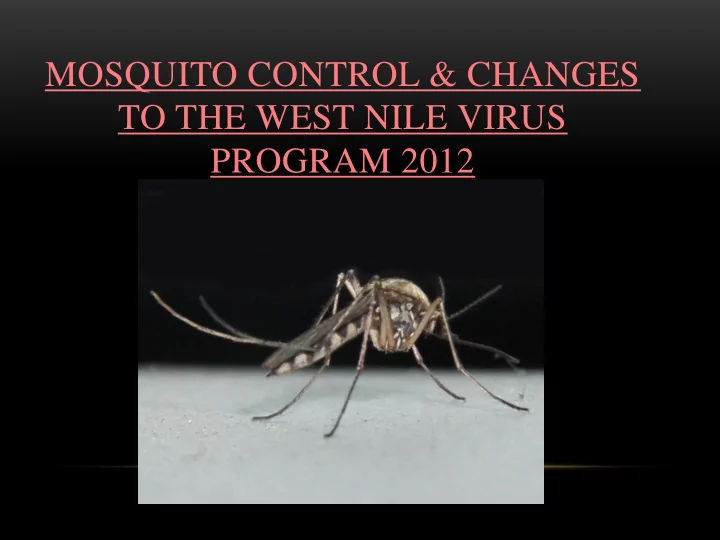
MOSQUITO CONTROL & CHANGES TO THE WEST NILE VIRUS PROGRAM 2012 - - PowerPoint PPT Presentation
MOSQUITO CONTROL & CHANGES TO THE WEST NILE VIRUS PROGRAM 2012 OVERVIEW What is West Nile Virus? What is the difference between a WNV and a Nuisance Mosquito Control Program? What did the program look like this year (changes)
OVERVIEW
- What is West Nile Virus?
- What is the difference between a WNV and a Nuisance
Mosquito Control Program?
- What did the program look like this year (changes)
- What were the challenges?
BETWEEN 2005 & 2011, THE MINISTRY OF HEALTH SERVICES OFFERED WNV RISK REDUCTION GRANT FUNDING FOR MUNICIPALITIES, FIRST NATIONS AND REGIONAL DISTRICTS IN THE
- PROVINCE. THE RDCO HAS BEEN APPLYING FOR
THIS FUNDING EACH YEAR. THIS FUNDING HAS BEEN DISCONTINUED AS OF 2012
BWP Consulting Inc. has been contracted to assist with the RDCO WNV program since 2005 and the has been the responsible for the program since 2011 (2012 is second year of five year contract)
WEST NILE VIRUS
- WNV is an arbovirus…spread by insects
- Arrived in North America in 1999
- Arrived in British Columbia in 2009- 10 mosquito
pools, two humans and 2 horses found infected in the RDOS
- Detected again in 2010 with one human case and a
number of infected birds in the Central Okanagan
- Horse confirmed positive in Central Okanagan in
2011
The West Nile Virus Cycle
WEST NILE VIRUS
- Causes illness in 20% of infected individuals
- 1% of infected individuals suffer serious illness
- Transmission is interrupted through prevention of
mosquito bites (personal protection or mosquito control)
- Not all mosquitoes can transmit WNV
?
First some biology……
- 29 species of mosquitoes have been identified in
the RDCO
- Females require blood meal to develop eggs
- Males are pollinators of grasses
- All larvae develop in standing water
BASIC MOSQUITO BIOLOGY:
MOSQUITO LIFECYCLE- FOUR STAGES ADULT
EGGS
LARVA (FOUR INSTARS)
Anopheles Coquillettidia (Mansonia) Culiseta Culex
PUPA (UH-OH)
- Nuisance Mosquitoes
(Aedes/Ochlerotatus) Lay eggs in soil Eggs become wet with rising water (floodwater mosquitoes) Larvae develop in 5 days to 10 days Adults emerge in clouds and can be incredibly aggressive Usually only bite once, lay eggs and die Short lived (depending on temp) More abundant in early season (May-early July)
- Disease Vectors (transmit West Nile
Virus) (Culex/Culiseta) Lay eggs on surface of water Eggs hatch within day or two Larvae develop in about 7-10 days Adults emerge throughout summer, not aggressive to humans Females bite many times (every 2 weeks depending on the weather) Relatively long-lived Later season (Late June through August)
FEMALE MOSQUITOES:
- Selective about who they bite:
- Bird biters
- Human biters
- Horse biters
- Frog biters
- Selective about where they lay
their eggs- (so we know where to look for them!):
- Saline ponds
- Highly polluted ditches
- Urban versus rural
- West Nile virus vectors lay eggs,
in containers, polluted habitats, catch basins, ditches, flooded fields
- Nuisance mosquitoes lay eggs in
flooded fields, near snowmelt and floodwater habitat
FEMALE MOSQUITOES:
- Nuisance:
- Target floodwater &
snowmelt
- Mission creek flooding
- Cattail ponds
- WNV Program
- Target permanent ponds
- Target water left after floods
- Catch basins (Culex pipiens)
- Ditches
DIFFERENCE BETWEEN A NUISANCE MOSQUITO CONTROL PROGRAM & WNV VECTOR CONTROL PROGRAM
WHAT WERE THE COMPONENTS OF THE RDCO NUISANCE MOSQUITO CONTROL PROGRAM?
Surface water larviciding in floodwater and snowmelt habitats. Treat Aedes, Ochlerotatus, Anopheles & Coquillettidia larvae Larviciding in Kelowna, small area of West Kelowna, Lake Country and the Electoral Areas
WHAT ARE THE COMPONENTS OF THE COMBINED WNV AND NUISANCE MOSQUITO CONTROL PROGRAM?
- 1. Public education
- 2. Mosquito Surveillance
- 3. Mosquito Control
- 1. Public education
Radio, newspaper & Castanet Published a brochure & poster boards Issued press releases Booths at Farmer’s Market, Kokanee Salmon Fest, Street Festivals, Fintry Fair, events in Lake Country
- 2. Mosquito
Surveillance- trapping adult mosquitoes to determine species composition and abundance. We had 4 trapping locations in 2012: (Greenhow Road, Mission, Glenmore Landfill area and Winfield)
- 2. MOSQUITO TRAPPING
- Captured over 3,300 mosquitoes in 2012
- 399 Culex tarsalis (12% of total catch)
- Highest numbers Glenmore followed by Mission Creek
- 133 Culex pipiens (4.0% of total catch)
- Highest trap counts in Mission & Winfield
- Nuisance Mosquitoes (Aedes, Ochlerotatus, Anopheles &
Coquillettidia) (84% of total catch)
- Highest trap counts in Mission
- 3. Mosquito
Control: Habitat Modification
- Tire collection
starts today!
HOW DO WE CONTROL MOSQUITOES?
100% larviciding with biological agents (larvae trapped in the water!) Active ingredient Bacillus thuringiensis var israelensis (open water) & Bacillus sphaericus (catch basins for Culex control) Safe for other insects, amphibians, fish mammals, & reptiles
HOW IS IT APPLIED?
- Backpack blower- like a leaf blower (489.15 kg of
granules applied to 97.8 ha)
- 15,344 catch basins treated with water-soluble pouches
in Kelowna & Lake Country (2 treatments of each basin).
CHANGES
- Peachland and West Kelowna opted out of the comprehensive
program Peachland had no control West Kelowna was reduced to small area around Rose Valley Elementary & 60 catch basins
- Because of changes
Treated 3,000 less basins Monitored and treated 35 fewer surface water sites
CHALLENGES
- Fintry Park area
- Many calls from residents and visitors
- Unable to find source- perhaps Lake?
- Residents & staff from West Kelowna
- Bylaw officer concerned because we would not visit owners
with habitat
- Handful of residents upset because we would not visit and it
turned out to be a pretty bad year for mosquitoes