
1
Towards Defining and Exploiting Similarities in Web Application Use Cases through User Session Analysis
Sreedevi Sampath, University of Delaware Amie Souter, Drexel University Lori Pollock, University of Delaware
Workshop on Dynamic Analysis (WODA), May 25, 2004 co-located with International Conference on Software Engineering (ICSE 2004)
Motivation and Overview
12.3.40.65 GET index.jsp 12.3.40.65 GET login.jsp 12.3.40.65 GET reg.jsp? login=xxx&password=hello& 12.3.40.65 GET myinfo.jsp
View user sessions as use cases Behaviorally related sequence of events performed by the user through interaction with the system User session analysis Test case generation Monitoring load of traffic Content personalization Test suite reduction Software development/ maintenance tools
- Clustering via concept analysis
- Common subsequences analysis
Learn about dynamic behavior
Step 1 Clustering via Concept Analysis
- Mathematical technique for clustering objects
that have common discrete attributes
- Set of objects, O: user sessions, us
- Set of attributes, A: URLs, u
- Relation, R: us requests u
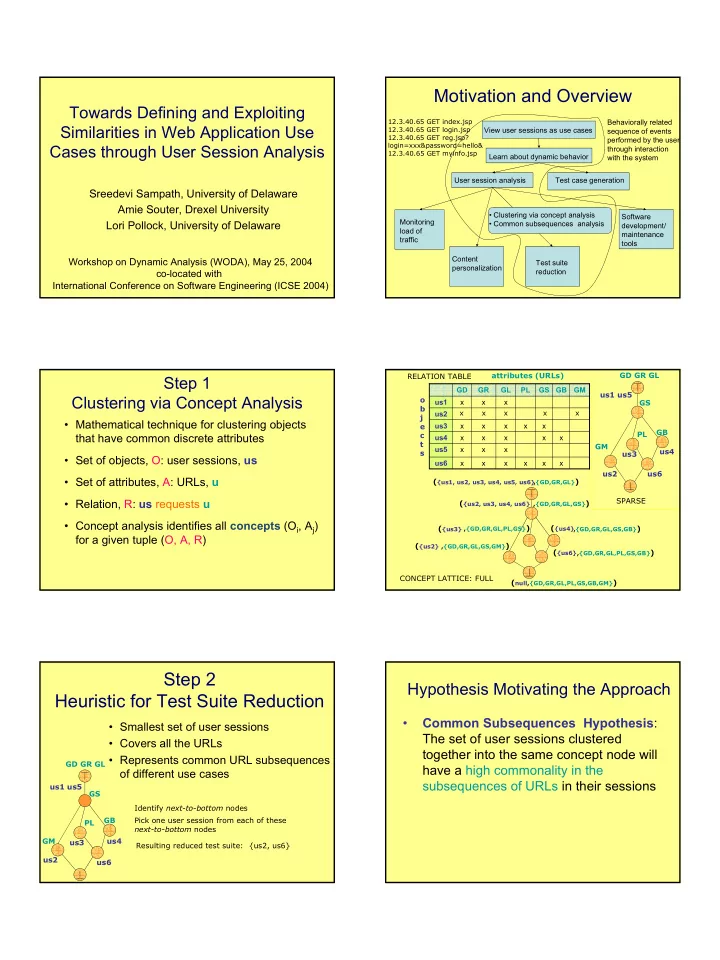
- Concept analysis identifies all concepts (Oi, Aj)
for a given tuple (O, A, R)
x x GB x x x x x GL x x PL x x x us4 x x us5 x x x us6 x x x us3 x x us1 GM GS GR GD us2 x x x x x
,{GD,GR,GL})
({us1, us2, us3, us4, us5, us6}
,{GD,GR,GL,GS}) ,{GD,GR,GL,PL,GS}) ,{GD,GR,GL,GS,GB})
({us3} ({us4} ({us2} ,{GD,GR,GL,GS,GM}) ({us6} ({us2, us3, us4, us6}
,{GD,GR,GL,PL,GS,GB}) {GD,GR,GL,PL,GS,GB,GM})
(null, CONCEPT LATTICE: FULL
- b
j e c t s attributes (URLs) RELATION TABLE GD GR GL us1 us5 GS PL GB us3 us2 GM us6 SPARSE us4
Step 2 Heuristic for Test Suite Reduction
- Smallest set of user sessions
- Covers all the URLs
- Represents common URL subsequences
- f different use cases
us1 us5 GS PL GB us3 us4 us2 GM us6 GD GR GL Resulting reduced test suite: {us2, us6} Identify next-to-bottom nodes Pick one user session from each of these next-to-bottom nodes
Hypothesis Motivating the Approach
- Common Subsequences Hypothesis: