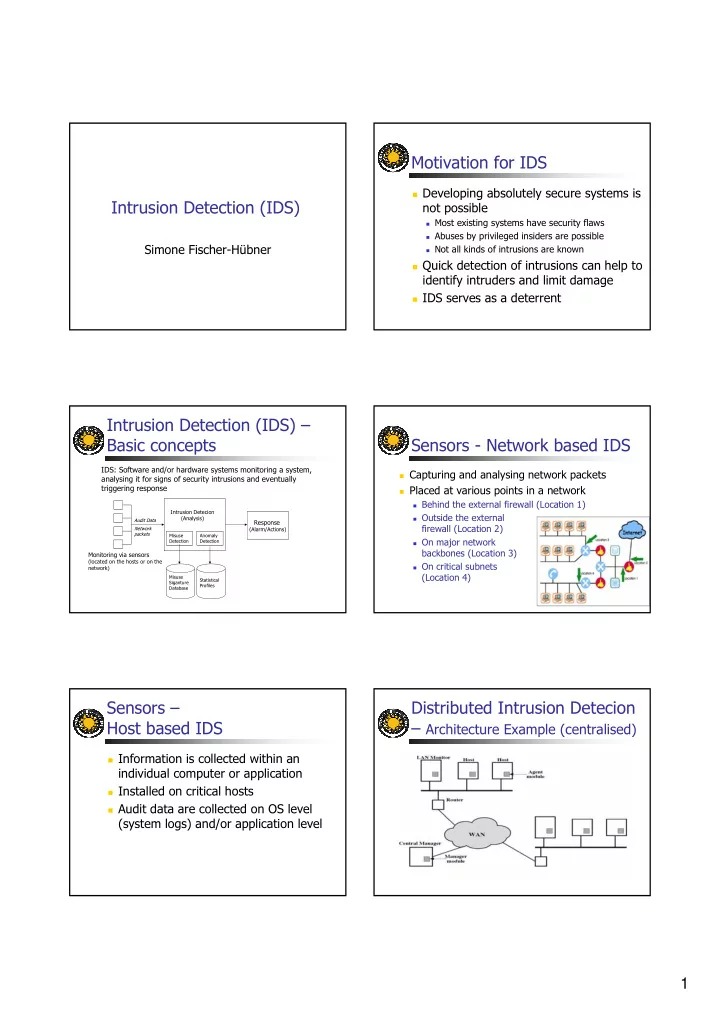
SLIDE 2 2 Distributed Intrusion Detection –
Issues
A distributed intrusion detection system may
need to deal with different audit record formats
One or more nodes in the network will serve
as collection and analysis points for the data, which must be securely transmitted to them
Architecture can be:
centralized (single point of analysis, easier but
bottleneck) or
decentralized (multiple centers that must be
coordinated)
Anomaly Detection
Based on the hypothesis that intrusions can be detected
by monitoring a system for abnormal patterns of system usage
I DES (Intrusion Detection Expert System) developed by
D.Denning at SRI/International in 1986
Usually rule-based pattern matching system which
includes
Statistical profiles for representing the behavior of subjects with
respect to objects
Rules matching new audit records against profiles, acquire/update
profiles, detect anonalous behavior
Examples for anomalies for intrusions:
Attempted break-ins:
- abnormally high rate of password failure
Masquerading, successful break-ins
- different login time, location or connection type,
- different accesses to data, execution of programs
Penetration by legitimate users:
- login at unusual times,
- route data to remote printers not normally used,
- execution of different programs, more protection violations,
- access to commands/files not normally permitted to him/her
Viruses:
- infected program needs more memory, disk space, CPU-time, I/O-
activities,
- it modifies other executable code not normally done by it,
- increase in the frequency of executable files rewritten in the infected
system
IDES Anomaly Detection –
Audit Records
Generated by the target system, translated into standard format, transmitted to the IDES system for analysis Audit record structure: ( subject, action, object, exception-condition, resource-usage, time-stamp ) Decomposition of activities involving multiple objects to single-object actions: e.g.: COPY GAME.EXE to <LIBRARY>GAME.EXE issued by Smith is aborted, because he does not have write-permission to <LIBRARY> Audit Records: (Smith, execute, <Library>COPY.EXE, 0, CPU=0002, 1105821678) (Smith, read, <Smith>GAME.EXE, 0, RECORDS=0, 1105821679) (Smith, write, <Library>GAME.EXE, write-viol, Records=0, 1105821679)
IDES Anomaly Detection –
Statistical Profiles (I)
- Profiles characterize the behaviour of a subject with respect to an object in
terms of a statistical metric and model
- Metric:
- Random variable x representing a quantitative measure accumulated over
a period (period: fixed or time between 2 events) Examples of types of metrics:
- Event counter:
- x is the number of audit records satisfying some property occurring during a period,
e.g. number of logins during one hour, number of execution failures during one session
- I nterval timer:
- x is the length of time between two related events, e.g. time length between
successive logins into one account
- Resource measure:
- x is the quantity of resources consumed by some action during a period, e.g.
number of pages printed per day
IDES Anomaly Detecion – Statistical Profiles (II)
- Statistical Model:
- Given a metric for a random variable x and n observations x1,...,xn.
- The statistical model shall determine whether a new observation xn+1 is
abnormal with respect to the previous observations.
- Operational Model:
- Abnormality is detected by comparing a new observation of x against fixed
limits, e.g. limitation of number of password failures during a short period.
- Mean and Standard Deviation Model:
- A new observation of x is defined to be abnormal, if it falls outside a
confidence interval: mean + d * stdev (the probability of a value falling outside this interval is at most 1/d2). sum = x1 + x2 + ....+ xn sumsquares = x1
2 +....+ xn 2
mean = sum / n stdev = √¯ (sumsquares / (n-1) - mean2 )