Moving Away from Letter of the Week: Enhancing When I saw a - - PDF document

moving away from letter of the week enhancing
SMART_READER_LITE
LIVE PREVIEW

Moving Away from Letter of the Week: Enhancing When I saw a - - PDF document

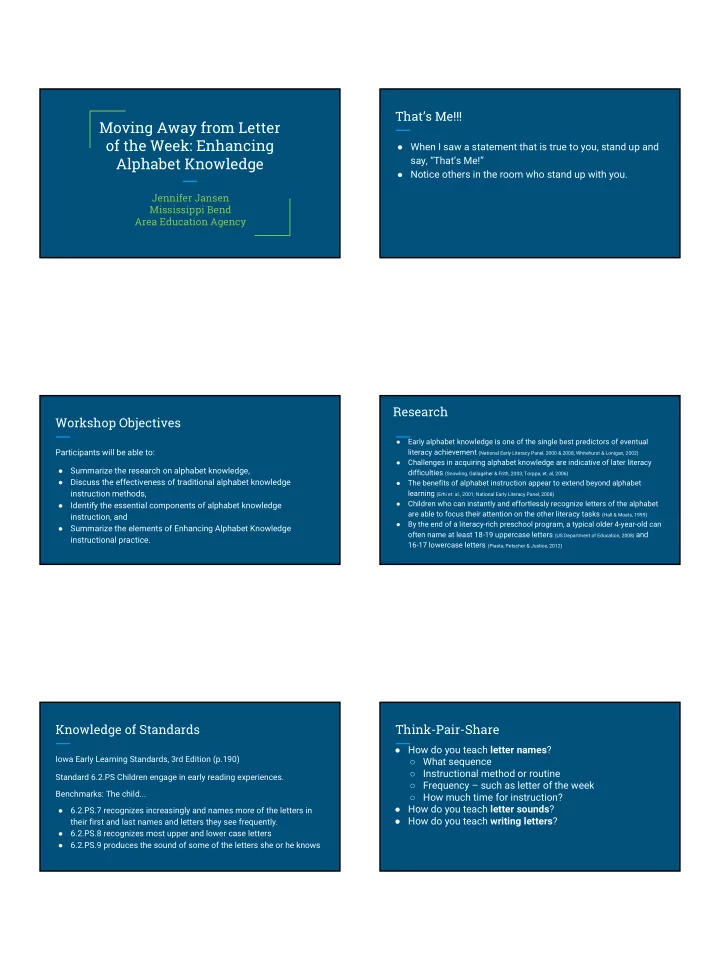
Thats Me!!! Moving Away from Letter of the Week: Enhancing When I saw a statement that is true to you, stand up and Alphabet Knowledge say, Thats Me! Notice others in the room who stand up with you. Jennifer Jansen


slide-1
SLIDE 1

Moving Away from Letter

  • f the Week: Enhancing

Alphabet Knowledge

Jennifer Jansen Mississippi Bend Area Education Agency

That’s Me!!!

  • When I saw a statement that is true to you, stand up and

say, “That’s Me!”

  • Notice others in the room who stand up with you.

Workshop Objectives

Participants will be able to:

  • Summarize the research on alphabet knowledge,
  • Discuss the effectiveness of traditional alphabet knowledge

instruction methods,

  • Identify the essential components of alphabet knowledge

instruction, and

  • Summarize the elements of Enhancing Alphabet Knowledge

instructional practice.

Research

  • Early alphabet knowledge is one of the single best predictors of eventual

literacy achievement (National Early Literacy Panel, 2000 & 2008, Whitehurst & Lonigan, 2002)

  • Challenges in acquiring alphabet knowledge are indicative of later literacy

difficulties (Snowling, Gallageher & Frith, 2003; Torppa, et. al, 2006)

  • The benefits of alphabet instruction appear to extend beyond alphabet

learning (Erhi et. al., 2001; National Early Literacy Panel, 2008)

  • Children who can instantly and effortlessly recognize letters of the alphabet

are able to focus their attention on the other literacy tasks (Hall & Moats, 1999)

  • By the end of a literacy-rich preschool program, a typical older 4-year-old can
  • ften name at least 18-19 uppercase letters (US Department of Education, 2008) and

16-17 lowercase letters (Piasta, Petscher & Justice, 2012)

Knowledge of Standards

Iowa Early Learning Standards, 3rd Edition (p.190) Standard 6.2.PS Children engage in early reading experiences. Benchmarks: The child...

  • 6.2.PS.7 recognizes increasingly and names more of the letters in

their first and last names and letters they see frequently.

  • 6.2.PS.8 recognizes most upper and lower case letters
  • 6.2.PS.9 produces the sound of some of the letters she or he knows

Think-Pair-Share

  • How do you teach letter names?

○ What sequence ○ Instructional method or routine ○ Frequency – such as letter of the week ○ How much time for instruction?

  • How do you teach letter sounds?
  • How do you teach writing letters?
slide-2
SLIDE 2

Research - Traditional Approach to Teaching Letters

  • A one-size fits all approach is not effective
  • Differences in children
  • Differences in letters
  • Phonological awareness connection to alphabet

knowledge

McKay & Teale, 2015 Jones, Clark, & Reutzel, 2012; McKay & Teale, 2015

Research - Differences Across Letters

  • Name Advantage
  • ABC Order
  • Frequency
  • Letter-Name Structure
  • Visual Similarity
  • Phonological Similarity and Pronunciation
  • Multiple sounds

Piasta, 2014

Research: Recommended Practices for Teaching Alphabet Knowledge

  • Exposure and practice
  • Small-group instruction
  • Multicomponent instruction
  • Order letters are taught
  • Pace

Essential Components in Alphabet Knowledge Instruction

  • Name
  • Shape (uppercase/lowercase)
  • Sound
  • Target Word
  • Mouth Shape
  • Writing letter form

A Case for Quality Target Words

  • Should have key sound, or one of the two key sounds, of

the letter

○ For example, not A is for Arm

  • Should not start with a letter name

○ For example, not E is for Elephant

  • Should not start with a blend because it's harder to

segment

○ For example, not D is for Drum

A Case for Quality Target Words

  • Easy to depict

○ For example, apple works well

  • Should not be something easily confused with another

item that begins with a different sound ○ For example, b is for boat is problematic. Children may say, “ship”

  • Likely to be known or easily learned by children
slide-3
SLIDE 3

A Case for Quality Target Words

Good Cat Octopus Sock Turtle Not so Good Cake Orange Shoe Truck

Enhancing Alphabet Knowledge Instruction

  • Brief, explicit lessons
  • Multiple, distributed instructional cycles

Jones, Clark, & Reutzel, 2012

Enhancing Alphabet Knowledge Instruction

  • Identifying letter name and letter sound
  • Recognizing the letter in text
  • Producing the letter form

Handout: EAK Lesson Template

Jones, Clark, & Reutzel, 2012

EAK Lesson In Action

Enhancing Alphabet Knowledge Instructional Cycles

  • Own Name Advantage
  • Alphabetical Order Advantage
  • Letter Name Letter Sound Advantage
  • Letter Frequency Advantage
  • Consonant Phoneme Acquisition Advantage
  • Distinctive Visual Features Writing Advantage
  • Handout: Overview of Instructional Cycles

Own Name Cycle

  • Learning advantage for initial letter in first name
  • Based on frequency of initial letters in class members names
  • Highly motivating and responsive to children’s developmental needs

for constructing self-identity

slide-4
SLIDE 4

Alphabetical Order Cycle

  • Learning advantage for alphabet sequential order
  • Begin with the letter a and ending with letter z
  • Prevalent instructional order in AK instruction, its important this is

not the only organizational pattern for teaching letters

  • Possible serial effects leading to difficulty with letters in the middle
  • f the alphabet

Letter Name-Letter Sound Relationship Cycle

  • Learning advantage for letters that have the letter sound pronounced

in the letter name

  • Begin with consonant letters that have the letter sound at the

beginning of the letter name (b, d, j, k, p, t, v, z), then consonant letters that have the sound at the end of the letter name (f, l, m, n, r, x), then consonants with no letter/sound association (h, q, w, y), and finally letters with more than one sound (c, g, s, a, e, i, o, u)

  • Instruction may proceed rapidly through the easier letters, allowing

increased time for more difficult to learn letters

Letter Frequency Cycle

  • Learning advantage based upon letter frequency in environmental

print and other printed materials

  • Begins with the letters occurring less frequently in text to the more

frequently occurring letters. ○ Consonant letters least to most most frequent (y, q, j, z, x, w, k, h, g, v, f, b, m, p, d, c, l, s, n, t, r) ○ Vowels least to most frequent (u, o, e, a, i)

  • Goal is to increase focus on the letters more difficult to learn due to

the lack of frequency in print

Consonant Phoneme Acquisition Order Cycle

  • Learning advantage based upon normative, developmental order of

consonant phoneme acquisition

  • Begins with letters more frequently articulated and acquired earlier

(o, e, i, a, u, p, m, h, n, w, b, c, k, g, d, t, f, y) proceeding to letters for which children have less experience producing the sound (r, l, s, z, j, v, q, x)

  • Teachers can use the normative developmental pattern to identify

potential reasons for difficulty with particular letters and focus on

  • ral speech that uses the more difficult to learn letters

Distinctive Visual Features Writing Cycle

  • Learning advantage based upon the number of distinctive features in

written letter forms

  • Letters with similar features presented in small clusters over several

days or presentation of letters with fewer distinctive features over subsequent days

  • Emphasis is on the critical distinctive features between similar

letters

Distinctive Features

Same Similar Different Cc Oo Pp Ss Vv Ww Xx Zz Ff Ii Jj Kk Ll Mm Uu Tt Yy Aa Bb Dd Ee Gg Hh Nn Qq

slide-5
SLIDE 5

Impact on Children’s Alphabet Knowledge

Teacher A 2016-2017

Impact on Children’s Alphabet Knowledge

Teacher A 2017-2018

Impact on Children’s Alphabet Knowledge

Teacher B 2016-2017

Impact on Children’s Alphabet Knowledge

Teacher B 2017-2018

Impact on Children’s Alphabet Knowledge

“Had to send you a picture to prove how the letter a day is helping my

  • students. Some of my students

have doubled their scores in letter identification!!!! I have never had this kind of growth in my 8 years of teaching preschool!”

Another Resource

“5. Brief, clear, explicit instruction in letter names, the sound(s) associated with the letters, and how the letters are shaped and formed (p. 3).

slide-6
SLIDE 6

Resources

Jones, C. D.; Clark, S. K.., & Reutzel, D. R. (2012). Enhancing alphabet knowledge instruction: Research implications and practical strategies for early childhood

  • educators. Early Childhood Education Journal, 41, 81-89.

Michigan Association of Intermediate school Administrators General Education Leadership Network Early Literacy Task Force. (2016). Essential instructional practices in early literacy: Prekindergarten. Lansing, MI: Authors. McKay, R. & Teale, W. H. (2015). No more teaching a letter a week. Portsmouth, NH: Heinemann.

So now what?

One thing you heard this morning that got you thinking. Start Doing? Keep Doing? Stop Doing?

Questions

Contact Information Jennifer Jansen jjansen@mbaea.org