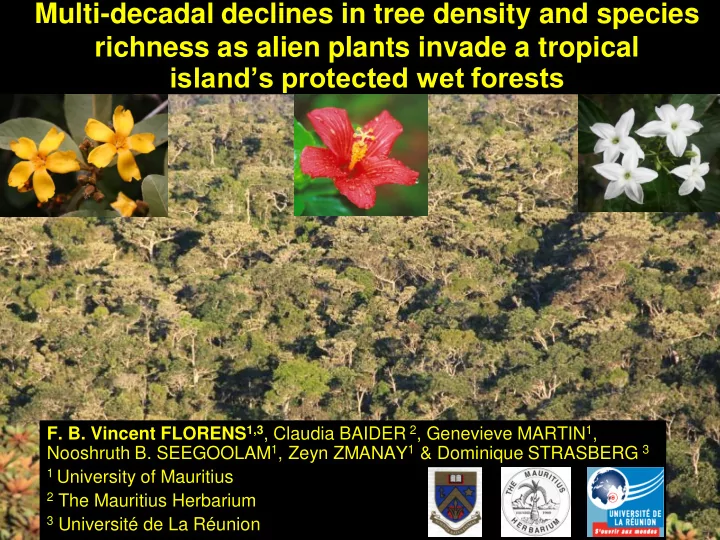
SLIDE 1 Multi-decadal declines in tree density and species richness as alien plants invade a tropical island’s protected wet forests
- F. B. Vincent FLORENS1,3, Claudia BAIDER 2, Genevieve MARTIN1,
Nooshruth B. SEEGOOLAM1, Zeyn ZMANAY1 & Dominique STRASBERG 3
1 University of Mauritius 2 The Mauritius Herbarium 3 Université de La Réunion
SLIDE 2
Invasive alien species (IAS) cause major environmental damage and represent a main threat to biodiversity.
Introduction
SLIDE 3 Introduction
Potential for causing species extinction is most obvious and rapid in inter-trophic interactions like predation compared to con-trophic interactions like competition.
150 300 450 600 750 900 1050 1200 1350 1500 Seedlings and non- reprodutive trees Reproductive trees Dead adult trees Frequency of Pandanus vandermeeschii
1982 1993 2004 Hare and rat eradication
Alien mammal eradication from an offshore Mauritius islet: ‘spectacular’ population recovery
Screwpine (Pandanus vandermeeschii)
SLIDE 4
Introduction
There exists a relative lack of cases demonstrating alien plants’ ability to cause plant extinction (Davis 2003, Sax and Gaines 2008,
Caujapé-Castells et al. 2010, Powell et al. 2013).
SLIDE 5 Introduction
Difficulties to incriminate alien plants as drivers of the
- bserved concurrent population decline and extinction
- f native plants: the coincidence of plant invasion with
- ther threats like predation (Gurevitch and Padilla 2004).
SLIDE 6
Introduction
Another difficulty: competition-driven extinctions possibly take longer to occur than those caused by predation (Davis 2003). Situation exacerbated by the longevity of many tropical trees (e.g. Fichtler et al. 2003) A situation of extinction debt (Kuussaari et al. 2009) rather than of extinction per se may thus be favoured.
SLIDE 7
Introduction
Long term studies on the effect of invasive species are rare despite the strong need for ecologists to adopt such a long-term perspective (Strayer et al. 2006).
SLIDE 8 Aims
- 1. Measure current invasion by woody alien plants in the
best preserved and protected native forests of a tropical
- ceanic island (Mauritius).
- 2. Compare tree community changes at some of the most
intact native habitats that were studied 20 and 70 years earlier (with Vaughan and Wiehe 1941; Lorence and Sussman 1986).
- 3. Relate results to more recent experimental approach
studies (comparisons between weeded and non-weeded forests)
SLIDE 9 Methods
Quantifying current invasion level by alien plants
- 75 random quadrats of 4 x 25 m distributed in 5 best preserved wet
forest sites
- Compare community changes between weeded and non-weeded
(at 2 sites)
Experimental approach: weeded v/s non-weeded Investigating fitness of native plants between weeded and non-weeded forests
- Compare survival, growth and reproductive rates between weeded and
non-weeded adjacent areas
Quantifying tree community changes through time
- Compare tree community with data from 1980’s and 1930’s
SLIDE 10
Study site
Myers et al., 2000, Nature 403: 853-585
SLIDE 11
Volcanic oceanic island 7.6 MY old
Mauritius – basic facts
890 km to the east of Madagascar 1,865 km2; highest peak 828 m First human colonisation: 1638. Uninterrupted since 1722
SLIDE 12
Angiosperms: 691 species 39% endemic; 9% extinct; 70% threatened
Native biodiversity
Vertebrates: 50 species 72% endemic; 46% extinct; 85% threatened Molluscs: 125 species 65% endemic; 34% extinct; 80% threatened
SLIDE 13 Confetti of habitats left
(Source: Vaughan and Wiehe 1937; Page and D’Argent 1997)
Habitat fragmentation
Minimum viable populations? ‘Ghost of past deforestation’
SLIDE 14
The largest area of contiguous native vegetation
Study sites: National Park and Mountain reserve
SLIDE 15 Plant invasion level
Mare Longue
2000 4000 6000 8000 10000 12000 14000 16000 18000 20000 22000 24000 26000 28000 30000 32000
0.5 1.5 2.5 3.5 4.5 5.5 6.5 7.5 8.5 9.5 10-20 > 20 dbh size class (cm)
Density per hectare
Brise Fer
2000 4000 6000 8000 10000 12000 14000 16000 18000 20000 22000 24000 26000 28000 30000 32000
0.5 1.5 2.5 3.5 4.5 5.5 6.5 7.5 8.5 9.5 10-20 > 20
dbh size class (cm)
Density per hectare
Camisard
2000 4000 6000 8000 10000 12000 14000 16000 18000 20000 22000 24000 26000 28000 30000 32000
. 5 1 . 5 2 . 5 3 . 5 4 . 5 5 . 5 6 . 5 7 . 5 8 . 5 9 . 5 1
> 2 dbh size class (cm)
Density per hectare
Bel Ombre
2000 4000 6000 8000 10000 12000 14000 16000 18000 20000 22000 24000 26000 28000 30000 32000
0.5 1.5 2.5 3.5 4.5 5.5 6.5 7.5 8.5 9.5 10-20 > 20 dbh size class (cm)
Density per hectare
Macchabe
2000 4000 6000 8000 10000 12000 14000 16000 18000 20000 22000 24000 26000 28000 30000 32000
0.5 1.5 2.5 3.5 4.5 5.5 6.5 7.5 8.5 9.5 10-20 > 20 dbh size class (cm)
Density per hectare
Native Alien
SLIDE 16 Invasion Understorey heavily dominated by alien plants
1000 2000 3000 4000 5000 6000 7000 8000 9000 10000 11000 1.5 2.5 3.5 4.5 5.5 6.5 7.5 8.5 9.5 10.5 11.5 12.5 13.5 14.5 15.5 16.5 17.5 18.5 19.5 >20
Diameter size class (cm) Number of individuals Native Alien
Natives Aliens
(75 plots of 100 m² from 5 sites with ‘best preserved’ forests)
SLIDE 17
A perfect nightmare
SLIDE 18
Native biomass lower when invasion more severe
2000 4000 6000 8000 10000 Low Medium High Basal area of native plants (cm2/100m2)
Invasion categories
Box and whiskers plots of basal area of native woody plants against relative degree of invasion by alien plants. Each relative category of invasion (low, medium, high) comprises the respective five plots from each site for a total of 25 plots per category. All differences between pairs of categories are significant at P < 0.05 (Post Hoc Tukey Test).
SLIDE 19 1930’s
”it is now impossible to find even a small area free from exotics”
(Vaughan & Wiehe 1941,
SLIDE 20 Comparison over 70 years
Macchabé
(per 1000 m2)
Vaughan & Wiehe 1941 Florens et
Aliens
> 1 cm dbh
2 (0.002 m-2) 4,303 (4.3 m-2) Natives
> 10 cm dbh
171 ± 24.6* 85 (P < 0.05) Native spp richness
> 10 cm dbh
32.5 ± 5 30 (NS)
SLIDE 21
Alien plant invasion progress over 20 years
> 2.5 cm, < 10 cm dbh Sites Lorence & Sussman 1980’s This study P< 0.01 % alien plants Brise Fer 34.8 60.7 Bel Ombre 20.8 25.7 Native species richness Brise Fer 54 47.6 ± 16.2 n.s. Bel Ombre 46 37.9 ± 7.4 Native density
(100 m-2)
Brise Fer 76.2 58 ± 9.1 Bel Ombre 71.5 63 ± 11.2 n.s.
SLIDE 22
SLIDE 23 Mortality
Site Forest regime N Deaths * Mortality rate
(over 3 ¾ years) Brise Fer Non-weeded
71 2 2.82%
Mare Longue
31 8 25.81%
Macchabé
38 3 7.89%
Brise Fer Weeded
133 1 0.75%
Mare Longue
23 0%
Macchabé
4 0%
- Cyclone snapped trees not included
Total tree mortality compared Non-weeded forest: 9.3% (N = 140) Weeded forest: 0.6% (N= 160)
Sideroxylon grandiflorum (Sapotaceae)* ‘Dodo-tree’
SLIDE 24 Reproductive output
Flowering is more abundant in areas without alien plants*
(U122,78 = 3520.5; P = 0.002)
Fruiting is on average 37 times higher in weeded areas*
(U140,135 = 6662.5; P< 0.001)
* Baider & Florens (2006) In Laurance & Peres Emerging threats to tropical forests. Chicago Univ Press
Invasion strongly reduces reproductive output
Canopy tree Sideroxylon grandiflorum – ‘Dodo tree’
SLIDE 25 Reproductive output
- C. paniculatum produced significantly more seeds in
weeded areas at both sites studied
1 10 100 1000 Brise Fer weeded Brise Fer non- weeded Mare Longue weeded Mare Longue non-weeded Average number of seeds and fruits per tree (log) 1 10 100 1000 Brise Fer weeded Brise Fer non- weeded Mare Longue weeded Mare Longue non-weeded Average number of seeds and fruits per tree (log) 1 10 100 1000 Brise Fer weeded Brise Fer non- weeded Mare Longue weeded Mare Longue non-weeded Average number of seeds and fruits per tree (log)
Zadj45,30 =-2.62; p < 0.01 U = 69.5; p < 0.01
Another canopy tree Canarium paniculatum (Burseraceae)
SLIDE 26
Reproductive output
Same results for other species and guilds
SLIDE 27
Growth rate
Growth rate of a canopy native tree (4 years monitoring)
Comparison between adjacent weeded and non-weeded forest
Management regime N Mean yearly growth rate
(mm ± SE)
Non-weeded area
125 0.47 ± 0.23
Weeded area
155 1.11 ± 0.21
Sideroxylon grandiflorum (Sapotaceae)
Growth rate (dbh)
SLIDE 28 Growth rate
Non weeded Weeded
N Growth (dbh, mm)
95%
N Growth (dbh, mm)
95% Brise Fer
795 0.10 0.08 0.12 686 0.58 0.45 0.72
Mare Longue
1353 0.08 0.06 0.11 995 0.44 0.35 0.53
Mean annual growth rate of the whole woody native species community (Monitored over about 4 years)
SLIDE 29 Whole community monitored over 4 years
Native woody plants > 1 cm dbh
Invaded Weeded (8 yrs earlier)
Number
Difference
(%) Number
Difference
(%) p* Brise Fer Recruitment 8 0.9 401 54.0 < 0.001 Retrogression 12 1.4 10 1.3 0.791 Deaths 52 6.0 46 4.4 0.762 Mare Longue Recruitment 52 3.6 311 29.6 < 0.001 Retrogression 27 1.9 17 1.6 0.038 Deaths 49 3.4 24 2.3 0.623
* Per plot of 0.01 ha (100 m2)
SLIDE 30 ‘Same plot changes’ over 4 years
50 100 150 200 250 300 350 400 450 500 0.5 1.5 2.5 3.5 4.5 5.5 6.5 7.5 8.5 9.5 10 to 15 15 to 20 > 20 50 100 150 200 250 300 350 400 450 500 0.5 1.5 2.5 3.5 4.5 5.5 6.5 7.5 8.5 9.5 10 to 15 15 to 20 > 20 50 100 150 200 250 300 350 400 450 500 0.5 1.5 2.5 3.5 4.5 5.5 6.5 7.5 8.5 9.5 10 to 15 15 to 20 > 20
Weeded Not weeded
Brise Fer Mare Longue
50 100 150 200 250 300 350 400 450 500 0.5 1.5 2.5 3.5 4.5 5.5 6.5 7.5 8.5 9.5 10 to 15 15 to 20 > 20
Number of individuals
DBH class (cm)
t 0 4 yrs later
SLIDE 31
SLIDE 32 3 318 50 100 150 200 250 300 350
Managed Invaded Individuals/ha
Adult Juvenile
Invasion effect on native Cyathea spp. (tree ferns)
Comparison between 1 ha invaded and 1 ha weeded
(Thormann, Baider & Florens unpubl data)
(Bindewald, Baider & Florens unpubl) Cascading impacts? Large epiphytic ferns
SLIDE 33 Population recovery within 24 years of weeding
20 40 60 80 100 120 140 160 180 Non-weeded Weeded 1996 Weeded 1986 Density of adult Asplenium nidus per ha a a b Kruskal-Wallis test: H = 154.49; p < 0.001 {0.1ha plots} 50 100 150 200 250 Non-weeded Weeded 1996 Weeded 1986 Density of adult Microsorum punctatum per ha a a b Kruskal-Wallis test: H = 122.73; p < 0.001 {0.1ha plots}
Asplenium nidus Microsorum
SLIDE 34 Downward expansion after weeding
10 20 30 40 50 60 70 80 90 100 1 3 5 7 9 11 13
Vertical height (m) Percentage of individuals (%)
Asplenium (juvenile) Asplenium (adult) 10 20 30 40 50 60 70 80 90 100 1 3 5 7 9 11 13
Vertical height (m) Percentage of individuals (%)
Asplenium (juvenile) Asplenium (adult) 10 20 30 40 50 60 70 80 90 100 1 3 5 7 9 11 13
Vertical height (m) Percentage of individuals (%)
Asplenium (juvenile) Asplenium (adult)
Weeded in1986 Weeded in 1996
(Invaded) (14 years) (24 years)
SLIDE 35 Conclusions
- Presence of alien plants in protected native forests may
come about through two broad ways with different implications for conservation:
- 1. They may be merely filling unoccupied spaces
- 2. They may be displacing native species.
- Although other factors may contribute to the decline
- bserved (e.g. habitat fragmentation, predation by alien
animals etc), this study shows a strong role played by con- trophic (plant-plant) interactions in driving the decline.
SLIDE 36
Conclusions
Many species, including threatened ones, can recover strongly as a consequence of the sole removal of invasive alien plants. Shows that the threat these pose can be overwhelmingly important in driving native species population declines. Our findings also indicate that imminent plant extinctions can be averted by little more than timely control of the invading plants.
SLIDE 37 Acknowledgments
Thank you